Finance
What AP Automation Actually Costs in 2026: Bill.com vs Tipalti vs Stampli vs AvidXchange Pricing Teardown
Compare AP automation platforms—Bill.com, Tipalti, Stampli, AvidXchange—and uncover hidden fees before you sign. See what you'll actually pay in 2026.

Khushbu Adav
Product at Predflow

The "starting at $X/month" quote from an AP automation vendor is rarely the number that appears on your first invoice. Implementation fees, ERP connector charges, per-user seat limits, and invoice volume caps routinely double or triple the sticker price. Finance teams discover this only after the contract is signed.
AP automation platforms are evolving fast. AI capabilities that used to be roadmap items are now standard expectations. Autonomous exception handling, fraud flagging, and supplier management are no longer differentiators. They are table stakes for any serious invoice automation solution in 2026.
This teardown covers the full-cost picture for Bill.com, Tipalti, Stampli, and AvidXchange. By the end, you will know what each platform actually costs at your invoice volume, where the hidden fees live, and which tool fits your ERP before you sit down with a sales rep.
What AP Automation Platforms Actually Charge: The Cost Components No One Lists on the Pricing Page
Every AP automation vendor leads with a base subscription number. That number rarely reflects what you will pay after month three.
The most common AP issues in invoice processing, including duplicate payments, data entry errors, and approval bottlenecks, all carry a cost. So does fixing them badly. Choosing the wrong pricing model for your volume creates a new problem on top of the ones you are trying to solve.
Base subscription vs. per-invoice fees: which model costs more at scale
Flat subscription models charge a fixed monthly fee regardless of how many invoices you process. Per-invoice models charge a small fee per document, typically between $0.25 and $2.00.
At low volume, flat subscriptions are almost always more expensive per invoice. At high volume, per-invoice fees compound fast. A company processing 1,500 invoices per month at $1.00 per invoice pays $18,000 per year in transaction fees alone, before touching the base plan.
Before comparing any invoice automation platform, calculate your current monthly invoice count and project 12-month growth. That single number drives most of the cost math.
Hidden costs: implementation, ERP connectors, and user seat limits
Here is the cost checklist vendors rarely volunteer:
Cost Component | Typical Range | Frequently Hidden? |
|---|---|---|
Onboarding and implementation | $1,500 to $15,000 | Yes |
ERP connector fees | $500 to $1,500/month | Yes |
Per-user seat charges | $20 to $75/user/month | Sometimes |
OCR or AI extraction add-ons | $100 to $500/month | Yes |
Payment network or ACH fees | $0.49 to $1.99/transaction | Yes |
Annual price escalation clauses | 5 to 15% | Rarely disclosed |
ERP connector fees are the most consistently underestimated line item. A native integration to NetSuite or SAP sounds free during the demo. In practice, many ap automation vendors charge a separate connector license, and that fee appears only in the full contract.
Volume tiers and what triggers overage charges
Most ap automation tools tier their pricing by invoice volume. Cross a threshold mid-month and the overage rate applies retroactively to the entire period. Some platforms apply overage to the batch, not the marginal units.
Read the overage clause before signing. A 500-invoice-per-month plan with a $3.00 per-invoice overage fee becomes very expensive in any month with a high-volume supplier onboarding or a backlog catch-up.
Pricing verified: data in this section reflects publicly available vendor information as of June 2026.
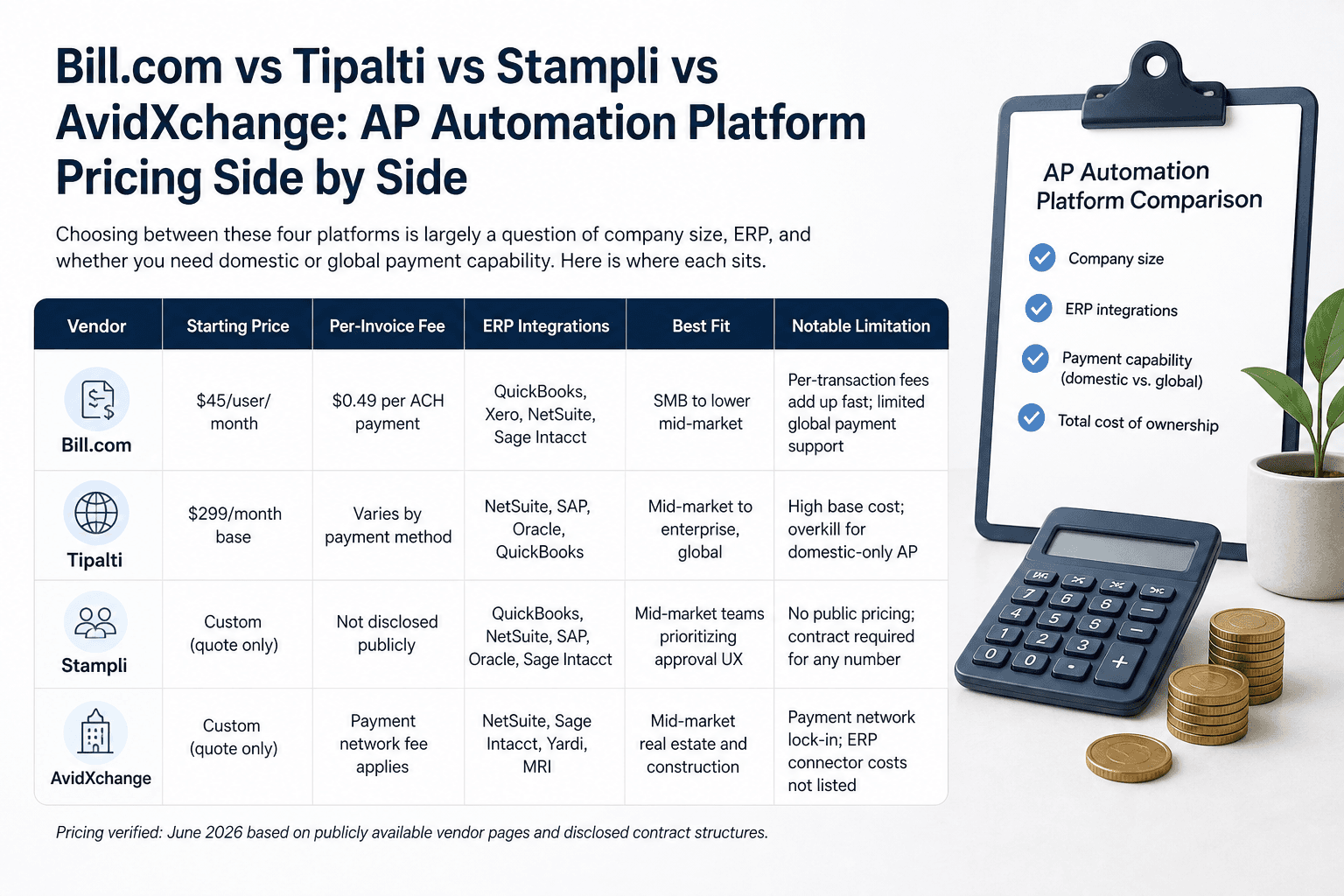
Bill.com vs Tipalti vs Stampli vs AvidXchange: AP Automation Platform Pricing Side by Side
Choosing between these four platforms is largely a question of company size, ERP, and whether you need domestic or global payment capability. Here is where each sits.
Multi-entity pricing is a consistent gap in public disclosures. YouTube demos of Stampli and Bill.com frequently highlight approval workflow UIs, but reviewers note that pricing for multi-entity setups is only disclosed during a sales call.
Vendor | Starting Price | Per-Invoice Fee | ERP Integrations | Best Fit | Notable Limitation |
|---|---|---|---|---|---|
Bill.com | $45/user/month | $0.49 per ACH payment | QuickBooks, Xero, NetSuite, Sage Intacct | SMB to lower mid-market | Per-transaction fees add up fast; limited global payment support |
Tipalti | $299/month base | Varies by payment method | NetSuite, SAP, Oracle, QuickBooks | Mid-market to enterprise, global | High base cost; overkill for domestic-only AP |
Stampli | Custom (quote only) | Not disclosed publicly | QuickBooks, NetSuite, SAP, Oracle, Sage Intacct | Mid-market teams prioritizing approval UX | No public pricing; contract required for any number |
AvidXchange | Custom (quote only) | Payment network fee applies | NetSuite, Sage Intacct, Yardi, MRI | Mid-market real estate and construction | Payment network lock-in; ERP connector costs not listed |
Pricing verified: June 2026 based on publicly available vendor pages and disclosed contract structures.
Bill.com: pricing tiers, per-transaction fees, and QuickBooks AP automation fit
Bill.com charges per user, per transaction, and sometimes per integration. The base Essentials plan starts around $45 per user per month. The Corporate and Enterprise tiers are quote-based.
QuickBooks AP automation is Bill.com's strongest native use case. The sync is direct, the setup is fast, and SMB teams with straightforward domestic payables get real value quickly. QuickBooks invoice automation through Bill.com works cleanly for teams processing under 300 invoices per month.
The per-ACH-payment fee is the catch. At volume, those $0.49 charges accumulate into a meaningful monthly line item that the subscription cost alone does not reflect.
Tipalti: enterprise invoice automation pricing and global payment costs
Tipalti's base price starts around $299 per month, with additional per-transaction fees that vary by payment rail, currency, and destination country. Global payment capabilities are the platform's primary differentiator.
For companies managing vendor invoices across multiple countries, Tipalti handles currency conversion, tax compliance, and local payment formats in one system. For domestic-only AP teams, it is priced significantly above what the use case requires.
The enterprise invoice automation depth here is genuine. NetSuite invoice automation, SAP invoice, and Oracle invoice automation integrations are all supported. ERP connector fees still apply and should be confirmed before contracting.
Stampli: AI-powered AP automation pricing and approval workflow model
Stampli does not publish pricing. Every number requires a sales conversation. What is documented in reviews and demos is a per-user, per-month model with a platform fee layered underneath.
The AI-powered AP automation capability is built around its invoice collaboration interface, which keeps approval conversations directly on the invoice document. For teams with complex internal approval chains, this reduces email back-and-forth and shortens cycle times.
The best invoice automation platform for your team depends on how complex your approval workflow is. Stampli leads on approval UX. The tradeoff is full pricing opacity and a contract-gated evaluation process.
AvidXchange: mid-market invoice automation solution costs and payment network fees
AvidXchange operates a closed payment network, meaning vendors must enroll to receive payments through the platform. There is no public pricing. Estimates from disclosed contracts place base costs between $5,000 and $20,000 annually before payment volume.
The platform targets mid-market companies in real estate, construction, and property management. Native integrations with Yardi, MRI, and Sage Intacct are a genuine advantage for those verticals.
The payment network model creates a lock-in dynamic. Switching platforms later means migrating your vendor payment enrollment base, which is a non-trivial operational project.
Which AP Automation Platform Fits Your ERP: SAP, NetSuite, Oracle, and QuickBooks Compatibility Costs
Your ERP determines more of your AP automation cost than your invoice volume does. Native integrations eliminate middleware. Middleware adds monthly fees, implementation time, and a new failure point.
Getting phased implementation right matters here. Teams that rush ERP integration during AP automation rollout consistently report the most post-launch exceptions.
SAP invoice automation and central invoice management: which vendors integrate cleanly
SAP central invoice management is a capable native layer, but YouTube walkthroughs of the configuration process show a steep setup curve. Most mid-market teams end up needing a third-party AP automation layer even when SAP is their primary ERP.
Tipalti and Stampli both offer SAP invoice automation connectors. Dolphin invoice automation is a specialist option specifically designed for SAP environments and handles SAP e-invoice compliance requirements that general-purpose platforms treat as an afterthought.
Vendor invoice management SAP setups typically require IT involvement and a 6 to 12 week implementation window. Budget for that time cost alongside the connector fee.
NetSuite bill capture and invoice approval workflow compatibility
NetSuite bill capture is available natively within the ERP, but it lacks advanced extraction accuracy and approval routing flexibility. Most teams supplement it with a dedicated AP layer.
Bill.com, Tipalti, and Stampli all offer NetSuite invoice automation connectors. The NetSuite invoice approval workflow functions differently across each platform. Bill.com syncs cleanly but has limited customization. Stampli's approval UI works alongside NetSuite without replacing it. Tipalti treats NetSuite as the system of record and pushes approved data back cleanly.
Connector costs for NetSuite integrations range from $200 to $800 per month depending on the vendor and contract tier.
Oracle invoice automation and QuickBooks invoice automation connector costs
ERP | Native Integration | Middleware Required | Estimated Connector Cost/Month |
|---|---|---|---|
SAP | Tipalti, Stampli (partial) | Often yes for full SAP Central Invoice Management | $400 to $1,200 |
NetSuite | Bill.com, Tipalti, Stampli | Rarely | $200 to $800 |
Oracle | Tipalti (strongest) | Sometimes | $300 to $1,000 |
QuickBooks | Bill.com (native) | No | Included in plan |
D365 | Limited native options | Usually yes | $500 to $1,500 |
Oracle invoice automation is best supported by Tipalti among the four vendors reviewed. QuickBooks invoice automation is Bill.com's home ground. Vendor invoice automation in D365 environments almost always requires middleware, and that connector cost sits at the high end of the range.
If your AP stack spans more than one ERP or your team is still manually resolving exceptions that your platform flags but cannot fix, Predflow's AI agents are built specifically for that gap. They map to your existing workflow first, then automate the exceptions that volume-based platforms leave behind without replacing the tools you already run on.
AP Automation Platform ROI: What the Real Cost Looks Like After 12 Months
Selecting an automated invoice processing software based on monthly subscription price without projecting 12-month total cost is the fastest way to sign a contract that costs more than the problem it solves.
How to calculate your current per-invoice processing cost
Manual invoice processing costs vary, but a realistic estimate for a mid-market company factors in AP staff time per invoice, error correction time, late payment penalties, and approval cycle delays.
A commonly applied formula: (AP team fully loaded hourly cost x hours spent per invoice) plus error and rework costs per month. Most manual processes land between $10 and $25 per invoice when all costs are included.
Where most companies see savings within the first year
Touchless invoice processing eliminates data entry and routing time. For companies with straightforward invoice formats and established vendor relationships, the reduction in manual handling is measurable within 90 days.
End to end AP automation that includes supplier invoice automation and invoice approval automation typically delivers savings in three areas: labor hours reallocated, faster payment cycles that capture early payment discounts, and fewer duplicate or erroneous payments.
Here is a worked example for a mid-market company processing 500 invoices per month:
Cost Category | Manual Process | Bill.com (12 mo.) | Tipalti (12 mo.) | Stampli (12 mo. est.) | AvidXchange (12 mo. est.) |
|---|---|---|---|---|---|
Platform cost | $0 | $8,100 | $7,200 | $12,000 est. | $10,000 est. |
ERP connector | $0 | $3,600 | $6,000 | $4,800 | $6,000 |
Per-invoice / transaction fees | $0 | $2,940 | $3,600 | Included | Network fee applies |
Labor (AP staff) | $36,000 | $12,000 | $11,000 | $10,500 | $11,500 |
Error and rework costs | $6,000 | $1,200 | $900 | $800 | $1,100 |
12-month total | $42,000 | $27,840 | $28,700 | $28,100 est. | $28,600 est. |
Pricing verified: estimates based on disclosed pricing, connector rates, and published labor benchmarks as of June 2026.
When a lower-priced AP automation tool becomes the more expensive choice
A lower subscription price becomes the wrong choice when it requires more manual exception handling. AI for accounts payable is now advanced enough that platforms without strong invoice extraction automation leave measurable error correction work on the table.
Agentic AP capabilities, including autonomous exception handling, are now entering production use at leading vendors. Platforms that cannot handle edge cases programmatically push those cases back to the AP team. At 500 invoices per month, even a 5% exception rate means 25 manual interventions per month. That labor cost is invisible in the subscription comparison but very real in the time sheet.
AI AP automation with genuine exception-handling capability will compress the ROI gap between platforms over the next 12 to 24 months. Choosing a platform without a clear AI roadmap today means paying for a manual workaround that your peer companies are automating away.
How to Choose the Right AP Automation Platform for Your Team Size and Invoice Volume
The most common sizing mistake is choosing an enterprise AP automation platform at low invoice volume and spending more in the first year than the automation saves. Finance leads running small AP operations report this exact outcome repeatedly.
Matching platform to company profile before evaluating features eliminates most of the decision complexity.
For mid-market companies asking which AP automation platform fits best: Stampli and Bill.com at the lower end of mid-market, Tipalti for global or high-complexity payables, and AvidXchange for sector-specific verticals with high payment volume. The right fit depends on ERP, geography, and approval chain complexity more than brand recognition.
Under 200 invoices/month: which platforms are cost-effective at low volume
At low volume, the invoice automation tool with the lowest total cost is almost always Bill.com. The per-user model scales down cleanly, the QuickBooks integration requires minimal setup, and the per-transaction fees stay manageable below 200 invoices.
Tipalti and AvidXchange are priced for larger operations. Their base costs alone exceed the ROI threshold for most sub-200-invoice teams.
200 to 2,000 invoices/month: the mid-market sweet spot and what to prioritize
This range is where the invoice automation system decision becomes genuinely complex. Stampli's approval workflow depth earns its cost for teams with multi-step internal approvals. Tipalti pulls ahead when international vendors are involved.
Vendor invoice management matters more at this volume. Supplier onboarding time, statement reconciliation, and exception handling frequency all increase. Choose a platform where those workflows are automated, not just logged.
Over 2,000 invoices/month: when enterprise AP automation platforms justify the price
Above 2,000 invoices per month, per-invoice fees become the dominant cost driver. Flat-rate enterprise contracts with Tipalti or AvidXchange typically make more financial sense than any per-transaction model.
Invoice to pay automation that handles matching, approval routing, and payment execution end to end becomes a hard requirement at this volume. Any manual touchpoint in the workflow creates a bottleneck that compounds fast.
Invoice Volume | Recommended Platform | Why |
|---|---|---|
Under 200/month | Bill.com | Lowest total cost, strong QuickBooks fit |
200 to 2,000/month | Stampli or Tipalti | Approval depth or global payment capability |
Over 2,000/month | Tipalti or AvidXchange | Enterprise pricing, scale, ERP depth |
Frequently Asked Questions
What is the average cost of AP automation software in 2026?
AP automation platforms range from $45 per user per month for SMB tools like Bill.com to $20,000 or more annually for enterprise platforms like AvidXchange. Total 12-month cost, including implementation, ERP connectors, and transaction fees, typically runs $25,000 to $35,000 for a mid-market company processing 500 invoices per month. The subscription price alone is rarely the accurate number.
Does Bill.com charge per invoice or per user?
Bill.com charges per user per month for the platform subscription, plus a per-transaction fee for ACH and check payments. The per-transaction fee is separate from the subscription and applies each time a payment is processed through the platform.
Which AP automation platform works best with QuickBooks?
Bill.com is the strongest native QuickBooks AP automation option. The integration is direct, requires minimal configuration, and syncs payment and invoice data in both directions without middleware.
How long does AP automation implementation typically take?
Most mid-market implementations take between 4 and 12 weeks. ERP integrations and data migration extend that timeline. Phased implementation, starting with invoice capture before adding approval routing and payment automation, consistently reduces disruption and accelerates team adoption.
Can AP automation platforms handle international vendor invoices?
Tipalti is the most capable of the four platforms reviewed for international vendor invoice management. It handles multi-currency invoices, local tax compliance, and cross-border payment rails natively. Bill.com and Stampli support international payments but with fewer built-in compliance features.
What is the difference between AP automation and invoice automation software?
AP automation covers the full accounts payable cycle: invoice capture, coding, approval routing, payment execution, and reconciliation. Invoice automation software typically refers to the capture and processing portion only. Most platforms marketed as AP automation tools include both, but the payment execution capability varies significantly by vendor.
Which Profile Matches You?
Three profiles come out of this teardown. A small team at low invoice volume gets the clearest answer: Bill.com at its base tier, connected to QuickBooks, with a realistic expectation of 4 to 6 week payback on the time savings.
A mid-market team scaling fast needs to evaluate Stampli or Tipalti based on whether approval complexity or international payments is the bigger constraint. An enterprise team with ERP complexity and over 2,000 invoices per month should negotiate a flat-rate contract with Tipalti or AvidXchange and confirm AI roadmap commitments before signing anything multi-year. AP automation pricing will keep shifting as agentic capabilities become standard features. A multi-year contract without an AI roadmap clause locks you into today's capability at tomorrow's cost.
If your team is still manually handling the invoices your automation flags but cannot resolve, talk to Predflow about building an AI agent layer that closes that gap without replacing your current stack.
Bring 20 NetSuite bills to a 30-minute teardown
We will walk your actual invoices through capture, 3-way match and posting on the call, and tell you which steps an agent can take over. No prep beyond the PDFs.
FAQ
Frequently asked questions
What exactly is an AI agent
An AI agent is an autonomous system designed to handle specific business tasks end-to-end. Unlike simple chatbots, AI agents can reason, take actions, integrate with tools, and follow defined workflows.