Supply Chain
Accounts Payable: Common Bottlenecks, Key Metrics, and Fixes
A three-way match shouldn't take four days — but for many finance teams, it does. Here are the accounts payable bottlenecks quietly draining your time and cash, plus the fixes that actually work.

Sanya Shah
Co-founder at Predflow

A three-way match that should take minutes stretches into four days. An invoice sits in an approver's inbox while the supplier adds a late fee. The finance manager asks where the payment is, and nobody has a clear answer.
These are not isolated failures. They are the predictable result of accounts payable processes built on manual handoffs, undocumented rules, and tools that do not talk to each other. The team is not the problem. The process is.
Human error, delayed approvals, and compliance gaps cause late payments and strained supplier relationships across organizations of every size. The pattern repeats because the failure points are structural, not accidental.
This article maps exactly where AP breaks down, which numbers reveal the damage, and what fixes actually hold at each failure point.
Why Accounts Payable Breaks Down at the Same Points Every Time
AP failures are not random. They cluster around the same structural weaknesses regardless of team size, industry, or software stack. Recognizing this shifts the problem from a people issue to a process design issue — which is far easier to fix.
Manual handoffs between systems create invisible queues
When an invoice arrives by email, gets logged into a spreadsheet, and then needs to be re-entered into an ERP, each transfer is a potential failure point. There is no automatic alert when a file gets missed. Work piles up in gaps between systems that no one monitors.
The result is invisible queues. No one knows an invoice is stuck until a supplier calls about a late payment.
Approval chains with no escalation logic cause silent delays
Most AP approval chains rely on someone remembering to follow up. If the approver is traveling, out sick, or simply buried, the invoice waits. There is no logic that automatically reroutes or escalates after a defined period.
Silent delays are expensive. The invoice due date passes, early payment discounts expire, and the supplier relationship absorbs the friction.
Fragmented vendor data leads to duplicate or misrouted payments
When vendor records live across multiple systems — a procurement platform, a payment system, a spreadsheet maintained by one person — inconsistencies accumulate. Two entries for the same vendor with different bank details or payment terms create real payment risk.
Duplicate payments and misrouted funds are not rare edge cases. They are a direct consequence of fragmented master data that no one has been assigned to maintain.
The 6 Most Costly Accounts Payable Bottlenecks
Each bottleneck below has a specific failure mode and a measurable cost. The goal is recognition: if you see your process in this list, you know exactly where to focus.
1. Unstructured invoice intake (email, PDF, portal — all separate)
Invoices arrive through multiple channels with no single intake point. Someone has to manually collect, sort, and route each one. Volume spikes overwhelm the team, and invoices get missed entirely.
The cost is processing time and error rate. Every channel added without a unified intake multiplies handling effort.
2. Missing or mismatched purchase orders at matching stage
Invoice matching fails when the PO does not exist, has been closed, or uses different line-item descriptions than the invoice. The match exception gets flagged and routed back to a human for manual resolution.
This is the most common cause of processing delays. A mismatch at matching stage can add days to a single invoice cycle.
3. Approval routing that relies on tribal knowledge
When routing rules exist only in someone's head, every new team member creates risk. Invoices go to the wrong approver, stall, or get approved by someone without the authority to do so.
The failure is not the person. It is the absence of documented, enforced routing logic.
4. No exception-handling logic — everything escalates manually
When an invoice falls outside the normal flow, there is no defined path. It lands on the most available person's desk, or it waits until someone notices. Teams with high exception rates spend a disproportionate amount of time on a small percentage of invoices.
This pattern directly limits how much volume the team can handle without adding headcount.
5. Lack of real-time liability visibility for cash forecasting
Finance teams making payment decisions without current AP data are working blind. Approved invoices pending payment, disputed invoices on hold, and upcoming due dates need to be visible in one place to make accurate cash flow projections.
Without that visibility, businesses either pay early unnecessarily or miss due dates because the liability was not on the radar.
6. Audit trail gaps that surface only during compliance reviews
Many teams rely on scattered records across emails, paper files, and spreadsheets. When an auditor asks for the full approval history of a payment, assembling it takes hours or days. Missing purchase orders, unclear payment terms, and incomplete invoice data create gaps that are only discovered under pressure.
The risk is not just audit friction. It is the inability to prove control, which carries its own regulatory and reputational cost.
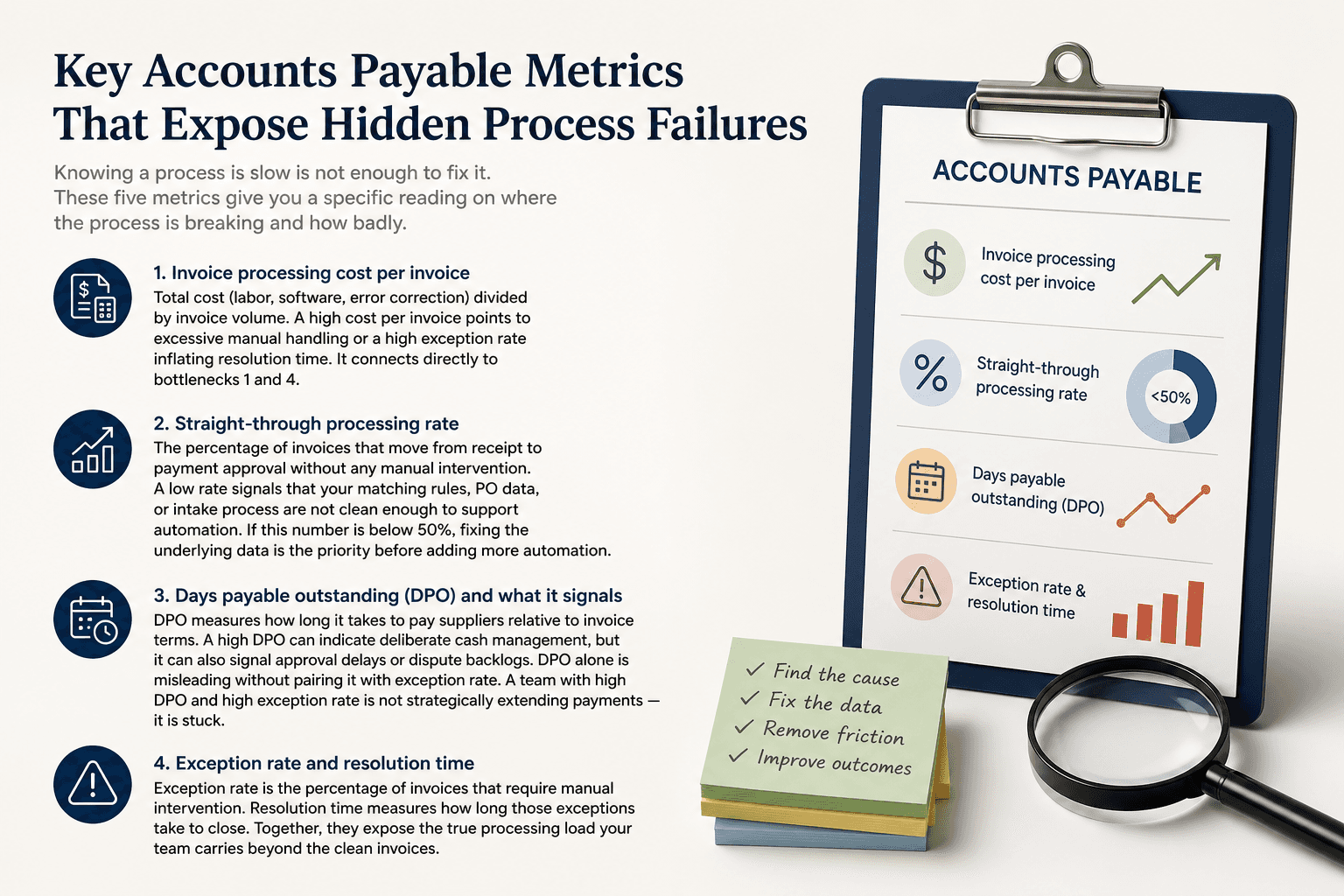
Key Accounts Payable Metrics That Expose Hidden Process Failures
Knowing a process is slow is not enough to fix it. These five metrics give you a specific reading on where the process is breaking and how badly.
Invoice processing cost per invoice
This is the total cost (labor, software, error correction) divided by invoice volume. A high cost per invoice points to excessive manual handling or a high exception rate inflating resolution time. It connects directly to bottlenecks 1 and 4.
Straight-through processing rate
This measures the percentage of invoices that move from receipt to payment approval without any manual intervention. A low straight-through processing rate signals that your matching rules, PO data, or intake process are not clean enough to support automation.
If this number is below 50%, fixing the underlying data is the priority before adding more automation.
Days payable outstanding (DPO) and what it signals
DPO measures how long it takes to pay suppliers relative to invoice terms. A high DPO can indicate deliberate cash management, but it can also signal approval delays or dispute backlogs. DPO alone is misleading without pairing it with exception rate. A team with high DPO and high exception rate is not strategically extending payments — it is stuck.
Exception rate and resolution time
Exception rate is the percentage of invoices that require manual intervention. Resolution time measures how long those exceptions take to close. Together, they expose the true processing load your team carries beyond the clean invoices.
Tracking exception trends continuously, not just at month-end, reveals whether process changes are actually reducing friction or just moving it.
Early payment discount capture rate
Suppliers offer early payment discounts as an incentive for faster settlement. Failing to capture them is a measurable financial loss, not just a missed opportunity. A low capture rate points directly to bottlenecks 3 and 5 — slow approvals and poor liability visibility prevent the team from acting on discount windows in time.
How Invoice Automation Fixes the Bottlenecks That Metrics Expose
Invoice automation is not a replacement for process design. It is the execution layer that makes a well-designed process run without constant manual input. Without defined validation rules and policy logic in place first, automation surfaces the same exceptions at higher speed.
Touchless invoice matching: where automation works without exception
Touchless processing works reliably when matching rules are explicit: which fields must match, what tolerance is acceptable on amounts, how to handle partial deliveries. Automation now supports validation at intake, so invoices that meet every rule proceed directly to payment without human review.
The precondition is clean PO data and clearly defined matching logic. Automation does not infer policy — it enforces the policy you give it.
AI invoice automation for exception routing and edge cases
Standard automation handles clean invoices well. AI invoice automation extends coverage to the harder cases: invoices with missing PO references, partial matches, or approval thresholds that vary by vendor or cost center. Instead of routing every exception to the same queue, AI can assess context and direct it to the right person with the relevant information already surfaced.
This is where most AP teams see the biggest reduction in manual handling time.
Predflow builds AI agents specifically for this layer. Rather than deploying a generic ruleset, Predflow maps your AP process first, so the agents handle exceptions using logic that reflects how your team actually works. That distinction matters when edge cases are not rare — they are a daily part of your invoice volume.
Embedding audit trails automatically rather than as an afterthought
Every approval decision, exception flag, and payment action should be logged at the point it happens, not reconstructed afterward from email threads. Automation that captures this in real time means audit readiness is continuous, not a fire drill triggered by a compliance review.
This directly addresses the compliance risk in bottleneck 6 and reduces the documentation gaps that create problems during regulatory reviews.
Practical Fixes for Each Accounts Payable Bottleneck
Each fix below maps to the corresponding bottleneck from the previous section. Start with the ones where your metrics are worst.
Standardize invoice intake before automating it
Before routing rules or matching logic can work, all invoices need to enter through a single point. Set up one intake channel and convert all incoming formats to a consistent structure at entry. This alone reduces handling time before any automation is applied.
Define matching rules explicitly — automation cannot infer policy
Document every matching condition your team currently applies manually: tolerance levels, how partial deliveries are handled, which cost centers require secondary approval. These rules need to exist in writing before they can be built into a workflow. Process documentation enables consistent execution by both people and systems.
Build escalation logic into approval workflows, not around them
Set time-based escalation rules directly in your approval system. If an invoice has not been actioned within 24 or 48 hours, it should automatically route to a backup approver. This removes the dependency on someone remembering to follow up and eliminates silent delays.
Create exception playbooks so not every edge case becomes a fire
Identify your most common exception types and write a resolution path for each. When an invoice arrives with a mismatched PO, the team should not need to decide from scratch how to handle it. A documented playbook reduces resolution time and means the same exception gets handled the same way every time.
Set up real-time liability dashboards tied to payment schedules
Connect approved invoices, payment due dates, and outstanding disputes into one view. Tracking invoice due dates and payment terms is essential for managing cash flow and capturing early payment discounts before the window closes. A real-time dashboard gives the team the information needed to prioritize payments without manual reconciliation.
Automate audit trail capture at the point of transaction, not retrospectively
Configure your AP system to log every action automatically: who approved, when, under what conditions, and what the invoice status was at each stage. Do not rely on email threads or manual notes to reconstruct this later. Built-in audit logging means your compliance posture is current at all times, not only when a review forces you to check.
Frequently Asked Questions
What are the most common accounts payable problems and how do you fix them?
The most common problems are unstructured invoice intake, approval delays with no escalation logic, and audit trail gaps. Each has a structural fix: standardize intake first, build time-based escalation into workflows, and automate audit logging at the point of transaction rather than reconstructing it later.
What metrics should an AP team track to measure process health?
The five most actionable metrics are invoice processing cost per invoice, straight-through processing rate, days payable outstanding paired with exception rate, and early payment discount capture rate. Tracking these continuously reveals whether process changes are reducing friction or just relocating it.
What is the difference between invoice automation and AI invoice automation?
Invoice automation handles clean, rule-conformant invoices without manual input. AI invoice automation extends this to edge cases: invoices with missing PO references, partial matches, or variable approval thresholds. The key difference is context awareness. Standard automation matches fields. AI automation assesses the situation and routes accordingly.
How do you reduce invoice processing time without adding headcount?
Start by measuring your straight-through processing rate. If it is low, the bottleneck is usually upstream: dirty PO data, unstructured intake, or undefined matching rules. Fix those first. Once the clean invoice flow is reliable, exception routing handles the remaining volume without requiring additional staff.
When does accounts payable automation make sense for a small or mid-size finance team?
Automation makes sense when manual handling is consuming time that the team cannot recover and when exception volume is growing faster than the team can manage it. The prerequisite is process clarity. A small team with documented matching rules and a single intake channel will get more from automation than a larger team with undefined workflows.
Conclusion
If you can identify two or more of the six bottlenecks in your own AP process, the problem is structural. A checklist fix will not hold because the failure points will keep reasserting themselves under volume or staff changes.
Most teams start with the easiest wins: standardizing intake and documenting matching rules. That is the right move. These create the foundation that everything else depends on. Once the clean invoice flow is stable, exception handling and audit trail automation follow without requiring a complete system overhaul.
The next logical step is mapping your own AP process to find exactly where the handoffs break. That diagnostic is where the real fixes start.
If you want to see how Predflow maps and automates AP workflows end-to-end, including the edge cases your current tools skip, explore how Predflow's AP agents work or request a process audit.
Bring 20 NetSuite bills to a 30-minute teardown
We will walk your actual invoices through capture, 3-way match and posting on the call, and tell you which steps an agent can take over. No prep beyond the PDFs.
FAQ
Frequently asked questions
What exactly is an AI agent
An AI agent is an autonomous system designed to handle specific business tasks end-to-end. Unlike simple chatbots, AI agents can reason, take actions, integrate with tools, and follow defined workflows.