


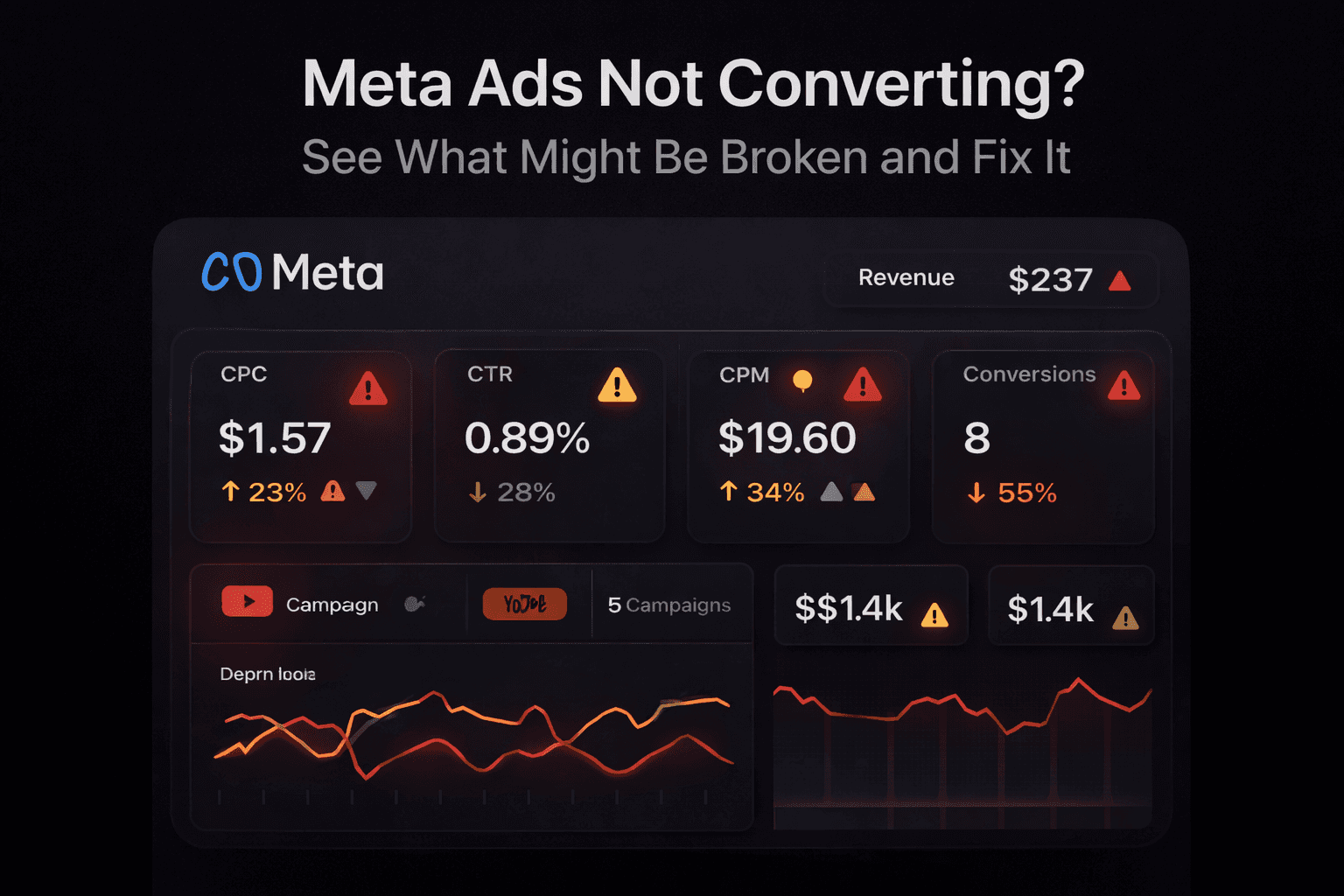
Your Meta ads dashboard shows 800+ clicks this week. Your Shopify dashboard shows 4 sales. The budget is bleeding and you have no idea which part of the system is broken. This is happening to more advertisers in 2026 than ever before, and the reasons are different from what they were even a year ago.
Meta's Andromeda algorithm, the removal of view-through attribution windows, Advantage+ becoming the default for most campaign types, and continued iOS tracking limitations have fundamentally changed how campaigns work. The playbook from 2024 will actively hurt you now. Here are 7 reasons your Meta ads are not converting and what to do about each one.
1. You Are Fighting Andromeda Instead of Feeding It
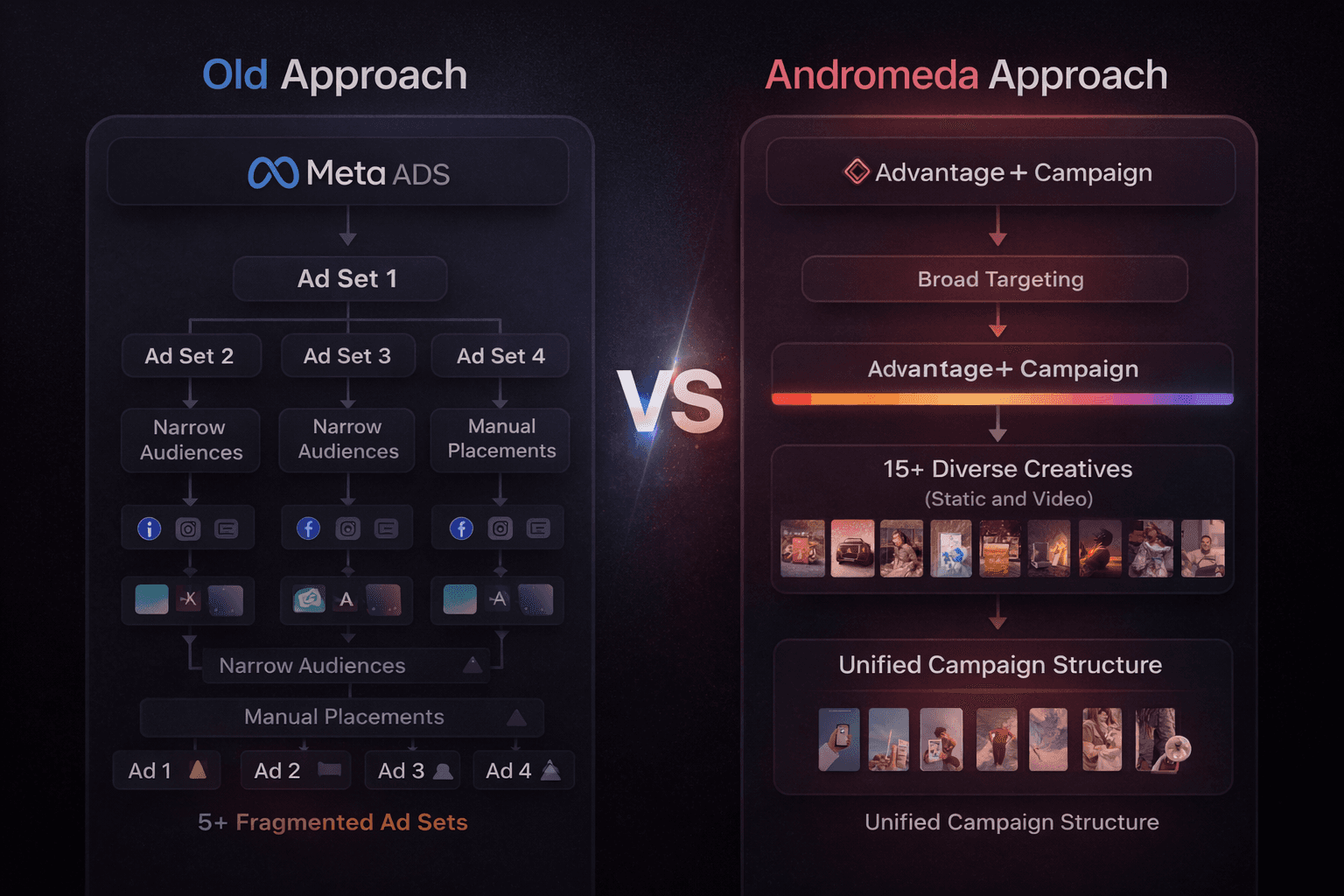
The biggest shift in Meta ads this year is Andromeda, the AI-powered ad retrieval engine that now controls which ads get shown to which users. It replaced the old system where advertisers controlled targeting and Meta optimized delivery. Now Meta controls both.
The advertisers struggling most are the ones still micromanaging audiences, splitting campaigns into dozens of ad sets, and manually restricting placements. Andromeda punishes this. It needs broad audiences, simple campaign structures, and creative diversity to work properly.
The fix: Consolidate your campaigns. Use one Advantage+ campaign with broad targeting and let Andromeda do the matching. Your job is no longer to find the audience. Your job is to feed the system enough creative variety that it can match the right ad to the right person. Start with 10 to 15 genuinely different creatives per campaign, not 15 variations of the same image with different headlines.
2. Your Creative Is Not Diverse Enough
This is the most common reason Meta ads stop converting in 2026, and most advertisers do not realize it. Andromeda's visual recognition models detect when your ads are too similar. If you are running the same product shot with slightly different text overlays, Meta treats it as one creative and penalizes your account with higher CPMs.
Meta removed the old "6 ads per ad set" recommendation. Top performers now run 15 to 50 genuinely different creatives. Not variations of the same concept, but different formats (static, video, carousel, UGC), different angles (testimonial, product demo, pain point, social proof), and different lengths.
The fix: Build a creative testing system that produces volume. If you are spending on human UGC alone, you cannot test fast enough. AI UGC tools can produce 80+ video variants for under $250, giving you the volume Andromeda needs to learn. Score every creative before launch with Predflow's free ad analysis tool to catch weak hooks or CTAs before they waste budget.
3. Your Attribution Windows Changed Without You Noticing
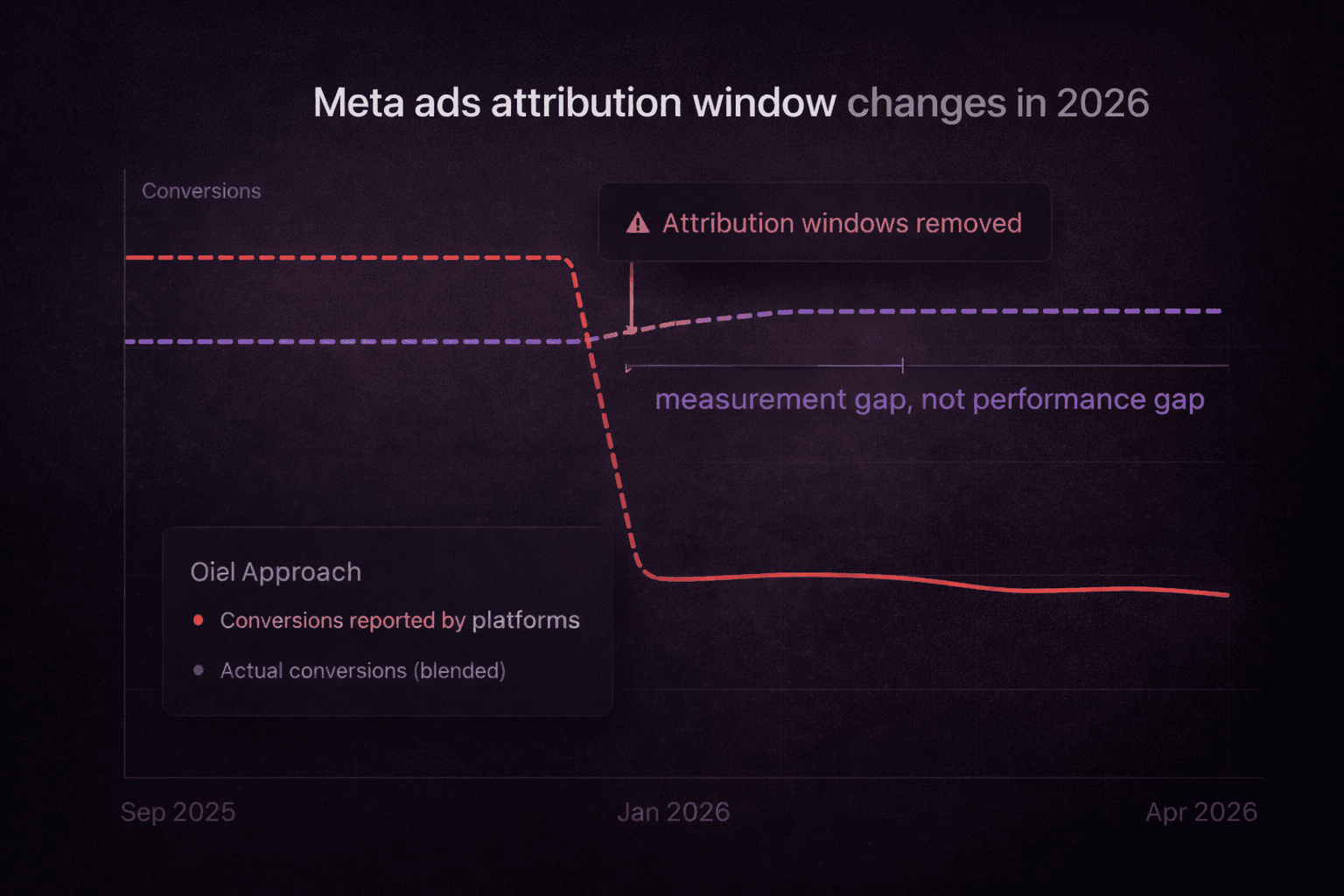
In January 2026, Meta permanently removed longer view-through attribution windows from the Ads Insights API. If you relied on 7-day or 28-day view-through attribution, your conversion numbers dropped 30 to 40% overnight. Your ads did not get worse. Your measurement window shrunk.
This hit awareness campaigns hardest. Video ads and brand campaigns where people rarely click immediately depended on view-through attribution to show value. Without it, these campaigns look like they are not converting when they may still be driving downstream purchases.
The fix: Stop judging campaigns only by platform-reported conversions. Use blended ROAS (total revenue / total ad spend) as your sanity check. If blended ROAS is healthy but Meta shows fewer conversions, attribution is the issue, not performance. For accurate channel-level attribution, you need a tool that reconciles revenue across platforms against actual sales rather than trusting what each platform self-reports.
4. Your Pixel and CAPI Are Sending Bad Data
Meta's algorithm can only optimize for what it can see. If your pixel is misconfigured, firing duplicate events, or missing conversions, Andromeda optimizes toward the wrong signals. This is surprisingly common and almost invisible in your dashboard.
Common issues include: purchase events firing on order confirmation pages that customers reload (creating duplicates), add-to-cart events firing before the customer actually clicks the button, and CAPI not properly deduplicated with pixel events so Meta either double-counts or discards conversions entirely.
The fix: Open Meta Events Manager and run the Test Events tool. Compare Meta's reported conversions against your actual Shopify orders for the last 7 days. If Meta reports 50 conversions but Shopify shows 30 orders from Meta traffic, your pixel is over-firing. If Meta shows 30 but Shopify shows 50, you are losing conversion signals. Both problems degrade optimization. Also check your Aggregated Event Measurement (AEM) priority list. If add-to-cart is prioritized above purchase events, Meta optimizes toward cart additions instead of actual sales.
5. You Are Disrupting the Learning Phase
Meta needs roughly 50 conversions per ad set per week to exit the learning phase. Every time you change the budget, swap a creative, adjust targeting, or edit the ad in any way, the learning phase resets.
Performance marketers are especially guilty of this. You see a campaign underperforming for 48 hours, panic, change the budget, swap out a creative, and restart the cycle. Meta never gets enough data to optimize because you keep resetting the process.
The fix: Set your budget and let campaigns run for 5 to 7 days before making changes. If a creative is clearly not working (below 1% CTR after 3 days with meaningful spend), kill it. But do not micro-adjust budgets or targeting daily. The key is knowing whether poor performance is a creative problem, an audience problem, or a learning phase problem. If you have a system that detects anomalies and diagnoses root causes automatically, you can make that distinction in minutes instead of guessing.
6. Your Landing Page Breaks the Promise
Your ad can perform perfectly and still produce zero conversions if the landing page does not deliver on what the ad promised. This is the most overlooked reason Meta ads fail because advertisers optimize the ad and ignore everything after the click.
Common breaks include: the ad promises 20% off but the landing page shows full prices, the ad features a specific product but the landing page is a generic collection page, the page loads slowly on mobile (where 80%+ of Meta traffic comes from), and the CTA is buried below the fold.
The fix: Click your own ad on your phone. Does the page load in under 3 seconds? Does the headline match the ad? Is the product or offer visible above the fold? Is the CTA obvious without scrolling? If any of these fail, fix the landing page before spending another rupee on ads. The best ad in the world cannot convert on a broken page.
7. You Are Optimizing for the Wrong Objective
This sounds basic but it catches more brands than you would expect. If you select "Traffic" as your campaign objective but expect purchases, Meta finds people likely to click, not people likely to buy. These are fundamentally different audiences.
Advantage+ Shopping Campaigns (ASC) are now the default for sales objectives. If you are still running manual campaigns optimized for link clicks or landing page views, you are working against the system.
The fix: Audit every active campaign. Confirm the objective matches what you actually want. Sales campaigns should optimize for purchases or value. If you are running a brand awareness campaign, do not expect direct conversions from it. Match your expectations to the objective and diagnose actual performance against realistic benchmarks rather than comparing awareness campaigns to conversion campaigns.
The Common Thread
If you look across all 7 reasons, a pattern emerges. Most Meta ad failures in 2026 come from feeding bad inputs into a system that is increasingly automated. Bad creative variety. Bad tracking data. Bad campaign structure. Bad landing pages. Andromeda is more powerful than any previous version of Meta's ad system, but it amplifies whatever you give it, including mistakes.
The fix is not more manual control. It is better inputs: more creative diversity, cleaner tracking, simpler structures, and a system that watches your performance and tells you when something breaks before you discover it in your weekly review. The brands converting profitably on Meta right now are the ones who stopped trying to outsmart the algorithm and started giving it what it needs to work.
Improve Ad performance with Predflow
Diagnose performance drops, creative fatigue, and attribution shifts