


How to Make AI UGC Ads That Actually Convert
Six months ago, AI-generated UGC looked like a gimmick. Stiff avatars, robotic lip-sync, uncanny valley energy that made viewers scroll past instantly. That has changed fast. The latest generation of AI UGC tools produces video ads that are good enough to test, good enough to run, and in many cases, good enough to outperform human creators on ROAS.
If you run ads for a D2C brand and you are not testing AI UGC yet, you are overpaying for creative testing. Here is how to actually do it well.
What AI UGC Ads Are (and Are Not)
AI UGC ads are video advertisements generated using artificial intelligence. You provide a product link or images, pick an AI avatar, feed it a script, and the tool produces a video that looks like a real person talking about your product. The best ones include natural lip-sync, product-in-hand demos, and multiple scene types.
They are not meant to replace human creators entirely. Think of them as draft creatives you can produce at scale for almost nothing. The goal is testing, not perfection.
The Tools That Actually Work
The AI UGC space has exploded, but only a handful of tools produce output that is worth putting ad spend behind. Here is what performance marketers are actually using right now:
Creatify is the most popular choice for batch testing. Its "ad clone" feature lets you take a competitor's winning ad structure and recreate it with your product and a different avatar. Batch mode queues 30+ videos at once. Pricing starts around $27 per month.
Arcads produces the most realistic avatars but runs on a credit system that gets expensive at high volume. Best for when you need 5 to 10 polished AI videos, not 100 test variants.
HeyGen offers 1,100+ avatars and supports 175+ languages, making it the strongest option for brands running ads globally. The avatars lean slightly more corporate than UGC-style.
MakeUGC has a unique workflow where you upload a reference ad and the AI rebuilds it with your product. Good for replicating proven structures without copying creatives directly.
Tagshop AI stands out for its built-in editor so you do not need to switch between tools. Strong avatar variety and multilingual support at an affordable price point.
Most teams settle on one primary tool and stick with it. Switching between platforms eats time that you could spend testing more concepts.
When You Want Full Creative Control
The tools above work great for speed. But if you want more control over how your AI creator looks, moves, and interacts with your product, Higgsfield AI opens up a different workflow entirely.
Here is what works well: generate a custom character using Nano Banana Pro inside Higgsfield. Then use Nano Banana again to create an image of that character actually holding or using your product. From there, Kling 3.0 inside Higgsfield turns that image into a video with realistic lip sync, natural gestures, and proper physics. The result looks significantly more polished than what most one-click tools produce because you control every step of the character and scene.
If you do not need that level of customization, Higgsfield also has a link-to-video-ad feature that generates a realistic UGC ad in about a minute from just your product link. It is a good middle ground between the fully automated batch tools and the manual character workflow.
The tradeoff is time. The custom character pipeline takes more effort per video than batch tools like Creatify. Use it when you already know which concept works and want a higher-quality AI version before deciding whether to invest in human creators.
How AI UGC Actually Performs Against Human Ads
The debate online tends to be polarized. Either AI is going to replace all creators, or it is useless slop. The reality, based on actual spend data, is more nuanced.
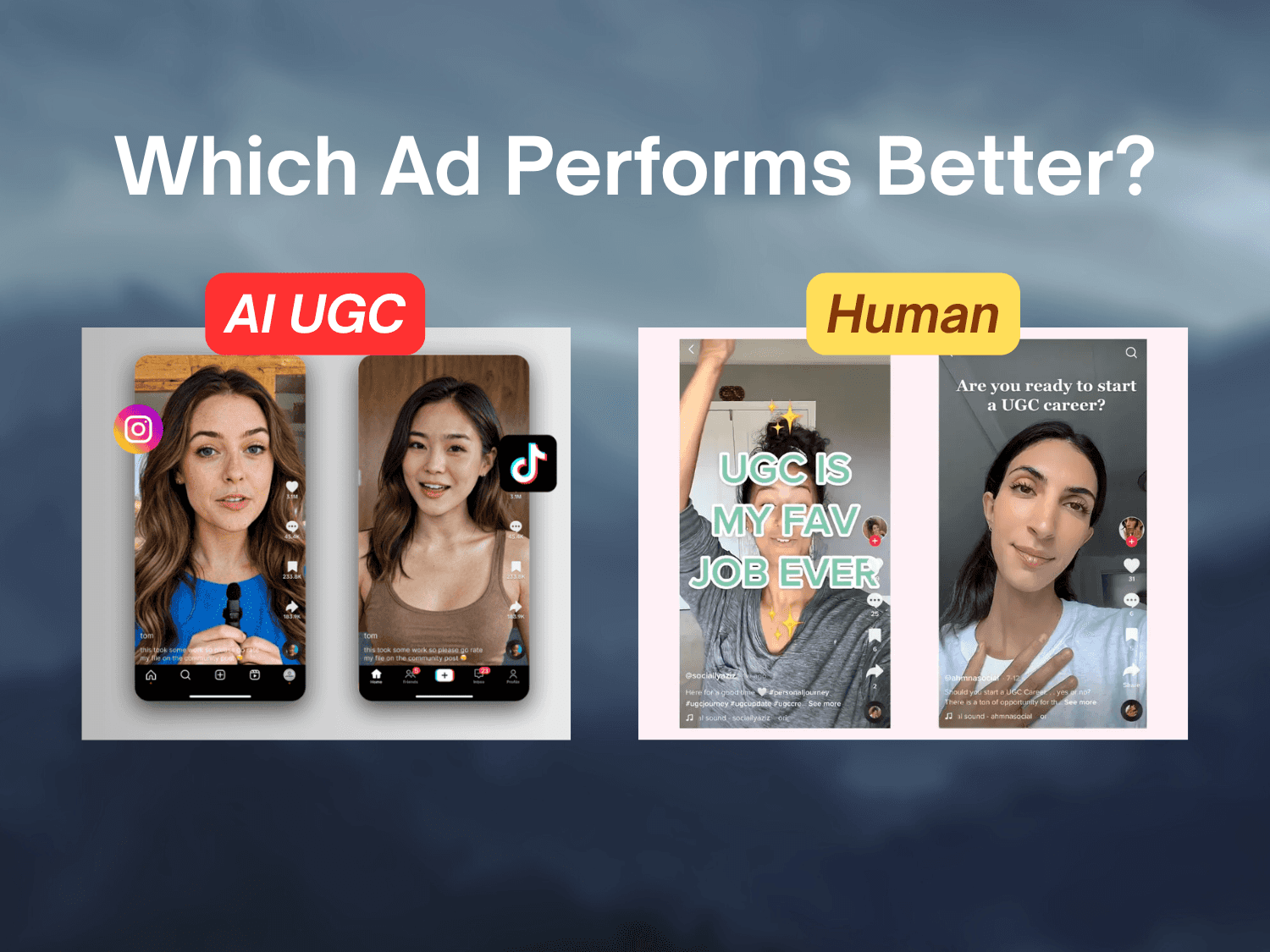
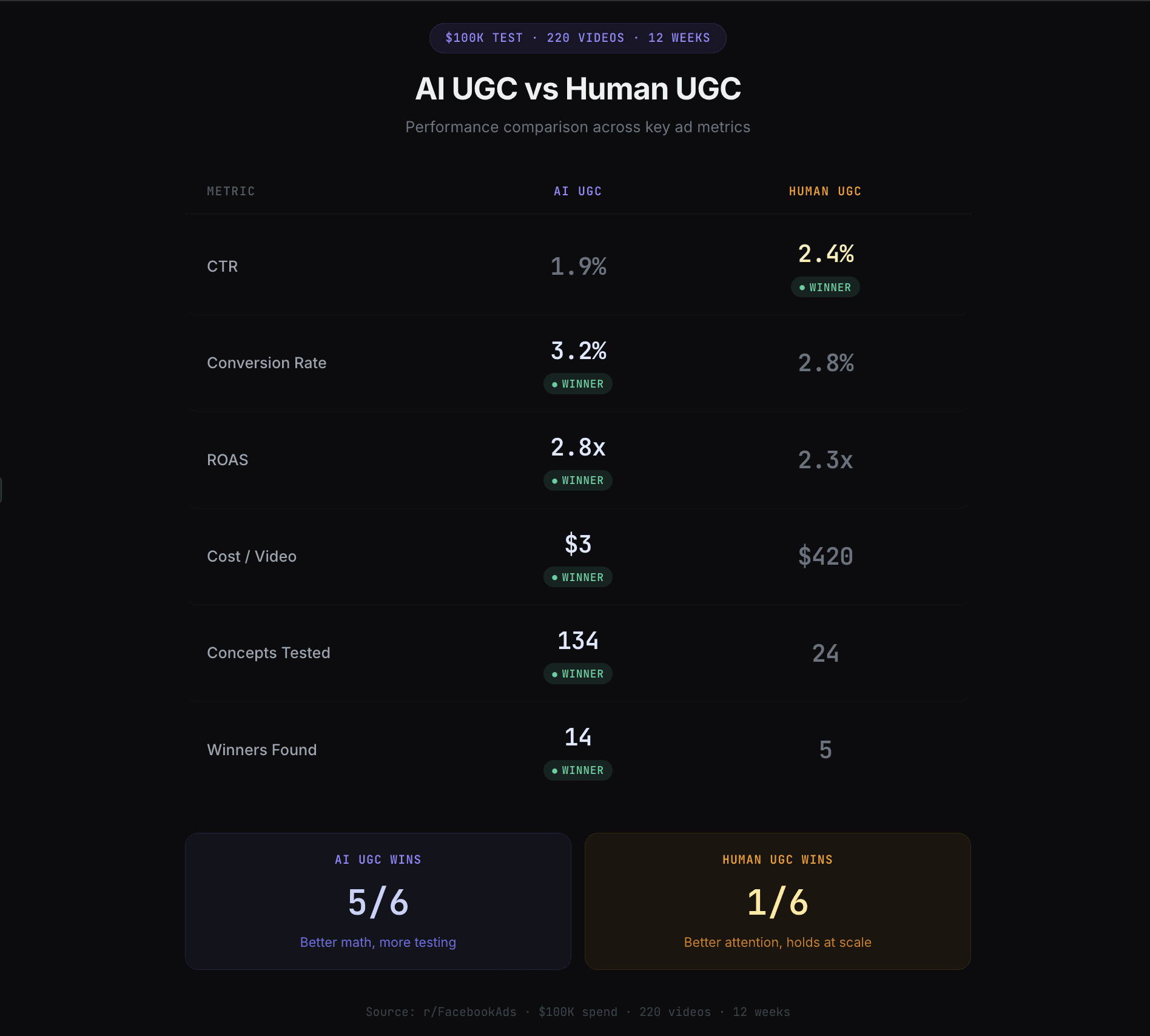
A widely discussed test on Reddit put $100K behind 220 video ads over three months, split between full AI, hybrid, and full human UGC. The results were telling.
Human UGC won on click-through rate: 2.4% versus 1.9% for AI. People engage more with real faces. No surprise there. But AI won on overall ROAS: 2.8x versus 2.3x for human. The reason was not that AI ads were better. It was that at $3 per video versus $420 for human UGC, the advertiser could test 134 AI concepts in the same period they could only produce 24 human videos. More experiments meant more winners found.
The takeaway is not "AI beats human." It is that testing volume matters more than individual creative quality when you are searching for what works.
Several experienced media buyers in the same thread flagged an important caveat: AI creatives fatigue roughly 30% faster than human UGC at scale. A winning AI ad that performs well at $50 per day can drop significantly when you push budget to $500 per day. Human UGC tends to hold its performance at higher spend levels because the subtle variation in real human delivery keeps audiences engaged longer.
The Workflow That Makes This Profitable
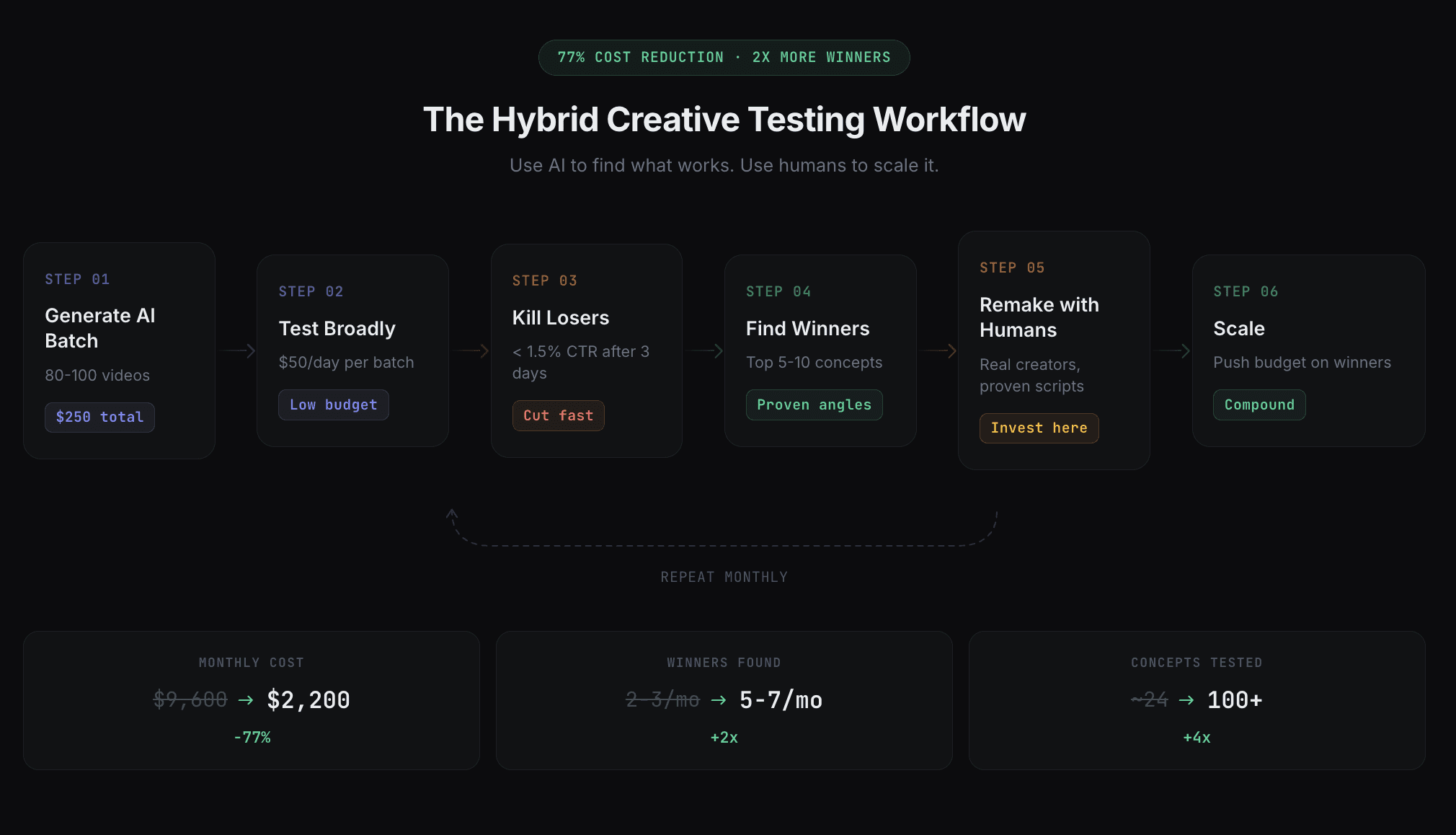
The brands getting the best results are not choosing between AI and human. They are using both in sequence.
Generate 80 to 100 AI video variants using batch tools like Creatify. Total cost: roughly $250.
Test broadly at low budget ($50 per day per batch) across Meta or TikTok.
Kill underperformers fast. Anything below 1.5% CTR after three days gets cut.
Identify the 5 to 10 winning concepts. Note which hooks, structures, CTAs, and angles performed.
Remake the winners with human creators. Use real people to produce polished versions of concepts that already proved they convert.
Scale the human versions with confidence.
This workflow cuts creative production costs dramatically while actually increasing the number of winning ads discovered each month. The AI phase is research. The human phase is execution.
Where AI UGC Works Best
Not every part of your funnel benefits equally from AI creatives.
Prospecting (top of funnel): AI UGC performs well here. You need high volume, fast iteration, and the ability to test many angles cheaply. Cold audiences are less sensitive to subtle authenticity cues because they do not know your brand yet.
Retargeting (bottom of funnel): Human UGC consistently outperforms AI in retargeting. Warm audiences who already know your brand respond better to real faces and genuine reactions. Multiple advertisers report 1.5x to 1.8x higher ROAS on retargeting with human UGC versus AI for the same products.
Younger audiences (under 30): Be cautious. This demographic is increasingly good at spotting AI-generated content, and many react negatively to it. Use AI for concept testing but lean heavily on human creators for anything you plan to scale to younger segments.
Scoring Your AI Creatives Before Launch
Just because AI makes creative production cheap does not mean you should run everything. Before putting spend behind any AI-generated ad, evaluate the fundamentals: Is the hook strong enough in the first frame? Is the CTA clear? Does the product appear early enough?
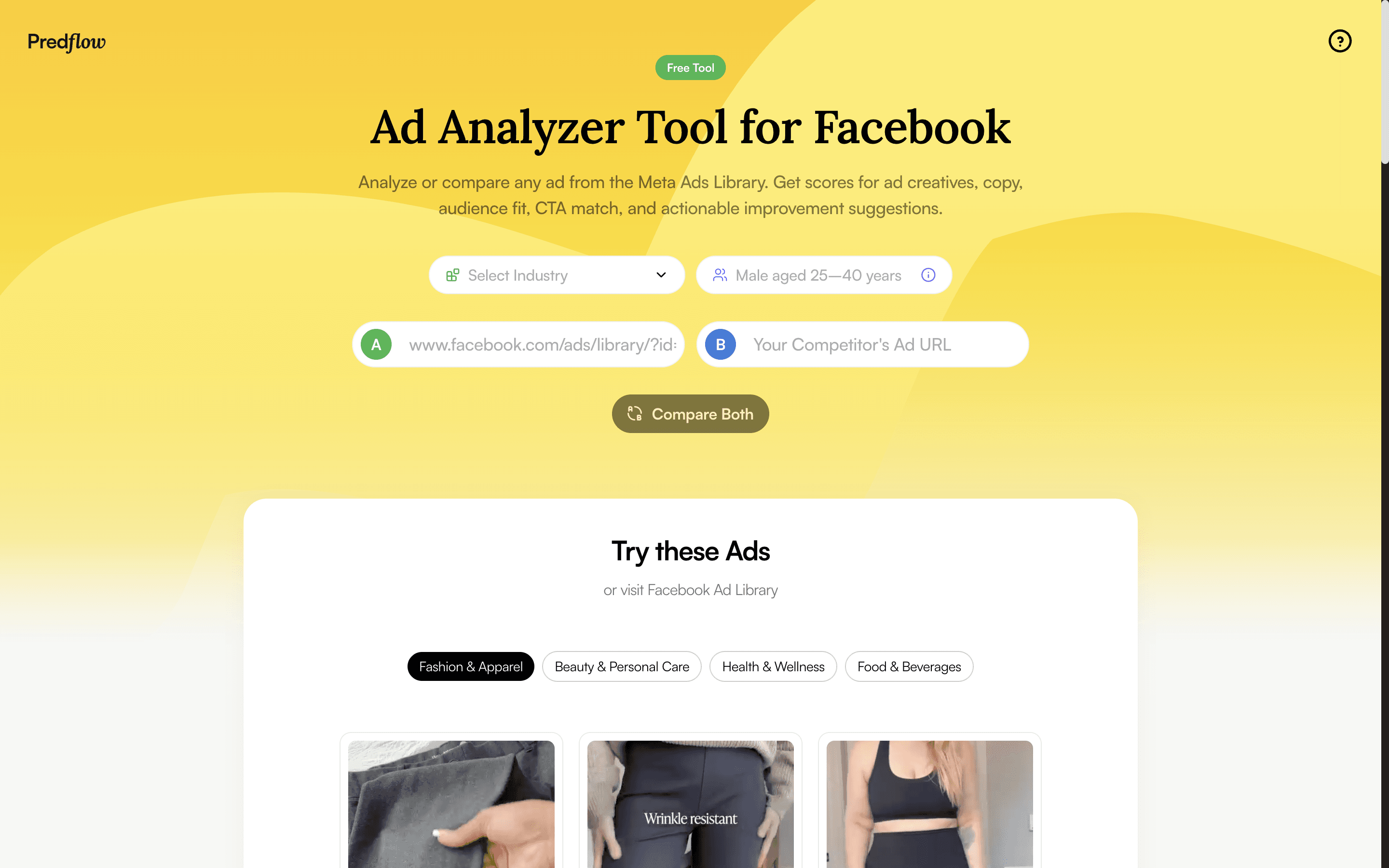
You can run any creative through Predflow's free ad analysis tool to score your hook, visual, CTA, and audience fit before committing budget. Spending 30 seconds on a pre-launch check can save days of wasted spend on a creative that was never going to work.
Once your AI and human creatives are live, tracking which ones are fatiguing and when to rotate becomes the next challenge. Ad intelligence tools can automate this monitoring so you catch declining performance early instead of discovering it in your weekly review when the damage is already done. If your numbers suddenly look off, having a clear framework to diagnose the root cause of ROAS drops saves you from making reactive changes that often make things worse.
Start Testing This Week
AI UGC is not the future of ad creative. It is the present of ad testing. The tools are good enough, the cost is low enough, and the speed advantage is too large to ignore.
Pick one tool. Generate 20 to 30 videos this week. Test them at low budget. See what hooks and angles your audience responds to. Then take what works and invest in human production for the versions you actually scale.
The brands that win at creative right now are not the ones with the best single ad. They are the ones who test the most, learn the fastest, and put their human creative budget where it actually compounds.
Improve Ad performance with Predflow
Diagnose performance drops, creative fatigue, and attribution shifts