



How to Diagnose and Fix a ROAS Drop: A Data-Driven Framework for D2C Brands
When you manage ads for a D2C brand, a sudden drop in ROAS (Return on Ad Spend) is inevitable. I have spent the last six years managing performance marketing for high-growth brands, often utilizing essential tools for D2C performance marketers. I have learned that the worst thing you can do during a performance dip is make changes based on a guess.
Most media buyers respond to a ROAS drop by immediately changing creatives or broadening audiences. This is reactive and often makes the problem worse. Instead, you need a systematic way to identify exactly what went wrong.
In this post, I will explain the "Daily Cycle Trap" and the 5-hypothesis framework I use to diagnose performance issues and restore profitability.
The Root Cause: The "Daily Cycle Trap"
Before you try to fix your ads, you need to understand how the algorithm handles your budget. I call this the Daily Cycle Trap.
Meta’s algorithm is designed to be risk-averse. Once it finds a stable volume of orders for your account, it tries to stay within that "safe zone." When you increase your budget to scale, the algorithm often fails to find more high-intent buyers. Instead, it spends your extra budget on:
Lower-quality audiences: People who are less likely to convert, which increases your cost per acquisition.
Audience recycling: Showing the same ads to the same people repeatedly, leading to high frequency and ad fatigue.
This results in higher spend but flat order volume. If you do not recognize this trap, you will continue to pay for inefficient traffic while your ROAS stays low.
The 5-Hypothesis Framework for Diagnosis
To stop guessing, I use a logic-based framework. I feed raw data like Spend, CPM, CTR, CPC, Conversion Rate, ROAS, Frequency, and Reach into an AI tool like Claude to generate five distinct hypotheses for the drop.
This approach ensures that every potential cause is tested against the data before any action is taken. This is also useful when you are seeing good ROAS but not scaling
Hypothesis | Explanation | Data Test | Verdict |
|---|---|---|---|
H1: Algorithmic Ceiling | You are stuck in the "Daily Cycle Trap" where extra budget is wasted. | Is Reach flat while Frequency and Spend are increasing? | ACCEPTED |
H2: Creative Fatigue | Your top-performing ads are no longer effective for your audience. | Is CTR dropping while CPM remains stable? | REFUTED |
H3: Offer Saturation | The market is no longer responding to your current discount or offer. | Is Conversion Rate (CR) dropping across all campaigns? | INCONCLUSIVE |
H4: Post-Click Friction | A change to the website or landing page is hurting the conversion funnel. | Compare Landing Page Load Time and Checkout Start Rate vs. last week. | REFUTED |
H5: Signal Loss | Your tracking pixel is misfiring or under-reporting conversions. | Cross-reference platform ROAS with your Blended ROAS (MER). | REFUTED |
How to Execute This Workflow
1. Collect Your Data
Extract your last 14 days of data, broken down by day. You need to see the daily trends in Reach, Frequency, and CTR to understand how the audience is reacting to your spend.
2. Use AI to Generate Hypotheses
Use a simple prompt to have an AI analyze your metrics:
"I am a performance marketer for a D2C brand. My ROAS dropped 25% this week. Here is my data: [Insert data]. Give me 5 distinct, mutually exclusive hypotheses for why this happened based on these metrics."
3. Validate with Metrics
For each hypothesis, look for the specific metric that proves or disproves it. You should only take action on Accepted hypotheses. If the data is unclear, the hypothesis remains "Inconclusive."
4. Disrupt the Account
If you confirm an Algorithmic Ceiling (H1), small adjustments will not work. You need to disrupt the account by:
Launching a completely new campaign structure.
Running a Budget Pressure Test (increasing budget by 50% or more) to force the algorithm to find new pockets of traffic.
Automating the Process with Predflow.ai
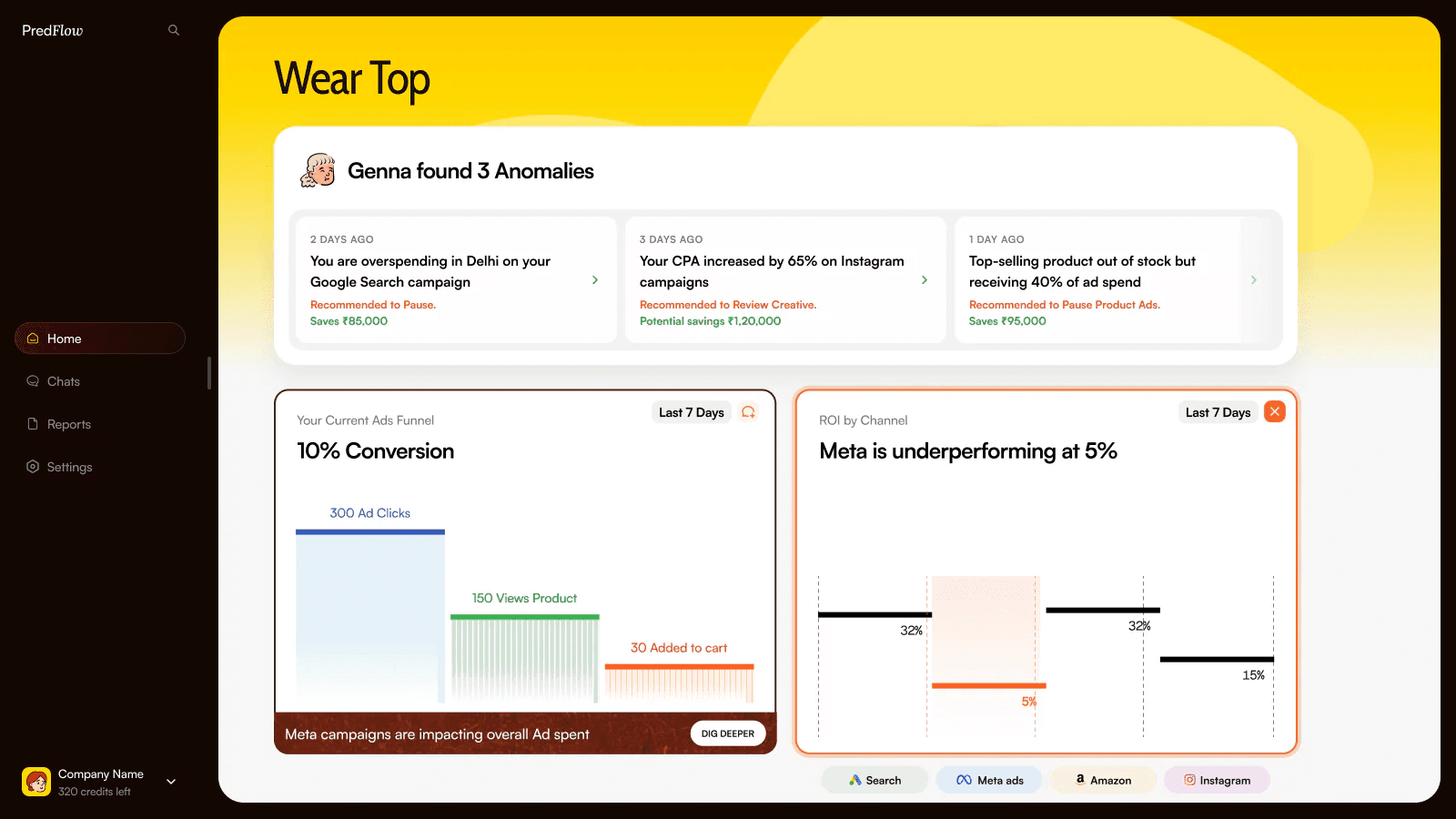
Performing this analysis manually every day is time-consuming. I wanted to automate the logic I use so that I could focus on creative strategy.
This led to the creation of Predflow.ai. We built an ad intelligence agent that continuously runs this hypothesis-driven workflow for you. It also functions as an anomaly and RCA tool, telling you exactly what to fix on a daily basis so you don't have to spend hours analyzing spreadsheets.
Currently, 100% of our customers have seen an increase in performance after using Predflow.ai. If you want to automate your diagnosis and improve your ad performance, you can check our pricing and use Predflow.ai here: https://predflow.ai You can also read about how other brands have succeeded in our customer stories.
FAQ
What is a good ROAS for D2C?
Most brands target a 3x to 4x ROAS, but you should always prioritize your Blended ROAS (MER) to ensure overall business profitability.
How often should I check for drops?
Monitor your data daily, but only make major changes based on 7-day or 14-day trends to avoid overreacting to daily volatility.
Can AI replace a media buyer?
No. AI is a tool for pattern recognition. It can identify root causes faster than a human, but you still need a media buyer to execute the strategy and develop the creative.
Improve Ad performance with Predflow
Diagnose performance drops, creative fatigue, and attribution shifts