AI AGENTS
4 Ringg AI Alternatives Worth Evaluating for Vendor Call Automation
Ringg AI competitors compared for 2026: Lyzr, Relevance AI, Gnani.ai, and Decagon, rated on vendor call automation and what happens after the call.

Khushbu Adav
Product, Predflow

Your AP or supply chain team is spending hours each week on outbound vendor calls. Confirming delivery windows, chasing invoice statuses, rescheduling pickups. Nothing gets logged automatically. No one can tell where a process stalled until something breaks.
Ringg AI addresses part of this problem. The Bangalore-based startup, cofounded in 2023 and backed by $5.5 million in Series A funding raised in January 2026, built a no-code platform for deploying multilingual AI voice agents across use cases like delivery confirmations, collections, and scheduling. For teams that need to get a voice agent live quickly, it is a credible option.
The tension is in what comes after the call. Operations teams evaluating Ringg AI for vendor automation frequently find gaps in end-to-end process orchestration, ERP integration, and structured exception handling. The voice layer works. The workflow layer is limited.
This article covers four alternatives so you can match a tool to your actual workflow needs, not just your call volume.
What Ringg AI Does — and Where It Falls Short for Vendor Workflows
What Ringg AI is built for
Ringg AI was cofounded in Bangalore in 2023 by Siddharth Shankar Tripathi, previously a product manager at Groww and Flipkart, and Utkarsh Shukla, formerly a data scientist at Atlan and Blinkit. The platform lets teams design and deploy multilingual AI voice agents without writing code. Core use cases include delivery confirmations, loan collections, appointment scheduling, candidate screening, and customer support calls.
For teams running high-volume outbound calling campaigns, the no-code builder reduces deployment time significantly. The multilingual capability makes it relevant for India-based operations managing vendors across language regions.
Where vendor automation teams hit friction
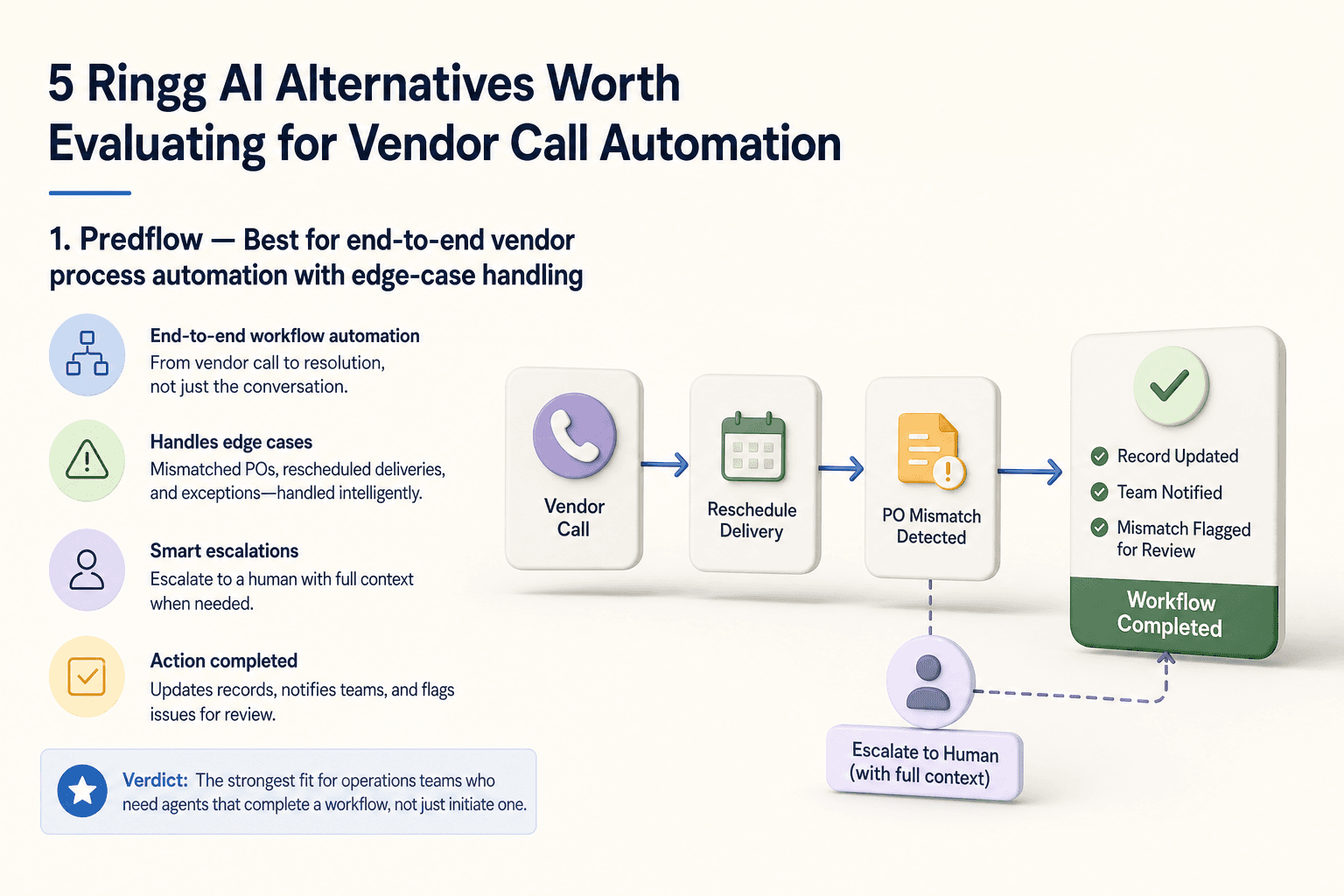
The friction appears when the call is only one step in a longer process. Vendor call automation in an AP or supply chain context rarely ends at the conversation. A confirmed delivery date needs to update the PO. A rescheduled pickup needs to trigger a warehouse notification. A disputed invoice needs to route to a reviewer with context attached.
Ringg AI is a voice-layer tool. It handles the ai calling bot function well, but it was not built as a full ai agent workflow platform. Teams that need their agent to write back to an ERP, handle conditional logic mid-call, or escalate with structured data find themselves building manual bridges between Ringg and their other systems. That is exactly the kind of manual handoff they were trying to eliminate.
How to Choose a Ringg AI Alternative: The 4 Criteria That Matter
Evaluating alternatives without a framework leads to feature comparison paralysis. These four criteria map directly to the operational pain points vendor automation is supposed to solve.
Integration with your existing AP or ERP stack. If a vendor confirms a different delivery date than the PO, can the agent update your ERP automatically, or does it create a support ticket for manual review? Integration depth determines whether automation is end-to-end or just front-end.
Structured exception handling and human escalation paths. When a call produces an unexpected answer, what happens next? A well-designed ai agent architecture routes exceptions to a human with full context, not a raw call transcript dropped into a shared inbox.
Process visibility and audit trail. Can your team see exactly where a workflow stalled, which vendor gave which answer, and what action the agent took? Without this, debugging a failed process is as slow as doing it manually.
Scalability without adding headcount. A tool that handles 100 vendor calls per week should handle 1,000 without requiring you to hire a workflow administrator. Multi-agent system design and agent orchestration determine whether the platform scales with your operation or against it.
4 Ringg AI Alternatives Worth Evaluating for Vendor Call Automation
1. Lyzr AI — Best for teams that want a pre-built agent framework with customization
Lyzr AI is an ai agent builder that provides pre-built agent templates across common enterprise use cases, with options to customize agent behavior and connect to external tools.
For back-office automation, Lyzr’s agent framework supports multi-step task execution and can be configured to handle vendor-facing workflows with defined logic branches. Teams with some technical capacity can adapt its agents to fit existing AP processes without building from scratch.
The limitation is consistency at scale. Lyzr’s customization flexibility is also its complexity. Teams without dedicated AI or technical resources to maintain agent configurations may find it difficult to keep workflows accurate as vendor processes change.
Verdict: A good fit for technically resourced teams who want a starting framework rather than a fully managed build.
2. Relevance AI — Best for no-code agent builders who need tool-chaining flexibility
Relevance AI is a no-code ai agent platform that lets teams chain tools, APIs, and data sources together into automated workflows without writing code.
For vendor automation, its strength is in tool-chaining. A team can connect a vendor call trigger to a spreadsheet update, a Slack notification, and an email follow-up in a single workflow. The platform supports conditional logic, making it more capable than simple voice-layer tools for multi-step processes.
The trade-off is depth of ERP integration. Relevance AI connects well to common SaaS tools but requires additional configuration work for direct ERP writes or structured AP system integration. For teams with complex back-end systems, the integration layer adds friction.
Verdict: Strong for operations teams running workflows across SaaS tools. Less straightforward for teams needing direct ERP or legacy system integration.
3. Gnani.ai — Best for voice-first workflows in regional language environments
Gnani.ai is a voice AI platform built specifically for India-based operations, with deep support for regional language processing across customer and vendor interactions.
For supply chain and AP teams managing vendor relationships across language-diverse regions in India, Gnani.ai provides voice agent coverage that generic English-first platforms cannot match. Its natural language understanding for Indian languages is a practical differentiator for collections, confirmations, and query resolution in regional contexts.
The limitation is workflow scope. Like Ringg AI, Gnani.ai is primarily a voice-layer platform. The ai agent workflow capabilities beyond the call itself are more limited than full orchestration platforms. Teams needing deep post-call process automation will need to integrate Gnani.ai with other tools.
Verdict: The clearest choice for voice-first vendor automation where regional language coverage is a hard requirement.
4. Decagon AI — Best for structured vendor and customer query resolution at scale
Decagon AI is an ai agent platform built for handling high-volume, structured query resolution across customer and vendor-facing channels.
Its strength in vendor automation is handling repetitive, structured queries at scale. Confirming order statuses, resolving invoice discrepancies, answering standard vendor questions. Decagon’s agent architecture is designed to maintain consistent, accurate responses across large interaction volumes without degrading quality.
The limitation is flexibility for non-standard workflows. Decagon performs well when vendor queries follow predictable patterns. For workflows with high variability or complex conditional logic, the platform’s structured approach becomes a constraint.
Verdict: The right fit for teams with high-volume, predictable vendor query workflows where consistency matters more than flexibility.
Quick Comparison: Ringg AI vs. the 4 Alternatives at a Glance
Use this table as a shortlisting tool, not a definitive ranking. Every team’s stack and workflow complexity is different.
Tool | Best For | Integration Depth | Edge-Case Handling | Pricing Model |
|---|---|---|---|---|
Ringg AI | Fast multilingual voice agent deployment | Limited | Basic | Custom |
Lyzr AI | Customizable agent framework for technical teams | Moderate | Configurable | Custom |
Relevance AI | No-code tool-chaining across SaaS tools | Moderate | Conditional logic supported | Tiered / Custom |
Gnani.ai | Regional language voice automation in India | Limited | Basic | Custom |
Decagon AI | High-volume structured query resolution | Moderate | Structured, less flexible | Custom |
The right choice depends on where your bottleneck actually sits. If the problem is deploying a voice agent quickly across languages, Ringg AI and Gnani.ai are practical starting points. If the problem is that calls trigger processes your current tools cannot complete without manual intervention, a full workflow automation platform like Relevance AI is the better path.
When Ringg AI Is Still the Right Choice — and When It Isn’t
Stick with Ringg AI if…
Your team needs to deploy a multilingual outbound call agent in under a week and does not require ERP integration.
Your vendor calls follow simple, single-step scripts where the outcome is a confirmation or a reschedule, and no downstream system needs to be updated automatically.
Your operation is in India, you need regional language support, and voice quality is the primary requirement.
You are running a pilot to test AI calling before committing to a full workflow automation build.
Choose an alternative if…
Your vendor calls involve conditional logic. If a delivery is rescheduled, the agent must update the PO, notify the warehouse, and log the change. Ringg AI’s workflow layer cannot handle that chain reliably.
Your AP or supply chain team needs a full audit trail of what each agent did after every call, with logs that connect to your existing systems.
Your vendor workflows span multiple steps across multiple tools, and manual handoffs between those steps are the core problem you are trying to solve.
You need agents that escalate to a human reviewer with structured context, not a raw call recording or a generic notification.
FAQ
What is Ringg AI used for in business operations?
Ringg AI is a no-code platform for building and deploying multilingual AI voice agents. Businesses use it for outbound calling workflows including delivery confirmations, loan collections, appointment scheduling, and candidate screening. It handles the voice interaction layer but is not designed as a full workflow automation platform.
How does Ringg AI compare to full workflow automation platforms?
Ringg AI focuses on voice agent deployment and conversation handling. Full workflow automation platforms handle the entire process chain, including post-call system updates, exception routing, and ERP writes. The key difference is whether automation ends at the call or continues through every downstream step.
Can AI agents handle vendor calls end-to-end without human involvement?
Most vendor call workflows require at least some human escalation path for exceptions. Well-designed ai agents can handle the majority of calls autonomously, but they need structured escalation logic for edge cases like disputed invoices or unmatched PO data. Platforms built around ai agent architecture with defined exception handling come closest to true end-to-end automation.
What should I look for in an AI agent platform for accounts payable automation?
Prioritize integration depth with your ERP or AP system, structured exception handling, a full audit trail of agent actions, and scalability without manual configuration overhead. A platform that starts with process mapping rather than tool selection will fit real AP workflows more reliably than one built around generic agent templates.
Is Ringg AI suitable for enterprise-scale vendor management?
Ringg AI suits enterprises that need high-volume multilingual outbound voice coverage with fast deployment. It is less suited for enterprises where vendor management involves complex multi-step workflows, deep ERP integration, or structured exception handling across many process branches. For those requirements, a full ai agent platform with broader orchestration capabilities is a better match.
Conclusion
The decision comes down to one question: is your team’s bottleneck voice quality or workflow reliability?
If the problem is getting a voice agent deployed quickly across languages with minimal configuration, Ringg AI and Gnani.ai are reasonable starting points. If the problem is that vendor calls trigger a chain of downstream actions your team currently handles manually, and those manual handoffs are where time and accuracy are lost, then a voice tool alone will not fix it. You need a platform that handles the full workflow, not just the call.
If your team is losing time to manual vendor follow-ups and needs agents that handle the whole process, not just the call, see how Predflow maps and automates your vendor workflows. Request a workflow audit.
Bring 20 NetSuite bills to a 30-minute teardown
We will walk your actual invoices through capture, 3-way match and posting on the call, and tell you which steps an agent can take over. No prep beyond the PDFs.
FAQ
Frequently asked questions
What exactly is an AI agent
An AI agent is an autonomous system designed to handle specific business tasks end-to-end. Unlike simple chatbots, AI agents can reason, take actions, integrate with tools, and follow defined workflows.