Finance
O2C Process: Stages, KPIs, and Common Bottlenecks
DSO keeps climbing but no one can explain why — sound familiar? Break down every stage of the O2C process, the KPIs worth tracking, and the bottlenecks most teams overlook.

Sanya Shah
Co-founder at Predflow

Your finance team closes another month, DSO is up again, and nobody can pinpoint why. The orders came in, invoices went out, but cash is still sitting in the pipeline. That gap between a confirmed customer order and actual money in the bank is where the O2C process either works or quietly drains your working capital.
O2C, order-to-cash, is not a back-office formality. It is the operational backbone connecting your sales commitments to your bank balance. Every manual handoff, approval queue, or invoice dispute inside that cycle adds days to your collections timeline and forces your team into firefighting mode.
Best-practice research on O2C consistently frames optimization across strategy, people, process, technology, and measurement together. None of those levers works in isolation. This article maps each stage of the O2C cycle, identifies the KPIs that surface problems early, and shows where specific bottlenecks are costing you the most time and cash.
What Is the O2C Process and Why Does It Matter for Cash Flow?
The end-to-end scope: from order capture to payment reconciliation
The O2C process covers every step from the moment a customer places an order to the moment payment is confirmed and reconciled in your accounts. It includes order management, credit checks, fulfillment, invoicing, accounts receivable tracking, collections, and cash application. A failure at any one stage delays the entire cycle.
Featured snippet definition: Order-to-cash (O2C) is the end-to-end business process that begins when a customer places an order and ends when payment is received and matched to the correct invoice. It spans order management, credit approval, fulfillment, invoicing, collections, and cash reconciliation. Inefficiencies at any stage directly reduce available working capital and slow cash flow.
Most teams treat these stages as separate departmental functions. That separation is exactly where the problems start. When order management, finance, and collections run on different systems with no shared visibility, errors compound across every handoff.
Why O2C sits at the center of working capital strategy
CFOs are focused on tighter cash discipline, faster working capital release, and improved customer experience, all while controlling operating costs. O2C sits directly at the intersection of all three. The speed and accuracy of invoicing, collections, and payment matching determines how much cash is available for operations at any given moment.
A slow O2C cycle is not just an efficiency problem. It inflates Days Sales Outstanding, ties up liquidity, and signals to customers that your billing operation is unreliable. Both outcomes have financial and relationship consequences that compound over time.
The 7 Core Stages of the O2C Cycle
Understanding where your process breaks down requires a clear map of every stage. Each step below represents a distinct handoff point where errors, delays, or missing information can derail the cycle downstream.
1. Order management: capturing and validating customer orders
Order management covers receiving a customer order, validating it against pricing agreements and product availability, and entering it into the system for fulfillment. Ownership typically sits with sales operations or a dedicated order desk. When orders are entered manually or pulled from disconnected channels, data errors here create billing disputes three stages later.
2. Credit management: assessing risk before fulfillment
Before an order moves to fulfillment, the finance team assesses the customer's credit limit and payment history. This step protects the business from fulfilling orders for customers unlikely to pay. When credit checks rely on manual review or outdated data, approvals stall and fulfillment queues back up.
3. Order fulfillment: picking, packing, and shipping
Fulfillment converts the approved order into a physical or digital delivery. Operations or logistics teams own this stage. Delays here push the entire downstream timeline back. If an order ships late or with the wrong items, the invoice becomes disputed before it is even opened.
4. Invoicing: generating accurate, timely bills
The billing team generates an invoice based on what was shipped and the agreed pricing terms. Automated systems streamline this step significantly. Manual invoicing introduces errors in PO numbers, quantities, and tax calculations, each of which gives the customer a legitimate reason to delay payment.
5. Accounts receivable: tracking what is owed
Accounts receivable tracks outstanding invoices and their due dates. AR teams monitor aging reports and flag overdue accounts. Without real-time visibility into which invoices are at risk, collections teams react to problems rather than preventing them.
6. Collections: following up on overdue accounts
Collections is the structured process of following up on unpaid invoices. It involves communication sequencing, escalation logic, and dispute resolution. When collections runs on spreadsheets or generic email, follow-up is inconsistent and high-value accounts receive the same treatment as low-value ones.
7. Cash application and reconciliation: matching payments to invoices
Once payment arrives, the team matches it to the correct open invoice and closes the receivable. Unstructured remittance data, partial payments, and deductions make this step time-consuming when done manually. A high volume of unmatched payments leaves AR balances inaccurate and clouds your true cash position.
The O2C KPIs That Actually Predict Process Health
Tracking the right metrics tells you where the cycle is breaking before cash flow takes the hit. These five KPIs give operations and finance leaders a practical dashboard for O2C health.
Days Sales Outstanding (DSO): the headline metric and its limits
What it measures: The average number of days between issuing an invoice and receiving payment.
Healthy benchmark: Lower is better. Benchmarks vary by industry, but a rising DSO trend over consecutive periods is a reliable signal of process deterioration.
What a declining trend signals: Collections follow-up is inconsistent, invoice disputes are going unresolved, or credit terms are being extended without controls. DSO is useful as a headline number, but it does not tell you which stage is causing the delay.
Invoice accuracy rate: where revenue leakage starts
What it measures: The percentage of invoices issued without errors requiring correction or dispute.
Healthy benchmark: Best-in-class operations run above 98% accuracy. Below 95% means your team is spending significant time on credit memos and corrections.
What a declining trend signals: Manual data entry errors in order management are flowing through to billing, or pricing and contract terms are not being applied consistently at invoice generation.
Order cycle time: speed from confirmed order to delivery
What it measures: Total time from order confirmation to delivery completion.
Healthy benchmark: Varies by industry and product type. The key signal is variance, not just average. High variance means fulfillment is unpredictable, which delays invoicing.
What a declining trend signals: Bottlenecks in credit approval, inventory availability, or logistics coordination are adding unplanned time before the invoice can even be issued.
Collection effectiveness index (CEI): measuring follow-through
What it measures: The percentage of receivables your team successfully collected within a given period relative to what was collectible.
Healthy benchmark: A CEI above 80% indicates a functioning collections process. Below that, collections follow-up is either too slow or too unfocused.
What a declining trend signals: Your team lacks prioritization logic for accounts. High-balance overdue accounts are getting the same attention as small ones, reducing overall recovery per hour worked.
Cash application rate: how cleanly payments are matched
What it measures: The percentage of incoming payments matched automatically to the correct invoice without manual intervention.
Healthy benchmark: Automated systems achieve match rates above 90%. Manual processes typically fall below 70%.
What a declining trend signals: Remittance data from customers is inconsistent, partial payments are increasing, or your system cannot handle deductions. Each unmatched payment requires manual investigation time.
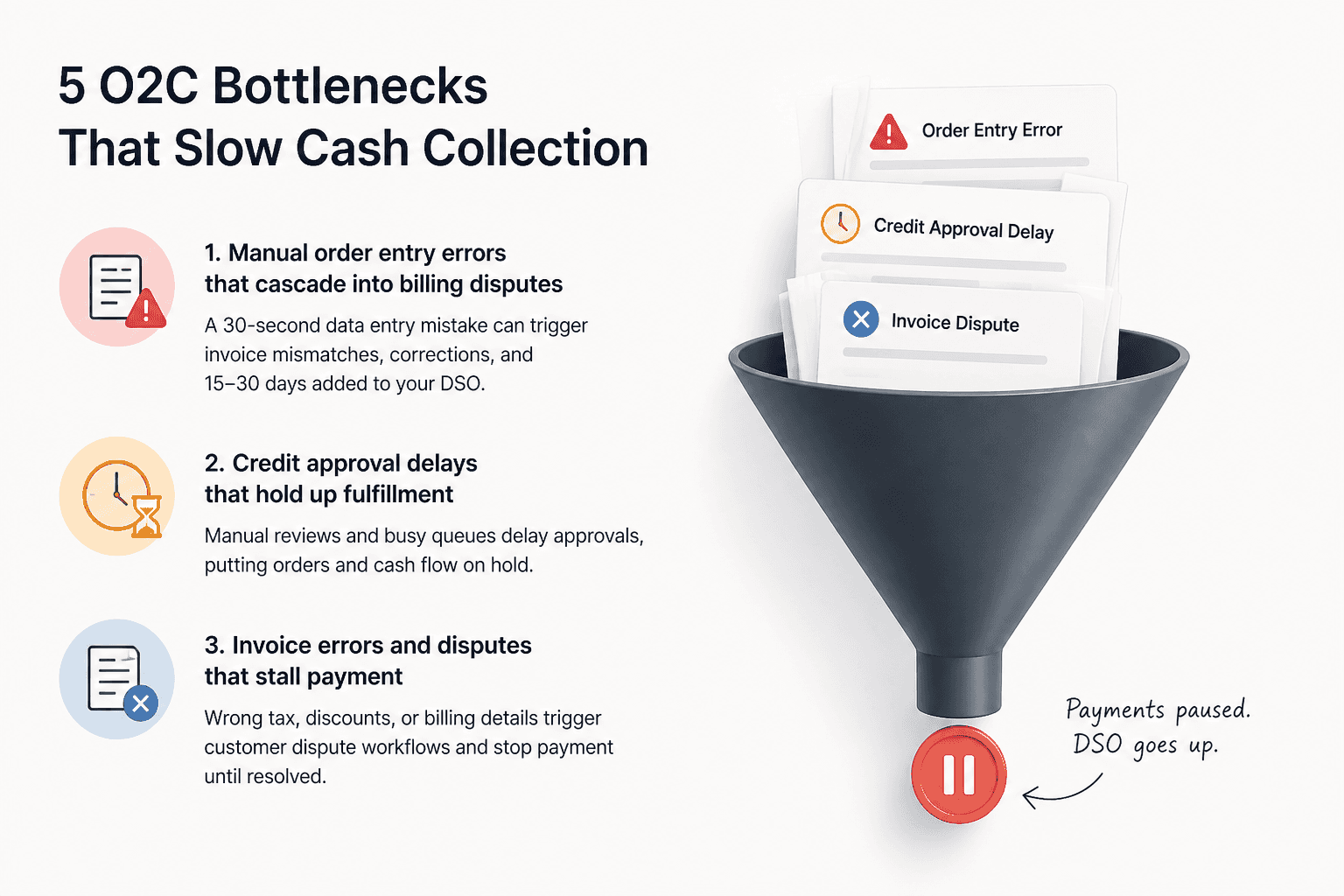
5 O2C Bottlenecks That Slow Cash Collection
Knowing the stages and tracking the KPIs only helps if you can identify the specific points where your process loses time. These five bottlenecks are the most common causes of extended DSO and strained collections teams.
Manual order entry errors that cascade into billing disputes
When order data is typed in by hand, transposition errors in PO numbers, pricing, or quantity fields are routine. The customer receives an invoice that does not match their purchase order. They put payment on hold and request a correction. That correction process, issuing a credit memo and reissuing the invoice, can add 15 to 30 days to your DSO on a single transaction. The root problem was a 30-second data entry mistake.
Credit approval delays that hold up fulfillment
Many mid-market businesses run credit checks through a manual review workflow. A credit analyst has to pull the account history, compare it against a limit, and email an approval to the order desk. When that analyst is handling 40 accounts or is out of office, approvals sit in a queue. Fulfillment cannot start, the customer waits, and your team fields calls about a delay that has nothing to do with product availability.
Invoice errors and disputes that stall payment
An invoice sent with incorrect tax treatment, misapplied discounts, or the wrong billing address is not just an inconvenience. For enterprise customers running their own AP processes, it triggers a formal dispute workflow on their end. Payment stops until the dispute is resolved. If your team does not have a structured dispute resolution process with clear ownership and turnaround SLAs, that invoice can age past 60 or 90 days before it is corrected and reissued.
Siloed systems with no shared visibility between teams
Order management runs in one system. Finance tracks invoices in another. Collections works from a spreadsheet. Nobody has a single view of where a specific order stands across the full cycle. When a customer calls to ask why they received a collections notice on an invoice they already paid, your team has to check three systems before they can answer. That coordination overhead is not just frustrating. It means exceptions take hours to resolve instead of minutes.
Teams running O2C across disconnected tools face a coordination problem that dashboards alone cannot fix. Predflow builds AI agents that map your O2C process first, then handle handoffs across your existing ERP, CRM, and billing systems without requiring manual intervention at each step. When a disputed invoice or partial payment triggers an exception, the agent flags it with context so your team can act immediately rather than investigate from scratch.
Unstructured collections follow-up with no priority logic
When collections runs on generic email reminders sent by due date rather than by risk or account value, your team spends the same effort on a 500-dollar overdue invoice as a 50,000-dollar one. High-value accounts at risk of becoming bad debt get a standard reminder while your collectors are triaging low-priority items. A structured collections process uses payment history, account value, and days overdue together to determine which accounts need immediate personal outreach and which can stay on an automated sequence.
How to Reduce O2C Cycle Time Without Adding Headcount
For operations leaders under pressure to improve cash flow without growing the team, the question is not whether to automate but where to start. CFOs are prioritizing cash discipline and cost control simultaneously, and mid-market teams adopting O2C automation are responding to that pressure directly. The right sequencing matters more than the volume of tools you deploy.
Start with process mapping before selecting tools
Before buying software, document how your O2C cycle actually runs today, not how it is supposed to run. Identify every manual handoff, every approval step that requires human judgment, and every point where data moves between systems. Most teams discover three or four steps where work stops completely while someone waits for input from another team. Those are your highest-priority automation targets.
Automate invoice generation and delivery first
Invoice automation has the fastest and most direct impact on DSO. When invoices generate automatically from confirmed shipment data and deliver to the customer the same day, you remove two to five days from the collection timeline on every transaction. It also eliminates the class of errors that come from manual data transfer between fulfillment and billing.
Use rules-based routing to eliminate credit approval queues
Most credit decisions are not genuinely complex. Customers within their limit with a clean payment history should receive automatic approval. Only exceptions, new customers, customers over their limit, or accounts with disputes, should require analyst review. Rules-based routing removes the queue entirely for standard cases and frees your credit team to focus on the decisions that actually require judgment.
Apply AI-assisted cash application to cut reconciliation time
AI-assisted cash application reads remittance data, matches payments to open invoices, and flags exceptions for human review rather than requiring a human to handle every transaction. Teams that move from manual cash application to AI-assisted matching typically see significant reductions in unallocated cash balances and AR aging report inaccuracies.
Build human oversight checkpoints for exceptions and disputes
Automation does not mean removing humans from the process. It means removing humans from repetitive, rules-based tasks so they can focus on exceptions that require judgment. Build clear checkpoints where your team reviews flagged disputes, approves high-risk credit decisions, and resolves unmatched payments. This keeps your team in control of the process without requiring them to monitor every transaction manually.
Frequently Asked Questions
What does O2C stand for in business?
O2C stands for order-to-cash. It refers to the complete business process that begins when a customer places an order and ends when payment is received and applied to the correct invoice. The process includes order management, credit approval, fulfillment, invoicing, collections, and cash reconciliation.
What is the difference between O2C and P2P processes?
O2C (order-to-cash) manages the sell side: receiving orders from customers, fulfilling them, invoicing, and collecting payment. P2P (procure-to-pay) manages the buy side: purchasing goods or services from suppliers, receiving them, and processing the supplier invoice for payment. Both affect working capital but from opposite directions.
Which O2C stage causes the most cash flow delays?
Invoicing and collections are the two stages most likely to extend DSO. Invoice errors trigger disputes that freeze payment, while unstructured collections follow-up allows overdue accounts to age without resolution. The root cause is frequently a data error in order management that does not surface until billing.
What is a good DSO benchmark for the O2C process?
DSO benchmarks vary by industry and payment terms. Rather than targeting a universal number, track your own trend over consecutive periods. A rising DSO across three or more periods signals that a specific stage in your O2C cycle is deteriorating. Identify which stage before assuming collections is the problem.
Can small or mid-sized businesses benefit from O2C automation?
Yes. Mid-market and SMB businesses often see faster returns from O2C automation because their teams carry more manual workload per person. Automating invoice generation and cash application in particular delivers measurable time savings without requiring a full enterprise technology stack. Start with the two or three steps consuming the most manual hours.
Conclusion
You now know where O2C breaks, which numbers expose it early, and which automation investments pay off fastest. The cost of leaving those bottlenecks in place is not abstract. Every month with manual order entry, siloed systems, and unstructured collections is another month of inflated DSO, overworked AR staff, and cash that sits unrealized in your pipeline.
As CFO expectations for predictable cash outcomes rise and mid-market automation adoption accelerates, the gap between teams running manual O2C and those running structured, automated workflows will widen. Waiting for a system overhaul is not a strategy. The teams gaining ground now are fixing one stage at a time, starting with the handoffs that cost them the most.
If your O2C process relies on manual handoffs or disconnected tools, see how Predflow maps and automates your workflow end-to-end, without replacing the systems your team already uses.
Bring 20 NetSuite bills to a 30-minute teardown
We will walk your actual invoices through capture, 3-way match and posting on the call, and tell you which steps an agent can take over. No prep beyond the PDFs.
FAQ
Frequently asked questions
What exactly is an AI agent
An AI agent is an autonomous system designed to handle specific business tasks end-to-end. Unlike simple chatbots, AI agents can reason, take actions, integrate with tools, and follow defined workflows.