Supply Chain
6 Marg Software Solutions Compared
Outgrowing Marg ERP? 6 alternatives compared, from Tally Prime and Zoho Inventory to SAP Business One and NetSuite, on automation and switching cost.

Gautam Borad
Founder, Predflow

Your supply chain team uses Marg software solutions for billing and inventory. Every report balances. Every invoice gets raised. And every time a purchase order needs to move into procurement review, someone copies a row into a spreadsheet and sends a message on WhatsApp.
That is the gap this article addresses.
Marg ERP 9+ has earned its position over 21 years and across more than 10 lakh users, particularly for small retailers and distributors who need affordable, reliable billing software in India. The on-premise architecture is stable, the distributor modules are practical, and the cost is hard to argue with at that scale.
But supply chains that span multiple locations, multiple teams, or multiple systems run into a structural problem. Marg’s module-by-module design means every handoff between billing, procurement, and operations still requires a human trigger. That is not a configuration issue. It is an architectural one.
This article compares six alternatives evaluated against four criteria: workflow automation depth, integration breadth, edge-case handling, and total operational cost. Each option is assessed for the specific supply chain teams most likely to benefit from it.
Why Supply Chain Teams Outgrow Marg Software Solutions
Marg ERP 9+ is not a flawed product. It does what it was designed to do. The problem is that supply chain operations eventually demand more than any single-module billing and inventory tool can deliver natively.
Where Marg ERP 9+ genuinely delivers value
For single-location distributors and small retailers, Marg ERP 9+ covers the core: inventory tracking, GST billing, and basic accounting. It is low-cost, widely supported, and available across most Indian cities. For a business running straightforward buy-sell-distribute cycles, it handles daily operations reliably.
The three workflow gaps that emerge at supply chain scale
First, cross-system automation is absent. When an invoice is raised in Marg, the next step in procurement or operations does not trigger automatically. Second, real-time process visibility across departments is not native. Third, the on-premise architecture means integrations with cloud platforms, e-commerce channels, or modern procurement tools require custom workarounds. The platform’s reliance on DBF file structures and the manual steps required to resolve syntax or program errors reflect a legacy foundation that was not built for distributed, multi-system workflows.
Signs your team has hit the ceiling
If your team spends time each day manually moving data between Marg and another system, or if a delayed supplier follow-up has ever caused a stockout or payment dispute, the tool is not failing. The process design is failing around it.
Marg ERP 9+ handles well | Marg ERP 9+ does not cover natively |
|---|---|
GST billing and invoicing | Cross-system workflow automation |
Inventory and stock management | Real-time process visibility across teams |
Distributor and retailer modules | Cloud-native integrations |
Low total cost of ownership | Contextual edge-case handling |
Wide support network in India | Automated exception routing |
The Decision Framework: What to Look for in a Marg Software Solutions Alternative
Before reviewing any alternative, define what you are actually buying. Most supply chain teams switch tools and recreate the same fragmentation problems in a new interface. Evaluating on these four criteria prevents that.
End-to-end workflow automation vs. module-by-module coverage. Can the system move a process from purchase order to invoice reconciliation without a human trigger at each handoff? Manual handoffs are where time and accuracy disappear.
Integration depth with existing billing and procurement tools. Does the platform connect to the systems your team already uses, or does it require you to replace everything at once? Deep integration preserves existing workflows while eliminating gaps.
Human oversight and edge-case handling. When an invoice does not match a PO or an approval stalls, does the system flag it and route it correctly, or does it silently fail? Process visibility determines whether exceptions get resolved or buried.
Total cost including implementation and staff overhead. Licensing fees are visible. The cost of a broken process, extra headcount to manage handoffs, and implementation time are not always calculated upfront. Include them.
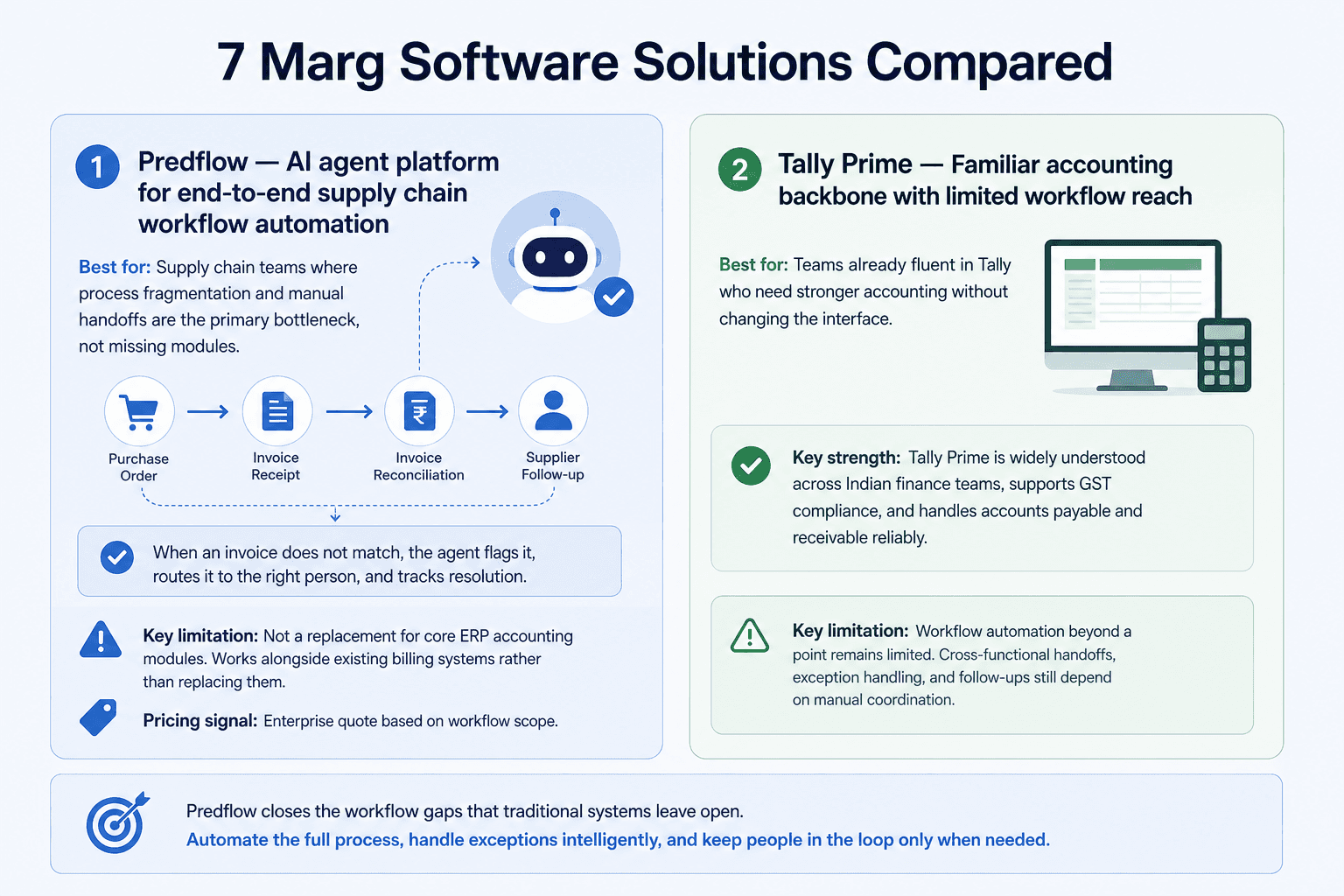
6 Marg Software Solutions Compared
1. Tally Prime — Familiar accounting backbone with limited workflow reach
Best for: Teams already fluent in Tally who need stronger accounting without changing the interface.
Key strength: Tally Prime is widely understood across Indian finance teams, supports GST compliance, and handles accounts payable and receivable reliably. The transition from Marg is relatively low-friction for finance staff.
Key limitation: Workflow automation beyond accounting is minimal. Cross-department handoffs in procurement and operations still require manual coordination. It solves the billing gap but not the process visibility gap.
Pricing signal: Starts at approximately INR 18,000 per year for a single user.
2. Zoho Inventory — Cloud-native inventory with strong integration ecosystem
Best for: Growing distributors and e-commerce-linked supply chains that need multi-channel inventory sync.
Key strength: Zoho Inventory connects natively with Zoho Books, Shopify, Amazon, and other platforms. Cloud-native architecture means real-time stock updates across locations without on-premise sync delays.
Key limitation: The broader Zoho suite requires purchasing multiple modules for full supply chain coverage. Workflow automation is available but rule-based, not contextually intelligent. Exceptions that fall outside preset rules still need human review.
Pricing signal: Free tier for small operations. Paid plans start around USD 59 per month.
3. SAP Business One — Enterprise-grade ERP for mid-market supply chains
Best for: Mid-size manufacturers and distributors ready to invest in a structured ERP implementation.
Key strength: SAP Business One covers procurement, inventory, sales, and financials in one system. Integration with supplier networks and warehouse management is deeper than most alternatives at this tier.
Key limitation: Implementation timelines and costs are significant. Teams without dedicated IT resources or an implementation partner will struggle with setup. It is enterprise software with enterprise complexity.
Pricing signal: Starts around USD 3,000 to USD 5,000 per user for perpetual license. Cloud versions available.
4. Unicommerce — E-commerce and omnichannel supply chain focus
Best for: Brands and distributors running parallel e-commerce and offline supply chains.
Key strength: Unicommerce handles multi-channel order management, warehouse operations, and returns processing with integrations across major Indian and global marketplaces. Purpose-built for the complexity of omnichannel fulfillment.
Key limitation: Strong on the e-commerce and logistics side. Financial management and accounts payable depth are limited. Teams still need a separate accounting tool alongside it.
Pricing signal: Custom pricing based on order volume and warehouse locations.
5. Vyapar — Mobile-first billing and inventory for small distributors
Best for: Small distributors and retailers who want a simpler, mobile-accessible alternative to Marg ERP 9+ without adding complexity.
Key strength: Vyapar is lightweight, GST-compliant, and runs on mobile and desktop. For businesses that found Marg useful but want a cleaner interface and offline capability, Vyapar is a direct lateral move.
Key limitation: Not designed for supply chain operations beyond single-entity billing and inventory. No meaningful workflow automation or cross-system integration. Scaling beyond a small operation will require switching again.
Pricing signal: Free tier available. Paid plans start around INR 1,799 per year.
6. Oracle NetSuite — Scalable cloud ERP for complex multi-entity operations
Best for: Supply chains operating across multiple legal entities, geographies, or currencies.
Key strength: NetSuite handles multi-subsidiary consolidation, advanced procurement, and financial reporting in one cloud platform. It scales from mid-market to large enterprise without requiring a platform change.
Key limitation: Implementation cost and time are high. Requires experienced NetSuite partners to configure correctly. The per-user licensing model makes it expensive for large operational teams.
Pricing signal: Enterprise quote only. Typically starts above USD 30,000 per year including implementation.
Head-to-Head: Marg Software Solutions vs. Top Three Alternatives on Workflow Automation
The right alternative depends on which of the three workflow failures is costing your team the most time each week.
Automation depth: handling exceptions without human intervention
Marg ERP 9+ has no native exception routing. When a PO does not match an invoice, a person resolves it manually. Cloud alternatives like Zoho Inventory offer rule-based triggers. AI agent platforms handle exceptions contextually, routing based on what the exception actually is.
Integration breadth: connecting billing, procurement, and operations
Marg integrates primarily within its own module ecosystem. Cloud-native alternatives connect to external platforms via APIs. The practical difference is whether your procurement tool, your e-commerce channel, and your warehouse system can share data without an export-import cycle.
Cost of a broken process: what manual fallback actually costs per week
A single stalled invoice approval that takes two hours to resolve manually, repeated three times a week across a team, equals roughly 300 hours per year on one failure point. Most operations have several such points running simultaneously.
Criteria | Marg ERP 9+ | Your shortlisted alternative |
|---|---|---|
Exception handling without human trigger | Manual | [Evaluate against your top 3 gaps] |
Cross-system integration breadth | Limited, on-premise | [Check API depth and native connectors] |
Cost of a broken process per week | High: manual fallback for most exceptions | [Estimate your current manual hours] |
If your primary pain is billing accuracy and GST compliance, Tally Prime or Zoho Books is the right move. If your primary pain is process fragmentation and exceptions falling through, that is an automation problem that ERP modules alone will not fix.
How to Migrate Away from Marg Software Solutions Without Disrupting Operations
The most common migration mistake is switching tools before documenting handoff points. Teams reproduce the same fragmentation in the new system because the underlying workflow was never mapped. The new tool inherits the same gaps.
Phase 1: Map your current workflows before touching any software
Document every step from purchase order creation to supplier payment, including who triggers each step and what happens when it stalls. This mapping phase reveals where the real bottlenecks live. Most teams discover the problem is not in the software but in the handoff between two systems or two people.
Phase 2: Run the new system in parallel on one process first
Choose one workflow, such as invoice matching, and run it through the new system alongside Marg for 30 days. Compare accuracy, time, and exception frequency. Parallel running contains the risk while generating real evidence for the full migration decision.
Phase 3: Cut over billing and inventory with a rollback trigger
Define a rollback condition before cutover: if error rates exceed a specific threshold in the first two weeks, revert to Marg for that process. This removes the irreversibility fear that keeps teams on legacy tools longer than necessary. Software lifecycle management works best when transitions are treated as controlled experiments, not one-way doors.
Frequently Asked Questions
Is Marg software solutions suitable for supply chain management beyond retail distribution?
Marg ERP 9+ works well for single-location retail and distribution operations where billing, inventory, and basic accounting cover the full workflow. Once supply chains expand to multiple locations, automated procurement cycles, or cross-system data flows, the on-premise architecture and module boundaries create coordination gaps that the software was not designed to resolve.
What is the main difference between Marg ERP 9+ and cloud-based alternatives?
Marg ERP 9+ is an on-premise system, which means data lives locally and integrations with external platforms require custom development. Cloud-based alternatives connect to other tools via APIs in real time, enabling automated data flow across billing, procurement, and operations without manual export-import cycles.
Can Marg software solutions integrate with modern procurement or e-commerce platforms?
Native integrations are limited. Some third-party connectors exist, but they typically require manual configuration and ongoing maintenance. Teams running active e-commerce channels or cloud procurement platforms generally find that maintaining these connections adds overhead rather than reducing it.
How much does it cost to switch from Marg ERP to an alternative system?
Direct licensing costs vary widely, from free tiers on tools like Vyapar and Zoho to enterprise quotes on SAP or NetSuite. The less visible costs are implementation time, staff retraining, data migration, and the operational disruption during transition. A phased migration approach reduces these costs by keeping existing workflows live while the new system is validated on one process at a time.
What type of business gets the most value from AI-powered workflow automation over traditional ERP?
Businesses where the bottleneck is not missing features but broken handoffs benefit most. If your team loses time because approvals do not route, invoices do not match, or supplier follow-ups fall through, adding more ERP modules does not solve the problem. AI-powered workflow automation addresses the coordination layer between systems, which is where most of that time disappears.
Conclusion
If your team is under 20 people running a single-location distribution operation, Marg ERP 9+ or Vyapar is likely still the right fit. Do not switch tools to solve a problem you do not yet have.
If you are losing hours each week to manual handoffs between billing, procurement, and operations, moving to a cloud-native alternative with deep integration capability is the right next step. If exceptions and edge cases are the real bottleneck, that is an automation problem. No ERP module resolves it. The right alternative is not the one with the most features. It is the one that eliminates the specific handoff where your team loses time today.
See how Predflow maps and automates supply chain workflows. Book a 20-minute process audit to identify your top three manual handoffs.
Bring 20 NetSuite bills to a 30-minute teardown
We will walk your actual invoices through capture, 3-way match and posting on the call, and tell you which steps an agent can take over. No prep beyond the PDFs.
FAQ
Frequently asked questions
What exactly is an AI agent
An AI agent is an autonomous system designed to handle specific business tasks end-to-end. Unlike simple chatbots, AI agents can reason, take actions, integrate with tools, and follow defined workflows.