PERFORMANCE MARKETING
Retail Deduction and Chargeback Recovery: How US Brands Stop Losing Margin to Short-Pays
Discover how chargeback software stops retail short-pays from eroding your margin—compare top tools and reclaim deductions your team never had time to fight.

Sanya Shah
Co-founder at Predflow
![Editorial illustration for AI Voice Bots: How They Work and How to Build One [2026]](https://framerusercontent.com/images/plJ2H4kcK3ZFNPQ5pIiMGp1VJhw.png?width=1536&height=1024)
Your AR team is cross-referencing retailer deduction codes in spreadsheets, submitting disputes one by one, and still writing off 30 to 40% of deductions as unrecoverable. Not because those claims are valid. Because the team ran out of bandwidth before they could build the case.
This is the invisible margin problem hiding in every retailer invoice. Finance and ops professionals consistently report that most deduction write-offs are not legitimate. They are abandoned because the dispute process is too manual and too time-consuming to justify the recovery amount per claim. The math works against recovery before the work even starts.
Chargeback software changes that math. This article covers how retailer deductions actually drain margin, what capable deduction management software does differently, a step-by-step recovery workflow, and a comparison framework for choosing the right tool for your operation.
Why Retailer Deductions and Chargebacks Are a Structural Margin Problem
This is not a billing error problem. It is a process failure built into how retailers communicate compliance expectations, and it compounds every quarter your team spends more time logging than recovering.
The difference between a retailer chargeback and a vendor deduction
A retailer chargeback is a penalty assessed for failing to meet a specific compliance requirement: wrong label placement, late shipment, incorrect pallet configuration. The retailer deducts it from your invoice payment automatically.
A vendor deduction is broader. It covers any short-pay a retailer takes against an invoice, including promotional allowances, shortage claims, and pricing disputes. Not all deductions are chargebacks, but all chargebacks create deductions.
Understanding the distinction matters because the dispute process differs. Chargebacks typically require proof of compliance. Shortage claims require proof of delivery. Conflating the two leads to rejected disputes and wasted team hours.
Where margin actually disappears: short-pays, compliance fees, and invalid deductions
The three most common retailer deduction categories are:
Category | Definition | Typically Disputable? |
|---|---|---|
Compliance chargebacks | Penalties for violating routing, labeling, or packaging requirements | Yes, if you have documentation |
Promotional deductions | Allowances tied to agreed trade spend or promotional programs | Sometimes, if the terms were misapplied |
Shortage claims | Retailer claims fewer units were received than invoiced | Yes, with POD and carrier confirmation |
Shortage claims are the most frequently invalid and the least frequently disputed. Without automated matching against proof-of-delivery records, teams cannot build the case fast enough to recover before the retailer's dispute window closes.
Why manual AR deduction workflows create a recovery ceiling
AR teams handling retail deduction management manually hit a ceiling that has nothing to do with skill. The volume of Amazon Vendor Central chargebacks alone can run into hundreds of claims per month, each requiring individual login, code lookup, documentation pull, and dispute submission.
YouTube walkthroughs of Amazon Vendor Central show AR teams logging dispute codes one by one across multiple portal sessions. That process does not scale. When claims are small and volume is high, the cost of dispute preparation exceeds the recovery value per claim, which is precisely why so many get written off.
Expert practitioners note that fully managed deduction resolution requires real-time monitoring and integration across systems, not a single portal. Without that, the recovery ceiling stays fixed regardless of how many hours the team puts in.
What Chargeback Software Actually Does — and What Most Tools Miss
What does chargeback management software do? Chargeback management software ingests retailer deduction data from portals, EDI feeds, and invoices, then automatically matches each deduction to its supporting documentation. It classifies claims by validity, files disputes with the required backup attached, and surfaces trend analytics so teams can identify which deduction types are recurring and preventable.
Core capabilities: ingestion, matching, dispute filing, and analytics
Effective AR deduction management software handles four functions. First, it pulls deduction data from every retailer portal your team currently logs into manually. Second, it matches each claim against purchase orders, ASNs, and proof-of-delivery records without human intervention. Third, it routes invalid deductions into dispute queues with documentation already attached. Fourth, it tracks dispute outcomes over time so win-rate trends can inform future prevention rules.
Teams using capable deduction management solutions stop spending hours on data gathering. They spend time only on claims that genuinely need judgment.
The gap most deduction management solutions leave open: edge cases and context
Rule-based deduction management systems work well when claims fit clean, predictable codes. They break down on the claims that do not. A shortage deduction with partial delivery confirmation, a compliance chargeback where the retailer applied the wrong code, a promotional deduction tied to an expired agreement. These edge cases are where most recovery opportunity sits, and most tools route them back to the team unsolved.
A common mistake in accounts receivable deduction management is treating the software as a closed loop when it is actually leaving the hardest claims on the table. The tool resolves the easy ones and the team still owns the rest.
SAP deduction management and ERP-connected tools: where they help and where they fall short
SAP deduction management handles structured, high-volume deduction processing well inside an ERP environment. The SAP deduction management component integrates with financial workflows and maintains audit trails that enterprise teams need for compliance.
The limitation is flexibility. SAP-native tools require significant customization to handle promotional and shortage disputes, which do not follow the same structured logic as compliance chargebacks. For mid-market brands without a dedicated SAP configuration team, that customization cost is a barrier. ERP-connected tools are powerful but often built for structured data, not the messy reality of retailer short-pays.
How to Build a Deduction Management Process That Actually Recovers Margin
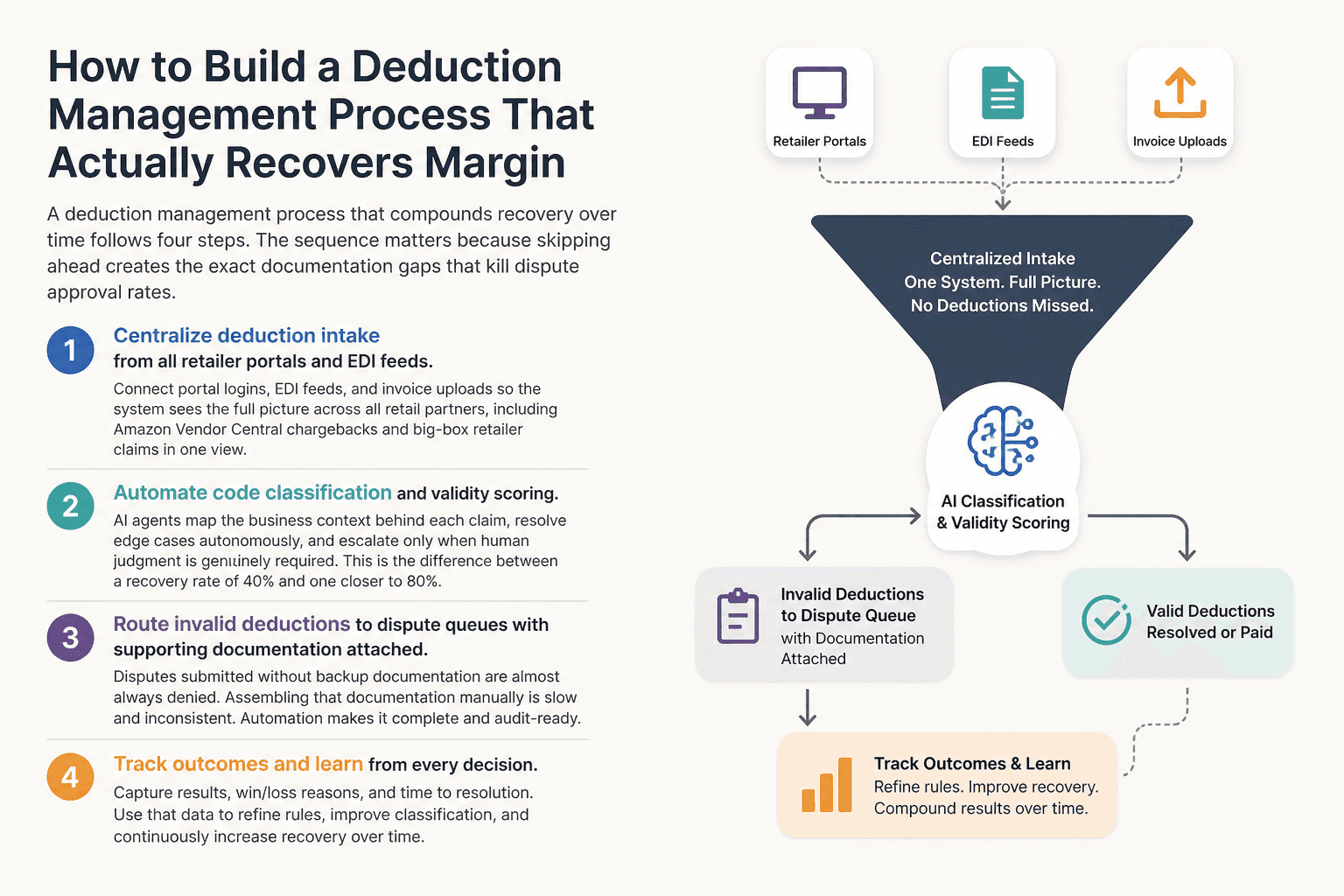
A deduction management process that compounds recovery over time follows four steps. The sequence matters because skipping ahead creates the exact documentation gaps that kill dispute approval rates.
1. Centralize deduction intake from all retailer portals and EDI feeds.
Pull every deduction into a single system before any classification happens. Fragmented intake means claims fall through the cracks at the source. Connect portal logins, EDI feeds, and invoice uploads so the deduction management system sees the full picture across all retail partners, including Amazon Vendor Central chargebacks and big-box retailer claims in one view.
2. Automate code classification and validity scoring.
Each deduction needs a validity score before it touches a human queue. Rule-based classification handles the clean cases. This is where most rule-based tools stall: when a deduction does not fit a clean code, the claim sits in a queue. Predflow's AI agents handle this differently. Instead of routing exceptions back to your team, they map the business context behind each claim, resolve edge cases autonomously, and escalate only when human judgment is genuinely required. For AR and ops teams already stretched thin, this is the difference between a recovery rate of 40% and one closer to 80%.
3. Route invalid deductions to dispute queues with supporting documentation attached.
Disputes submitted without backup documentation are almost always denied. Assembling that documentation manually is where team hours disappear. The process must attach the right proof automatically at the point of routing: POD for shortage claims, compliance records for chargebacks, signed agreements for promotional deductions. If a team member opens a dispute queue item and documentation is missing, the workflow has already failed.
4. Track dispute outcomes and feed win-rate data back into prevention rules.
Every resolved dispute is a signal. A chargeback you win three times in a row from the same retailer, using the same documentation, is a prevention rule waiting to be written. Deduction management services that track outcomes and surface these patterns turn recovery into a compounding process rather than a constant catch-up.
Ongoing monitoring of reason codes and chargeback ratios over time shifts the team from reacting to disputes individually toward preventing the conditions that generate them.
See how this played out in a real marketplace settlement reconciliation case study
Chargeback Software Comparison: Choosing the Right Fit for Your Operation
The right chargeback software depends less on feature lists and more on the operational profile of your AR team. Three profiles cover most US brands in retail.
For small AR teams: what to prioritize when volume is manageable but bandwidth is not
Small AR teams do not need the most powerful deduction management system. They need one that reduces the number of manual touchpoints per claim. Prioritize portal connectivity, auto-populated dispute templates, and a clean dashboard showing what is pending, what is filed, and what has been recovered.
Avoid tools that require heavy configuration before delivering value. A small team cannot absorb a six-month implementation while claims are still flowing in.
For mid-market CPG and retail brands: when rule-based tools hit their ceiling
CPG deduction management at mid-market scale means hundreds of claims per month across five to fifteen retail partners, each with different deduction codes, dispute portals, and documentation requirements. Rule-based tools handle the high-frequency, low-complexity claims well. They stall on everything else.
This is the profile where the gap between a 40% and 80% recovery rate is most visible. Edge cases are frequent enough to matter but too numerous for the team to handle manually. The right deduction management solution here needs genuine exception-handling intelligence, not just automated routing.
For enterprise operations: ERP integration, SAP compatibility, and audit trails
Enterprise retail deduction management requires ERP connectivity, often SAP deduction management component compatibility, and audit-ready dispute records. Volume is high, retailer relationships are complex, and compliance requirements are strict.
SAP-native tools are strong on structure but require customization for promotional and shortage disputes. Enterprise buyers should evaluate how much of that customization cost is absorbed by the vendor versus placed on internal IT.
Operational Profile | What They Need Most | Where Generic Tools Fail |
|---|---|---|
Small AR team | Simple intake, pre-built dispute templates | Too much configuration upfront |
Mid-market CPG/retail | Edge case handling, multi-retailer coverage | Stalls on non-standard deduction codes |
Enterprise with ERP | SAP integration, audit trails, compliance reporting | Limited flexibility for promotional disputes |
Deduction Management Best Practices That Compound Recovery Over Time
The most common mistake after implementing chargeback management software is stopping the audit. Teams assume the tool is running, disputes are filing, and the process is working. They stop reviewing dispute outcomes, and the feedback loop that would improve prevention never closes.
Treat win-rate data as a prevention signal, not a scorecard
A high win rate on shortage claims against a specific retailer means your documentation process for that retailer is strong. It also means the retailer keeps filing those claims. Winning disputes is not the same as eliminating the deduction. Use win-rate data to identify where upstream process changes would stop the claim from being filed at all.
Standardize documentation requirements before automating dispute filing
Automation accelerates whatever the documentation process is. If the process is inconsistent, the automation files incomplete disputes faster. Map what documentation each claim type requires for each retailer before configuring dispute automation. Accounts receivable deduction management best practices start with documentation standards, not software configuration.
Build a deduction reason code library specific to your top five retail partners
Deduction codes are not standardized across retailers. Walmart's code 24 means something different from Target's or Kroger's. A retailer-specific code library, mapped to dispute procedures and documentation requirements, reduces classification errors and speeds up dispute preparation. This library becomes more valuable over time as your team logs outcomes against each code.
FAQ
What is the difference between a chargeback and a deduction in retail?
A chargeback is a specific compliance penalty a retailer assesses for failing to meet routing, labeling, or packaging requirements. A deduction is any short-pay taken against an invoice, which includes chargebacks but also covers shortage claims, promotional allowances, and pricing disputes. All chargebacks create deductions, but not all deductions are chargebacks.
How does chargeback management software integrate with SAP or existing ERP systems?
Most enterprise-grade deduction management software connects to SAP via API or EDI, syncing deduction data with open invoice records and posting dispute resolutions back to the general ledger. The SAP deduction management component handles structured financial data well, but promotional and shortage disputes often require additional configuration. Confirm what customization is required before selecting a platform.
What recovery rate should we expect from deduction management software?
Recovery rates vary by industry, retailer mix, and documentation quality. Teams moving from fully manual processes to automated deduction management software typically see meaningful improvements in disputed claim resolution, particularly on shortage and compliance claims where documentation was previously assembled too slowly to meet dispute windows.
Can AI-based deduction management tools handle Amazon Vendor Central chargebacks?
Yes. AI-based deduction management systems can connect to Amazon Vendor Central, ingest chargeback codes, and match them against PO and ASN data to identify invalid claims. The value is in handling the volume of individual claims that AR teams cannot process manually within Amazon's dispute windows.
How long does it take to implement a deduction management system?
Implementation timelines depend on the number of retailer portals, ERP integrations, and documentation sources involved. Simple deployments with a small retailer set can go live in four to eight weeks. Enterprise implementations with SAP integration and multi-retailer coverage typically run three to six months. Process mapping before implementation reduces surprises and shortens the timeline.
The Decision in Front of Your AR Team
If your team is writing off more than 20% of disputed deductions as unrecoverable, that is not a staffing problem. It is a process and tooling problem. Adding headcount extends the ceiling slightly but does not remove it. The manual workflow still creates the same documentation gaps, the same missed dispute windows, and the same abandoned claims.
The alternative is a deduction management process that automates intake, classifies claims by validity, attaches documentation at the point of routing, and feeds dispute outcomes back into prevention rules. The team focuses on exceptions that need real judgment. The software handles the rest.
See how Predflow maps your deduction workflow before building anything. Request a process review to identify exactly where your current process is leaving recovery on the table.
Bring 20 NetSuite bills to a 30-minute teardown
We will walk your actual invoices through capture, 3-way match and posting on the call, and tell you which steps an agent can take over. No prep beyond the PDFs.
FAQ
Frequently asked questions
What exactly is an AI agent
An AI agent is an autonomous system designed to handle specific business tasks end-to-end. Unlike simple chatbots, AI agents can reason, take actions, integrate with tools, and follow defined workflows.