Finance
7 Bill.com Alternatives for High-Volume AP Teams (2026)
Outgrown Bill.com? Compare 7 alternatives built for high-volume AP teams dealing with complex workflows, manual handoffs, and rising costs in 2026.

Sanya Shah
Co-founder at Predflow

At 50 invoices a month, Bill.com does the job. At 500, it becomes the bottleneck. Finance teams that built their account payable process around Bill.com in earlier growth stages are now hitting the same wall: manual handoffs between systems, approval workflows that cannot handle complexity, and pricing that quietly compounds as the team grows.
That signal got louder in May 2026, when BILL announced an organizational restructuring. Even the company is recalibrating its priorities. For AP teams already feeling friction, that is a reasonable moment to ask whether the tool still fits.
This article is not a feature comparison dump. It is a framework for choosing the right replacement based on your invoice volume, ERP stack, and workflow complexity. Eight alternatives. Four decision criteria. One practical guide to get you from list to decision.
Why High-Volume AP Teams Hit a Wall with Bill.com
Bill.com was built as a bill payment tool. Teams that have grown beyond simple payment processing discover it was never designed to be the control layer for a complex AP workflow.
The invoice volume tipping point most teams miss
The cracks appear gradually. One common signal is bulk invoice uploads failing or taking excessive time to process. Another is payment reminders that require manual follow-up because the automation does not pace itself to your workflow. These friction points feel like minor inconveniences at low volume. At 400 to 600 invoices per month, they consume hours each week.
Where Bill.com approval workflows break under complexity
Bill.com approval logic is built primarily around invoice totals. When your team needs conditional routing based on department, cost center, project code, or vendor type, the tool forces workarounds. Limited line-item data capture compounds the problem: if the system cannot read what is on the invoice at a granular level, it cannot route it correctly. Invoice automation that relies on rigid rules breaks the moment your business adds a new entity, currency, or approval tier.
Why pricing becomes unpredictable as headcount and volume grow
Per-user fees plus per-payment fees plus add-ons for features you assumed were standard create a pricing structure that is hard to forecast. Growing teams face a specific trap: adding headcount to manage AP volume also adds software cost, so the economics of scaling do not improve. AP automation software should reduce cost per invoice as volume grows. Bill.com’s model often does the opposite.
If more than two of these feel familiar, you are not looking for a fix. You are looking for a replacement.
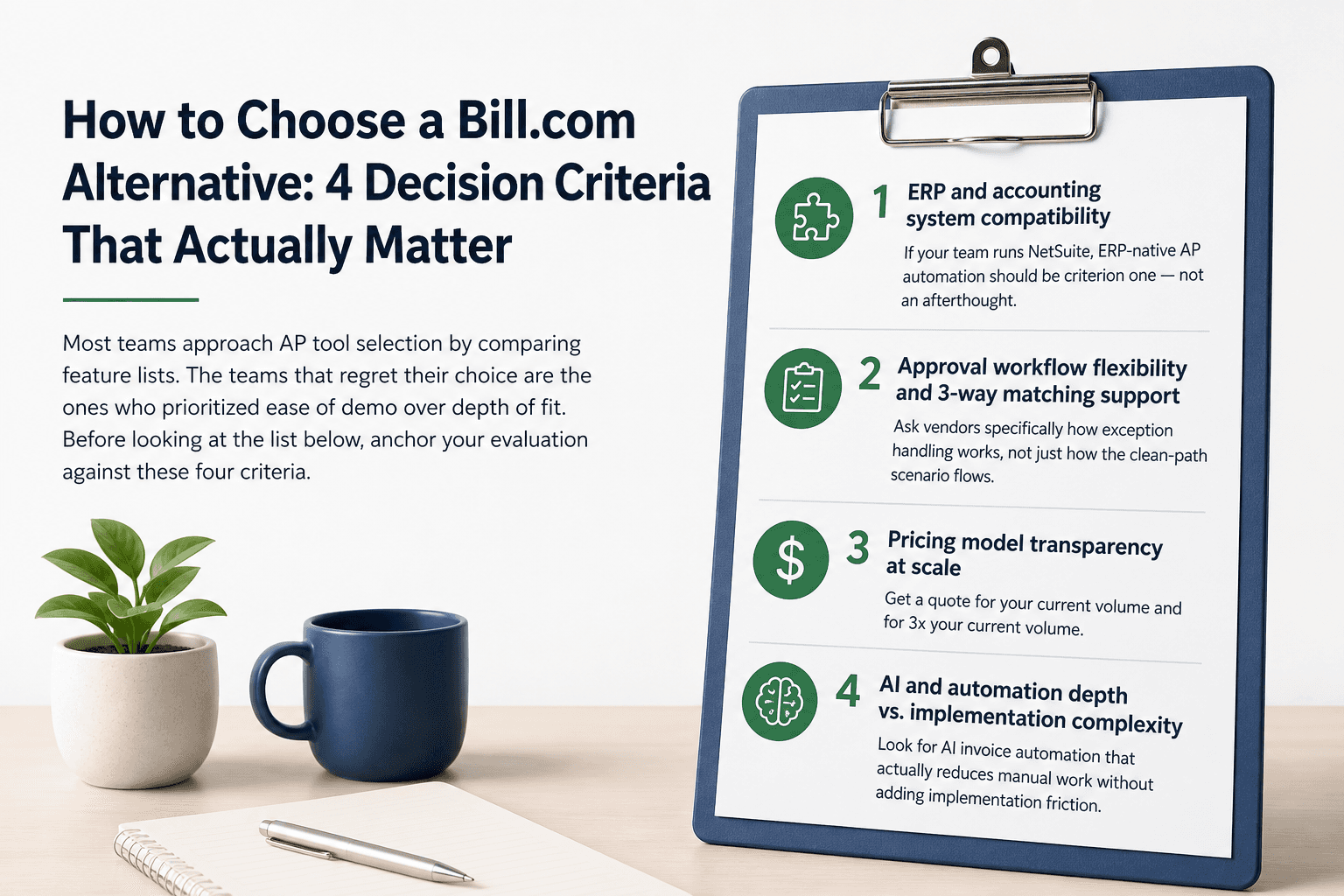
How to Choose a Bill.com Alternative: 4 Decision Criteria That Actually Matter
Most teams approach AP tool selection by comparing feature lists. The teams that regret their choice are the ones who prioritized ease of demo over depth of fit. Before looking at the list below, anchor your evaluation against these four criteria.
ERP and accounting system compatibility
Your AP tool lives downstream of your ERP. If the integration is clunky, data drifts, reconciliation breaks, and your team manually patches the gap. If your team runs NetSuite, ERP-native AP automation should be criterion one — not an afterthought. NetSuite AP automation built as a native module behaves differently from a third-party connector, and that difference shows up every time an invoice posts.
Approval workflow flexibility and 3-way matching support
3-way matching invoice processing — matching the purchase order, the receipt, and the invoice — is a baseline requirement for any team operating with purchase orders. Not every tool does this well, and fewer do it without manual intervention on exceptions. Ask vendors specifically how exception handling works, not just how the clean-path scenario flows.
Pricing model transparency at scale
Get a quote for your current volume and for 3x your current volume. If the pricing structure cannot give you a credible answer for both, you will face the same unpredictability you are trying to escape.
AI and automation depth vs. implementation complexity
AI invoice automation promises vary widely. Some tools automate data entry. Others automate the full workflow, including exception flagging, coding, routing, and ERP sync. The implementation complexity scales with the depth, so evaluate both together. A tool that takes six months to implement and requires dedicated IT support has a very different total cost than its license fee suggests.
Compare all 12 platforms side by side
7 Bill.com Alternatives Ranked for High-Volume AP Workflows
The best Bill.com alternative for high-volume AP teams depends on your ERP stack and workflow complexity: Tipalti leads for global payment volume, Stampli for approval complexity, and Centreviews for NetSuite environments.
1. Tipalti — Best for global, high-volume vendor payments
Tipalti handles mass payment processing across 196 countries with built-in tax compliance and supplier self-service. It fits finance ops teams managing hundreds of vendors across multiple currencies and entities. The onboarding process is thorough but time-intensive; teams report that initial supplier migration takes longer than expected. Pricing is enterprise-tier and typically requires a direct quote based on payment volume.
2. Stampli — Best for approval-centric teams with complex workflows
Stampli centers its product around the invoice itself, keeping all communication, approval activity, and coding in one place. It works well for teams whose primary pain is approval bottlenecks and audit trail gaps. The AI assistant, Billy the Bot, learns your coding patterns over time, but it requires a meaningful invoice history to reach useful accuracy. Pricing is mid-market and generally per-user with a base platform fee.
3. Airbase — Best for mid-market companies consolidating spend management
Airbase combines AP automation, expense management, and corporate cards into one platform. It suits finance teams that want to reduce tool sprawl while gaining control over total spend. The consolidated model means you are paying for capabilities you may not need if AP is the only problem you are solving. Pricing is tiered by company size and module selection.
4. SAP Concur Invoice — Best for enterprise teams already in the SAP ecosystem
Concur Invoice integrates natively with SAP ERP environments and handles high document volumes with structured approval chains. It fits large enterprises with dedicated IT and a preference for staying within the SAP ecosystem. Implementation complexity is high and typically requires a consulting partner. Licensing is enterprise-grade, negotiated by contract.
5. MineralTree — Best for controller-led AP with strong ERP integration
MineralTree focuses on the controller’s workflow: clean ERP posting, payment control, and audit-ready records. It integrates with over 70 accounting systems and works well for teams where the controller owns the AP process end-to-end. It does not cover procurement or spend management upstream. Pricing is based on invoice volume and ERP tier.
6. Centreviews (Medius) — Best for NetSuite-heavy finance operations
Centreviews, now part of Medius, was built with NetSuite integration as a core design principle rather than an add-on. For teams running netsuite ap automation, the two-way sync is more reliable than most third-party connectors. The platform handles 3-way matching and multi-entity processing without custom development. Pricing is quote-based, scaling with entity count and volume.
7. Coupa — Best for procurement-to-pay at enterprise scale
Coupa covers the full procurement-to-pay cycle, making it relevant when AP is part of a broader sourcing and compliance requirement. It is enterprise-first: implementation timelines are long, internal change management is significant, and the ROI case requires volume to justify the investment. For teams that only need AP automation, Coupa is typically more than necessary. Pricing is enterprise contract only.
Which Bill.com Alternative Is Right for Your AP Team? A Quick Decision Guide
Use this as a fast filter. Match your situation to the best-fit option without re-reading the full list.
If you run NetSuite and process 500+ invoices per month
Centreviews (Medius) is the most direct fit. The native NetSuite integration reduces reconciliation work and supports 3-way matching invoice processing without custom connectors. Unlike Bill.com, which was built as a bill payment tool and layers ERP sync on top, Centreviews treats NetSuite as the system of record from day one. MineralTree is the alternative if your controller wants tighter payment controls alongside the ERP integration.
If your biggest problem is approval workflow complexity
Stampli is built around this specific problem. Conditional routing, multi-level approvals, and full audit trails are core features, not add-ons. If your approval chains involve multiple departments, entities, or cost centers, Stampli handles the routing logic that Bill.com’s total-based approval model cannot support. Finance ops teams with heavy communication around invoice exceptions find the centralized invoice workspace reduces email volume significantly.
If you need global vendor payments at scale
Tipalti handles currency, tax documentation, and supplier self-service at a scale that most mid-market tools cannot match. If your account payable process involves cross-border vendors, regulatory compliance requirements, or mass payment runs, Tipalti’s infrastructure is built for that specific load. Budget extra time for onboarding; supplier migration is the longest part of the implementation.
If you want AI-native automation that handles the full AP lifecycle
Not all ai invoice automation is equivalent. Tools that automate data capture still leave exception handling, approval routing, and ERP posting to human coordination. If your team wants the full workflow automated — including the non-standard invoices, disputed line items, and multi-step approvals — a process-first AI approach is the deciding factor. This is the case where finance ops teams see the most direct reduction in manual handoffs.
Which threshold did you actually hit?
Volume, entity count, PO matching depth, exception rate, or ERP posting — the right move differs for each. Bring a month of invoice data and we will name yours in 30 minutes.
Frequently Asked Questions
What is the best Bill.com alternative for high-volume AP teams?
The best alternative depends on your ERP and workflow complexity. Tipalti leads for global payment volume, Stampli for approval-heavy workflows, and Centreviews for NetSuite environments.
Does Bill.com support 3-way matching for invoice processing?
Bill.com has limited 3-way matching invoice capability. It can match invoices to bills in its system, but true PO-receipt-invoice matching at the line-item level requires integrations or manual steps. Teams with purchase order workflows at volume consistently find this a meaningful gap.
Can Bill.com alternatives integrate with NetSuite?
Yes, most alternatives on this list integrate with NetSuite, but the depth varies. Centreviews (Medius) and MineralTree offer the tightest native NetSuite AP automation. Tools like Tipalti and Stampli connect via API or middleware, which works well but requires more configuration to avoid data drift.
How much does it cost to switch from Bill.com to another AP tool?
Direct licensing costs vary from roughly $500 per month for mid-market tools to enterprise contracts in the six-figure annual range. The real switching cost includes data migration, workflow remapping, vendor communication, and team training. Teams that underestimate implementation time typically add two to four months to the ROI timeline.
What is the difference between Bill.com and full AP automation software?
Bill.com is primarily a bill payment and approval tool with accounting system sync. Full AP automation software covers the complete lifecycle: invoice capture, line-item coding, exception handling, conditional approval routing, 3-way matching, and ERP posting. The difference matters most at high volume, where each manual step in the gap between payment and approval compounds into hours of weekly work.
Make the Call Before the Pain Compounds
Staying with Bill.com is defensible if your invoice volume is stable and your workflows are straightforward. But if the approval bottlenecks, manual handoffs, and pricing surprises from Section 1 describe your team’s current week, the cost of waiting is real. Every month of friction has a headcount cost attached to it.
The practical next step is not a full evaluation project. Pick two tools from the list above, map them against the four criteria in Section 2, and run a single pilot workflow through each. Teams that take that step rarely go back to the status quo.
If you want to see how Predflow maps and automates your existing AP workflow before replacing any tool, book a 20-minute process review. No demo script, just your actual workflow.
Bring 20 NetSuite bills to a 30-minute teardown
We will walk your actual invoices through capture, 3-way match and posting on the call, and tell you which steps an agent can take over. No prep beyond the PDFs.
FAQ
Frequently asked questions
What exactly is an AI agent
An AI agent is an autonomous system designed to handle specific business tasks end-to-end. Unlike simple chatbots, AI agents can reason, take actions, integrate with tools, and follow defined workflows.