Supply Chain
What Is the Account Payable Process? How It Works for Supply Chain Teams
Overdue invoices, lost approvals, and frustrated vendors — sound familiar? Here's how a well-run account payable process keeps your supply chain moving without the chaos.

Gautam Borad
Founder at Predflow

Three vendors are waiting on payment status. One invoice is five days overdue. Your team is searching through email threads trying to figure out where the approval is sitting. Nobody has a clear answer, and the vendor is starting to ask questions.
This is not a rare situation. It is what happens when the account payable process runs on manual handoffs, disconnected tools, and approvals that live in someone's inbox. Minor errors in data entry or invoice handling create late payments, strained supplier relationships, and compliance exposure that compounds quietly until it becomes a real problem.
This article breaks down exactly how the account payable process works, where each step typically fails for supply chain teams, and what a more reliable process design looks like.
What the Account Payable Process Actually Covers
The account payable process is the end-to-end workflow a business uses to receive, validate, approve, and pay vendor invoices. It is not just a department function. It is a sequence of steps that touches procurement, finance, and operations simultaneously.
The core steps: from invoice receipt to payment release
The standard AP workflow moves through six steps:
Invoice receipt — The business receives an invoice from a vendor, by email, portal, or mail.
GL coding — The invoice is assigned to the correct general ledger account and cost center.
PO matching — The invoice is checked against the original purchase order and goods receipt.
Approval routing — The invoice is sent to the right approver based on amount, department, or vendor.
Payment scheduling — The payment is queued based on due date and cash flow priorities.
Reconciliation — The payment is recorded, matched to the invoice, and logged for audit purposes.
Each step depends on the one before it. A problem at step one reaches step five with interest.
Where AP sits inside the broader finance ops cycle
AP sits between procurement and cash management. Procurement creates the obligation when a purchase order is issued. AP fulfills that obligation by ensuring the vendor gets paid accurately and on time. Finance ops uses AP data to forecast cash outflows, manage liabilities, and report on payment performance.
When AP runs well, the rest of finance ops has reliable data to work from. When it runs on manual processes, the downstream data is unreliable and the reporting reflects that.
Why supply chain teams carry more AP complexity than most
Supply chain operations typically manage higher invoice volumes, more active vendors, and tighter delivery timelines than other business units. A retailer with 200 suppliers processes a different AP load than a professional services firm with 15 vendors.
More vendors mean more invoice formats, more payment terms, and more exceptions. Every process gap that exists in a simple AP workflow gets multiplied across the supply chain context.
The Six Steps of the Account Payable Process — and Where Each One Breaks
Each step in the account payable process has a clear function. Each one also has a failure mode that most teams are already familiar with.
Step 1: Invoice receipt and data capture
What it does: The team captures invoice data, either manually by keying it in or through an OCR or intake tool.
Where it breaks: Manual data entry introduces errors at the source. Wrong amounts, incorrect vendor codes, and missing PO references flow directly into every step that follows.
Step 2: GL coding and cost allocation
What it does: Each invoice line is assigned to a general ledger code and cost center so the expense is reported correctly.
Where it breaks: When coding rules are not documented, different team members code the same type of invoice differently. This creates reporting inconsistencies that are hard to trace at month-end.
Step 3: Three-way PO matching
What it does: The invoice is matched against the purchase order and the goods receipt to confirm the quantity, price, and vendor all align.
Where it breaks: Discrepancies between any of the three documents create an exception. In manual workflows, exceptions go into a queue that no one owns clearly. An error introduced in step one almost always surfaces here as a matching failure.
Step 4: Approval routing and escalation
What it does: The invoice is routed to the appropriate approver based on predefined rules around amount, vendor, or department.
Where it breaks: Approval follow-up can consume up to 20% of an AP professional's time. Approvers miss emails, approval chains are unclear, and escalation paths do not exist until someone complains about a late payment.
Step 5: Payment scheduling and release
What it does: Approved invoices are queued for payment based on due dates, vendor terms, and available cash.
Where it breaks: When steps one through four introduce delays, payment scheduling becomes reactive. Teams pay late, miss early payment discounts, and damage vendor relationships that took years to build.
Step 6: Reconciliation and audit trail
What it does: Each payment is matched back to the original invoice and recorded with full documentation for audit and reporting purposes.
Where it breaks: Manual reconciliation relies on records that are scattered across email, spreadsheets, and ERPs. Gaps in documentation become compliance problems during audits. Incomplete records also make it nearly impossible to detect duplicate invoice submissions before payment goes out.
The failures are not isolated. A data capture error in step one creates a matching exception in step three and a payment delay in step five. The breakdown is cumulative.
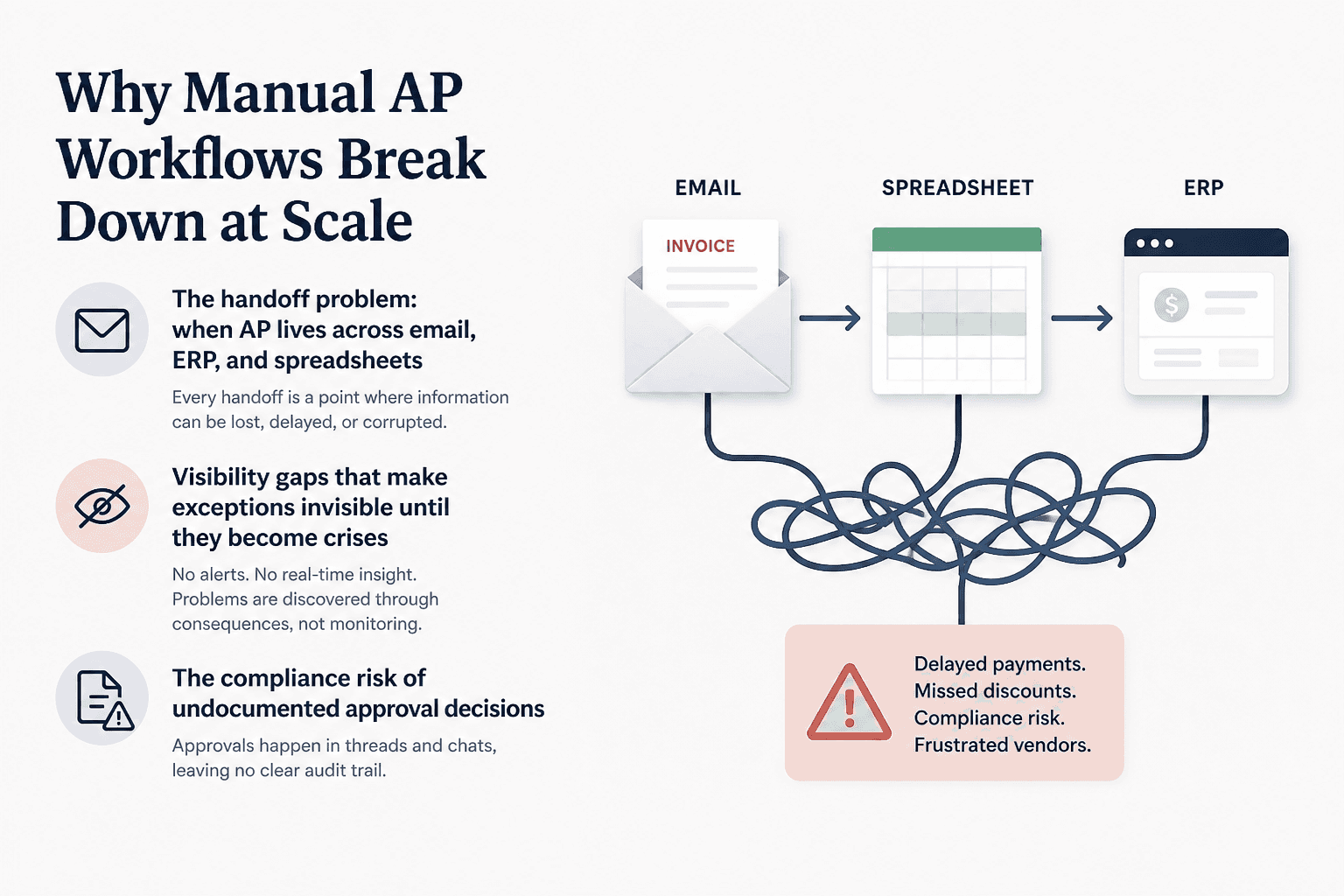
Why Manual AP Workflows Break Down at Scale
Manual AP failure is not a people problem. It is a process architecture problem. Teams that struggle with AP at higher volumes are not understaffed. They are running a process designed for low volume on a supply chain that has outgrown it.
The handoff problem: when AP lives across email, ERP, and spreadsheets
When invoice data moves between email, a spreadsheet tracker, and an ERP system through manual copy-paste steps, every handoff is a point where information can be lost, delayed, or corrupted. There is no single source of truth, so when a vendor asks about payment status, the honest answer is "let me check three places and get back to you."
Fragmented workflows also make training difficult. New team members learn the workarounds, not the process, because the workarounds are the process.
Visibility gaps that make exceptions invisible until they become crises
In a manual workflow, an invoice that is stuck at approval is invisible until someone notices the due date has passed. There is no alert, no escalation, and no dashboard showing where the bottleneck is sitting.
AP functions are now assessed not just by processing volume but by how reliably they protect cash, enforce compliance, and deliver visibility. A manual process cannot deliver that visibility because it was never designed to. The absence of real-time insight means problems are discovered through consequences, not monitoring.
The compliance risk of undocumented approval decisions
When approvals happen over email or verbal conversation, the audit trail is a thread buried in someone's sent folder. Missing purchase orders, unclear payment terms, and incomplete invoice data create documentation gaps that become serious problems during audits and regulatory reviews.
Fraud risk compounds this. Duplicate invoices and vendor fraud are harder to detect when records are fragmented. By the time a duplicate payment is flagged, the payment has often already cleared.
How Invoice Automation Changes the Account Payable Process
Invoice automation does not replace the six steps. It changes who handles each one and how exceptions are managed when something does not match.
What invoice automation handles without human input
Well-designed invoice automation handles data capture, GL coding based on predefined rules, and three-way PO matching without human intervention when documents align. Touchless invoice matching works reliably when validation rules are clearly defined and the incoming data is structured.
This removes the repetitive manual work from the process and routes clean invoices straight through to payment scheduling. Teams stop spending time on invoices that do not need their attention.
Where AI invoice automation adds exception-handling logic
The step that breaks most AP automation implementations is exception handling. Capturing a clean invoice is straightforward. Deciding what to do when a PO reference is missing, a price has changed, or a vendor has submitted a duplicate requires context that simple rules cannot cover.
AI invoice automation adds a layer that evaluates exceptions against policy thresholds, routes them to the right approver with full context attached, and flags patterns like recurring discrepancies from a specific vendor. Exception routing based on approval thresholds and policy logic turns a manual bottleneck into a managed workflow.
Real-time visibility into liabilities and scheduled payments, combined with embedded audit trails, closes the compliance gap that manual processes leave open.
What still requires human oversight — and why that is by design
Payment release decisions at certain thresholds, vendor relationship calls, and judgment calls on disputed invoices still belong with humans. A well-designed automated AP process makes those decisions faster and better-informed, not unnecessary.
The goal is not to remove humans from AP. It is to remove humans from the parts of AP that do not benefit from human judgment, so they can focus on the parts that do.
This is the gap Predflow is built for. Rather than layering automation tools onto an existing broken process, Predflow starts with process mapping, understanding exactly how your AP workflow runs before building agents to handle it. The agents manage routine steps end-to-end and route genuine exceptions to the right person with full context, so your team is not approving blindly or debugging a black box.
AP Process Best Practices Supply Chain Teams Should Implement Now
These practices apply regardless of your current tooling. They reduce AP risk and improve process control before any automation is introduced.
Standardize your PO and invoice intake before automating anything
Automation cannot fix an intake process where invoices arrive in five different formats with inconsistent data fields. Before implementing any tool, define a standard invoice format, enforce PO references on all vendor invoices, and document what a complete, approvable invoice looks like. This step alone reduces matching exceptions significantly.
Track due dates and payment terms at the process level, not the inbox level
Tracking invoice due dates is essential for managing cash flow and preventing late payments that harm supplier relationships. More importantly, structured tracking lets you identify early payment discount opportunities, which manual inbox management almost always misses. Move due date visibility out of individual inboxes and into a shared, queryable system.
Build exception escalation rules before an exception occurs
Most teams define escalation paths only after a payment is already late. Document who owns each exception type, what the escalation timeline is, and what information the approver needs before they are contacted. Pre-defined escalation rules turn a reactive scramble into a predictable workflow.
Review AP performance metrics regularly — not just at month-end
Regular AP process reviews should include analyzing invoices for errors, identifying bottlenecks, and checking compliance with payment policies. Reviewing only at month-end means problems compound for three to four weeks before anyone addresses them. Weekly visibility into exception rates, aging invoices, and approval cycle times catches issues while they are still fixable.
Frequently Asked Questions
What is the account payable process in simple terms?
The account payable process is the workflow a business uses to receive vendor invoices, verify them against purchase orders, get them approved, and release payment. It covers everything from the moment an invoice arrives to the moment the payment clears and is recorded in the financial system.
What is the difference between accounts payable and accounts receivable?
Accounts payable tracks money a business owes to vendors and suppliers. Accounts receivable tracks money owed to the business by its customers. AP is an outflow function. AR is an inflow function. Both affect cash flow and both require structured processes to manage accurately.
How does invoice automation reduce AP errors?
Invoice automation reduces errors by removing manual data entry from the process. Structured data capture eliminates keying mistakes, automated PO matching catches discrepancies before payment, and embedded audit trails ensure every approval decision is documented. Errors that make it through are flagged as exceptions rather than passed downstream silently.
What causes the most delays in the account payable process?
Approval routing is the most common source of delay. When approvers do not have clear ownership, context, or escalation timelines, invoices wait in queues indefinitely. Data entry errors that create matching exceptions at step three are the second most common source, because those exceptions often require manual investigation before the invoice can move forward.
Can small supply chain teams realistically automate AP?
Yes, but scope matters. Small teams benefit most from automating data capture, PO matching, and approval routing first. These steps consume the most manual time and introduce the most errors. Full end-to-end automation is achievable but works best when the underlying process is documented and standardized before any tool is introduced.
The Choice in Front of Your AP Team
If your team cannot answer "where is this invoice right now" in under 60 seconds, the AP process has a structural problem. Adding headcount patches the symptom. It does not fix the handoffs, the visibility gaps, or the compliance risk underneath.
The supply chain AP environment in 2026 demands more than processing volume. It demands proof of control. A manual process cannot deliver that at scale. The question is not whether to redesign the process. It is whether to do it now or after the next audit finding or late payment dispute forces the issue.
If your AP process is slowing down your supply chain, Predflow can map your current workflow and show you exactly where automation would have the most impact. Book a process review — no commitment, no generic demo.
Bring 20 NetSuite bills to a 30-minute teardown
We will walk your actual invoices through capture, 3-way match and posting on the call, and tell you which steps an agent can take over. No prep beyond the PDFs.
FAQ
Frequently asked questions
What exactly is an AI agent
An AI agent is an autonomous system designed to handle specific business tasks end-to-end. Unlike simple chatbots, AI agents can reason, take actions, integrate with tools, and follow defined workflows.