Supply Chain
3 Way Matching Invoice: What It Is, How It Works, and Why It Matters
One mismatched invoice can stall a vendor relationship for weeks. Here's how 3 way matching catches errors before payment clears — and why it matters for every AP team.

Khushbu Adav
Product at Predflow

An AP team processing 400 invoices a month has a problem that spreadsheets cannot fix. One mismatched invoice slips through, a vendor gets overpaid, and a reconciliation dispute stalls the relationship for weeks. The process designed to prevent exactly this is called 3 way matching. It cross-checks three documents before a single payment clears, and when it works, it stops overpayments, catches receiving errors, and gives auditors a clean paper trail.
Most finance teams know the concept. Fewer have a process tight enough to catch edge cases at volume. This article explains what 3 way matching is, how each step works, where manual processes fail, and what automation actually changes at the workflow level.
What Is a 3 Way Matching Invoice?
3 way matching invoice is a verification process in accounts payable where three documents must align before an invoice is approved for payment: the purchase order, the goods receipt note, and the supplier invoice. If all three documents agree on vendor, quantity, price, and totals, the invoice is cleared. If they do not, payment is held until the discrepancy is resolved.
This is the foundational control in the account payable process for any organization purchasing physical goods or contracted services at scale.
The Three Documents Involved: PO, GRN, and Invoice
Document | Created By | What It Confirms |
|---|---|---|
Purchase Order (PO) | Buyer / Procurement team | Authorized item, quantity, and agreed price |
Goods Receipt Note (GRN) | Warehouse / Receiving team | What was actually delivered and accepted |
Supplier Invoice | Vendor | What the vendor is billing for |
Each document represents a different point in the transaction. The PO captures intent. The GRN captures reality. The invoice captures the vendor's claim. Matching all three confirms the claim matches both intent and reality.
What Counts as a Match — and What Doesn't
A match means all three documents agree on vendor name, line-item descriptions, quantities, unit prices, and total amounts within an accepted tolerance. A mismatch occurs when any of those fields diverge beyond that tolerance. Common mismatches include a vendor billing for 100 units when only 92 were received, or an invoice price that differs from the negotiated PO rate. Both trigger an exception that must be resolved before payment.
How the 3 Way Matching Invoice Process Works Step by Step
Understanding the sequence helps teams identify exactly where their current account payable process loses control.
Step 1: Purchase Order Is Issued
The procurement team creates a PO and sends it to the vendor. The PO locks in the agreed quantity, unit price, and delivery terms. This document becomes the financial baseline for the entire transaction.
Step 2: Goods or Services Are Received and Documented
When the shipment arrives, the receiving team logs what was actually delivered and creates a goods receipt note. The GRN records accepted quantities and flags any damaged or missing items. Without this step, the process has no ground-truth record of what the company actually received.
Step 3: Supplier Invoice Arrives
The vendor submits an invoice requesting payment. The invoice enters the AP queue and is matched against the existing PO and GRN for that transaction.
Step 4: The Three-Document Comparison
This is the core control step. The AP team compares four key data points across all three documents: vendor name, line-item quantities, unit prices, and totals. All three documents must agree within the organization's tolerance range. A discrepancy on any field triggers an exception.
Step 5: Approval, Exception Handling, or Rejection
If all fields match, the invoice is approved and queued for payment. If there is a discrepancy, the invoice moves to a hold queue, dispute workflow, or escalation path depending on the type and size of the gap. Without a defined exception-handling process, invoices sit unresolved. A common mistake here is having no formal escalation path, so exceptions pile up in an individual approver's inbox with no visibility for anyone else. Vendors follow up, relationships strain, and late payment fees accumulate.
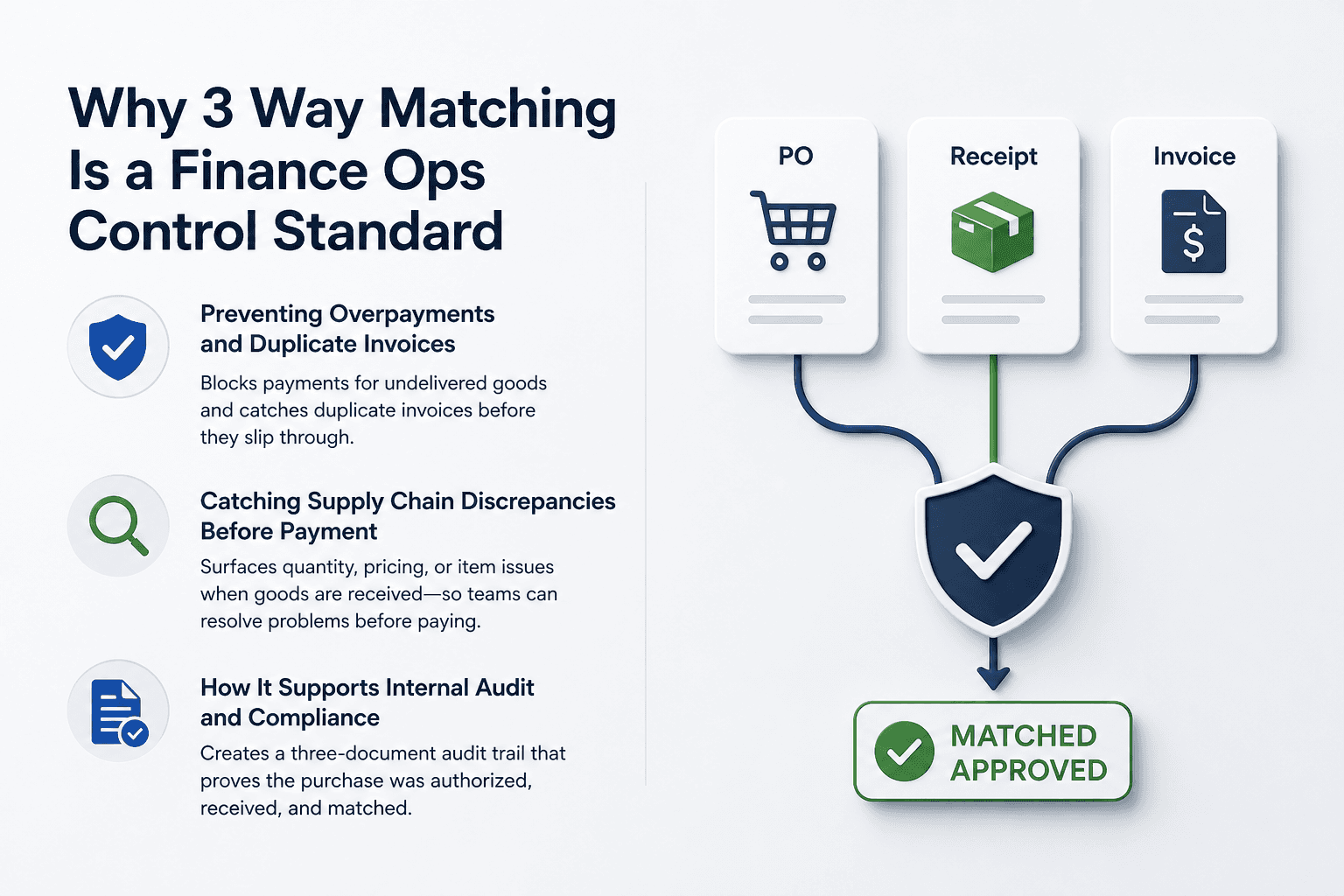
Why 3 Way Matching Is a Finance Ops Control Standard
Ensuring invoice accuracy is one of the most critical responsibilities in the account payable process. Without structured controls, AP teams face overpayments, delayed approvals, and exposure to fraudulent invoices.
Preventing Overpayments and Duplicate Invoices
Without 3 way matching, a vendor can bill for goods that were never delivered, and the only barrier to payment is an AP team member noticing the error manually. Duplicate invoices, where the same invoice is submitted twice under slightly different reference numbers, are caught when the PO has already been matched and closed. The control is not sophisticated. It is simply consistent.
Catching Supply Chain Discrepancies Before Payment
3 way matching surfaces supply chain issues at the moment they occur, when goods are received and invoices are reviewed. If quantities do not match, items are missing, or pricing differs from what was agreed, teams catch and investigate the issue before payment is made. This prevents small receiving errors from becoming financial losses that are nearly impossible to recover after a payment clears.
How It Supports Internal Audit and Compliance
Every matched invoice creates a three-document audit trail. When auditors or regulators review a payment, they need evidence that the purchase was authorized, the goods were received, and the invoice matched both. A consistent 3 way matching process produces that evidence automatically. Without it, teams reconstruct approvals manually during audits, which is time-consuming and error-prone.
Where Manual 3 Way Matching Invoice Processes Break Down
Growing invoice volumes do not just slow manual matching. They expose structural weaknesses that were always present but manageable at lower scale.
Volume Bottlenecks and Processing Delays
Manual matching requires an AP team member to pull three documents, compare fields, and make a judgment call for every invoice. At 50 invoices a month, this is manageable. At 500, it becomes the AP team's primary job. Processing times extend, vendors miss payment windows, and the team spends its capacity on data comparison instead of exception resolution.
Inconsistent Tolerance Rules Across Approvers
When tolerance thresholds live in an approver's head rather than in a documented policy, matching standards drift. One approver accepts a 3% price variance. Another flags anything above 1%. The result is inconsistent treatment of similar invoices and unpredictable vendor experiences. A core mistake in manual environments is setting thresholds to keep approvals moving quickly rather than aligning them with actual financial risk. Speed and control are not the same thing, and conflating them creates exposure.
No Visibility Into Where an Invoice Is Stuck
In a manual process, an invoice in exception handling is invisible to everyone except the person who last touched it. A vendor calls asking for payment status. The AP manager has no real-time view of the queue. Escalations happen over email chains with no audit trail. Finance ops teams describe this as one of their highest-friction recurring problems, and it compounds every time volume increases.
How Invoice Automation Changes the 3 Way Matching Process
Invoice automation does not simply speed up the same manual steps. It changes the control architecture of the process itself.
Automated Document Extraction and Field Matching
AI invoice automation pulls structured data from PDFs, scanned documents, and vendor portals without manual data entry. It extracts vendor name, PO number, line-item quantities, unit prices, and totals, then compares them against the corresponding PO and GRN automatically. The practical result is that straight-through processing handles the high volume of clean invoices, freeing the AP team to focus entirely on exceptions.
Exception Routing With Context, Not Just Rules
Rule-based automation can flag a mismatch. AI-driven automation routes that mismatch to the right person with the relevant context already attached: the original PO, the GRN, the invoice, the specific field that failed, and the tolerance threshold applied. Approvers spend less time hunting for documents and more time making the actual decision.
Predflow builds AI agents that handle 3 way matching invoice workflows end-to-end, routing exceptions with the relevant context already assembled rather than passing a raw flag to an approver. Predflow maps the existing process first before deploying agents, so the automation fits how the team already works rather than requiring a process overhaul.
Continuous Improvement Through Match Pattern Learning
Over time, AI invoice automation identifies patterns in how exceptions are resolved. If a specific vendor consistently invoices at a slightly different unit measure but the discrepancy is always approved, the system can learn to apply the correct normalization rule. This reduces recurring exceptions and tightens the matching process without manual policy rewrites.
3 Way vs. 2 Way vs. N-Way Matching: Choosing the Right Control Level
Not every transaction needs the same level of verification. Matching policy should reflect transaction type, value, and risk.
When 2 Way Matching Is Sufficient
2 way matching compares only the PO and the invoice, skipping the goods receipt step. This works for service-based invoices where there is no physical delivery to document, such as consulting retainers or software subscriptions. When there is no GRN to create, requiring one adds bureaucratic overhead without adding real control.
When to Move to N-Way Matching
N-way matching adds documents beyond the three core ones, such as inspection reports, quality certificates, or contract amendments. This level of control is appropriate for high-value capital purchases, pharmaceutical procurement, or any transaction where regulatory compliance requires documented verification at multiple checkpoints. Physical goods with quality requirements and multi-party contracts are the clearest use cases.
Setting Tolerance Thresholds That Reflect Real Risk
Tolerance thresholds must be set against actual financial risk, not processing convenience. Allowing any AP team member to approve invoices up to $50,000 without secondary review speeds up the queue, but it assigns significant financial authority to a role focused on payment accuracy rather than on whether the purchase made sense. Thresholds should reflect what level of variance represents a real discrepancy versus normal rounding, and who in the organization has the authority to approve a payment of that size.
Frequently Asked Questions
What documents are required for 3 way matching?
Three documents are required: a purchase order issued by the buyer, a goods receipt note created when the items are received, and the supplier invoice. All three must agree on vendor, quantity, unit price, and total amount before payment is approved.
What is the difference between 2 way and 3 way invoice matching?
2 way matching compares only the purchase order and the invoice. 3 way matching adds the goods receipt note, confirming that what was billed was also physically received. The additional document is what makes 3 way matching the stronger control for physical goods procurement.
Can 3 way matching be fully automated?
The matching and exception flagging steps can be fully automated using AI invoice automation tools. Human judgment is still appropriate for complex exceptions, disputed line items, or high-value discrepancies. Automation handles volume; people handle judgment calls.
What happens when a 3 way match fails?
A failed match places the invoice in an exception queue. Depending on the organization's process, it may trigger a dispute with the vendor, a request for a corrected invoice, or an internal escalation to a manager. Payment is held until the discrepancy is resolved and documented.
How does 3 way matching reduce fraud risk?
It requires three independently created documents to agree before payment is released. A fraudulent invoice would need to correspond to an existing PO and a logged goods receipt. Without both, the invoice fails the match and is flagged automatically rather than passing through on an approver's manual review alone.
Conclusion
If your team is matching invoices manually at scale, the question is not whether to improve the process. The question is which gap to close first. Tightening the tolerance policy, adding a formal GRN step, or introducing invoice automation each address different failure modes. The right starting point depends on where invoices are actually getting stuck in your current workflow.
Understanding that gap before selecting a solution saves teams from implementing automation on top of a broken process and expecting different results.
If you want to see how an AI agent handles 3 way matching invoice workflows inside your existing process, without a rip-and-replace implementation, explore how Predflow maps and automates AP workflows end to end.
Bring 20 NetSuite bills to a 30-minute teardown
We will walk your actual invoices through capture, 3-way match and posting on the call, and tell you which steps an agent can take over. No prep beyond the PDFs.
FAQ
Frequently asked questions
What exactly is an AI agent
An AI agent is an autonomous system designed to handle specific business tasks end-to-end. Unlike simple chatbots, AI agents can reason, take actions, integrate with tools, and follow defined workflows.