Finance
AP Outsourcing vs AP Automation vs Embedded Engineers
AP outsourcing, AP automation software or embedded engineers? A side-by-side on cost, control and exception handling, and which fits your invoice volume.

Gautam Borad
Founder at Predflow

You signed a contract with an AP outsourcing vendor six months ago. Or you implemented Bill.com. Either way, invoices are still getting stuck, approvals are still missed, and you still have no real-time view of what is happening. The fix did not fix anything.
This is more common than it sounds. Most AP solutions solve the symptom — too much manual work — without addressing the underlying problem: a fragmented process with no single owner and no visibility layer.
This article gives you a decision framework across three models: outsourcing the work to a BPO, automating the workflow with AP automation software, or embedding intelligent agents directly into your existing process. Each model fits a different situation. By the end, you will know which one matches yours.
What AP Outsourcing Actually Gives You — And What It Quietly Takes Away
AP outsourcing hands your accounts payable process to a third-party team. The appeal is immediate: no hiring, no training, fast relief from manual volume.
But the trade-off is real, and most finance teams only feel it after the contract is signed.
What tasks AP outsourcing vendors typically cover
A typical AP outsourcing vendor handles invoice receipt and data entry, vendor statement reconciliation, payment runs, and basic query resolution. For companies drowning in invoice volume with no internal bandwidth, this is genuine short-term relief.
The account payable process stays intact on paper. Someone is doing the work. The problem is that someone is not you.
Where outsourcing breaks down: visibility, compliance, and sensitive data
The moment invoices leave your team, visibility drops. You get reports, not real-time data. You get summaries, not audit trails you own.
For businesses managing sensitive vendor contracts, regulated spend categories, or complex approval hierarchies, this is a compliance risk, not just an inconvenience. If your ERP is NetSuite or SAP, the outsourcing team is working around your system, not inside it.
The partnership mistake most companies make when handing off AP
Outsourcing amplifies whatever weaknesses already exist in your process. If your team has not defined clear success metrics before handoff, the vendor will default to volume, not accuracy. If approvers are not trained on what the vendor needs from them, approvals slow down, not speed up.
The five failure patterns that appear most often:
Choosing on price only. A cheaper vendor processes more volume with less accuracy.
Skipping success metrics. No defined KPIs means no accountability.
Not training internal approvers. The vendor cannot approve. Your team still has to. If they are unprepared, the bottleneck moves, it does not disappear.
Handing over too much control. Losing visibility into exceptions means losing control of cash flow timing.
Ignoring performance reports. Reports that no one reads become reports that never improve.
Treat each of these as a decision signal. If your team is prone to any of them, outsourcing will make it worse.
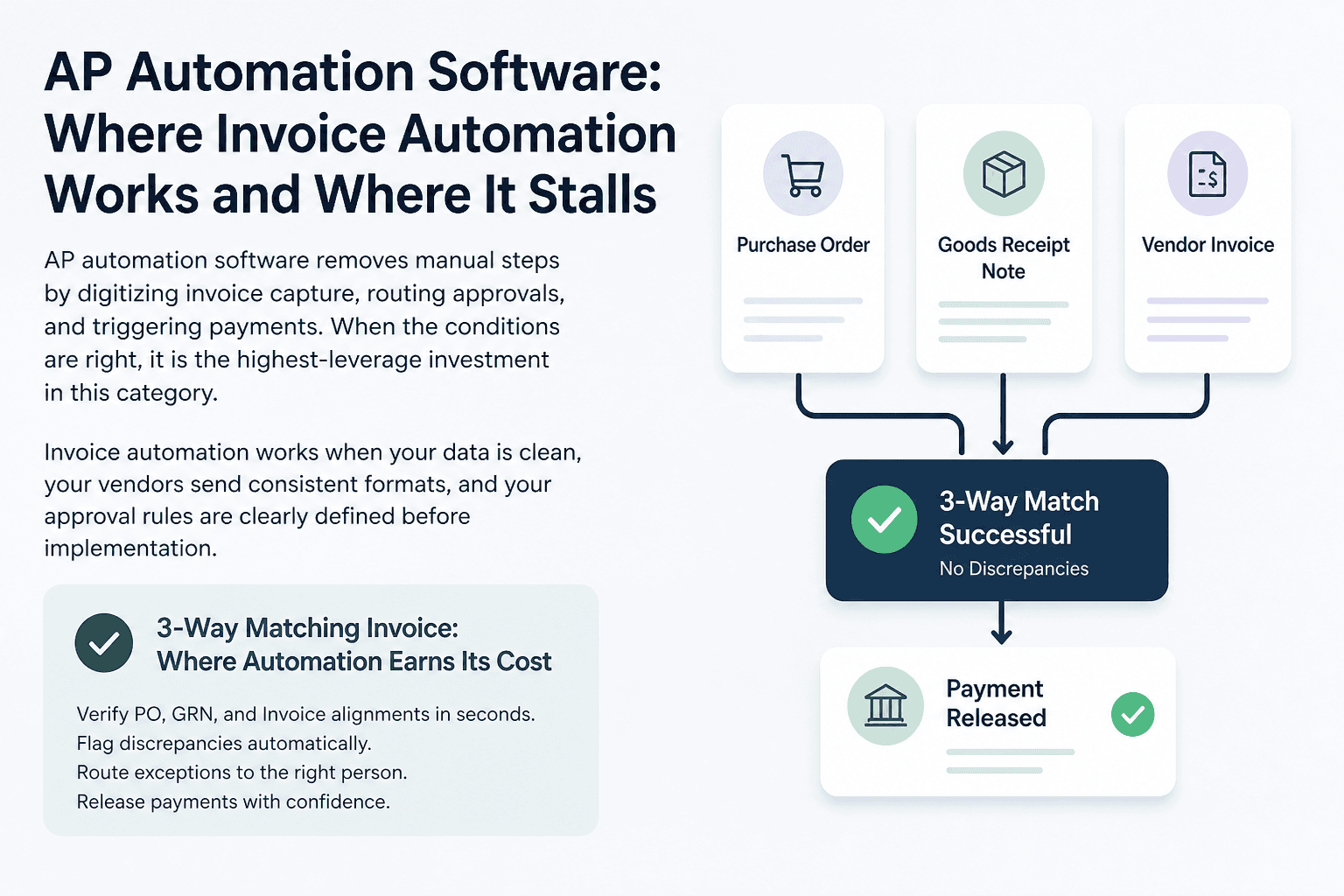
AP Automation Software: Where Invoice Automation Works and Where It Stalls
AP automation software removes manual steps by digitizing invoice capture, routing approvals, and triggering payments. When the conditions are right, it is the highest-leverage investment in this category.
When conditions are not right, you buy a tool and rebuild your process around it instead of the other way around.
What invoice automation actually handles end-to-end
AP automation software captures invoices digitally, extracts line-item data, matches invoices to purchase orders and receipts, routes for approval based on rules, and releases payments. It handles the structured, repeatable parts of the account payable process without human intervention. The key word is structured. Invoice automation works when your data is clean, your vendors send consistent formats, and your approval rules are clearly defined before implementation.
3-way matching invoice: where automation earns its cost
Three-way matching is the process of verifying that a purchase order, goods receipt note, and vendor invoice all align before payment is released. Done manually, this is one of the highest time costs in any AP function. A single mismatch can hold payment for days.
AP automation software handles 3-way matching invoice verification in seconds, flagging discrepancies automatically and routing exceptions to the right person. This is where tools like NetSuite AP automation and similar platforms pay for themselves fastest, especially at high invoice volumes.
Why tool-first implementations stall without process mapping first
The most common implementation failure: buying the software before mapping the process. If your approval logic has exceptions built on institutional knowledge — a manager who handles all EU vendor invoices differently, a PO type that always needs a secondary review — the tool will not know that unless someone documents it first.
Platforms like Bill.com and NetSuite AP automation are powerful within well-defined workflows. Outside those boundaries, they produce exceptions the tool cannot handle and humans have to catch anyway. The manual work does not disappear. It just moves to a different queue.
Embedded AP Agents: When AI Handles the Edge Cases Your Tools Miss
Embedded AI agents are not a software platform you configure. They are purpose-built automations designed around your specific AP workflow, including the exceptions, the edge cases, and the system integrations that off-the-shelf tools cannot reach.
This model fits teams whose processes are too complex or too fragmented for a SaaS platform to handle cleanly.
How embedded agents differ from rule-based AP automation
Rule-based automation follows a fixed decision tree. When an invoice matches a rule, it processes. When it does not, it stops and waits for a human.
Embedded AI agents understand context. They can recognize that a duplicate invoice from a specific vendor in a specific date range is a known billing pattern, not an error. They handle edge cases without escalating every exception to your team. That is the practical difference between ai invoice automation built around rules and agents built around your actual process.
Process mapping first: why context matters more than the tool
The embedded model requires process mapping before any automation is built. Every decision point, exception type, approval path, and data dependency is documented first.
This takes longer to set up than plugging in a SaaS tool. The return is an automation layer that does not break when reality does not match the rulebook.
For complex finance ops environments — multi-entity structures, high exception rates, ERP integrations across SAP or NetSuite — this is the only model that holds at scale.
Finance ops use cases where embedded agents outperform outsourcing
The clearest use case is invoice-to-GRN posting: matching an invoice against a goods receipt note, reconciling variances, and posting the result to the ERP. When this involves multiple data sources, variable formats, or approval branching by cost center, no BPO team and no SaaS platform handles it reliably without significant manual intervention.
Predflow is built around this model. Agents are designed around your actual AP process first, then automated within it, so edge cases and exceptions are handled without manual escalation or visibility gaps. If you want to understand what an embedded engagement actually looks like, the process is explained in detail at predflow.ai/how-we-work.
AP Outsourcing vs Automation vs Embedded Agents: A Direct Cost and Control Comparison
The right model is not the cheapest one. It is the one that matches your process maturity, invoice volume, and tolerance for visibility trade-offs.
Cost structure: one-time, recurring, or headcount-based
Outsourcing costs scale with volume and headcount. As your invoice count grows, so does the monthly fee. AP automation software carries a platform subscription plus implementation cost, with better unit economics at scale. Embedded agents involve an upfront build cost and a lower ongoing maintenance cost, with no per-invoice pricing.
Control and visibility trade-offs across all three models
Outsourcing gives you the least visibility. Automation gives you good visibility within the tool's scope. Embedded agents give you full visibility across the process, including exceptions.
Which model fits your current scale and process maturity
Row | AP Outsourcing | AP Automation Software | Embedded AI Agents |
|---|---|---|---|
Cost Model | Per invoice / headcount | Monthly SaaS + setup | Build fee + low maintenance |
Setup Time | 1 to 4 weeks | 3 to 6 months | 4 to 12 weeks |
Visibility | Low, report-based | Medium, within tool scope | High, full process coverage |
Handles Edge Cases | Manual escalation | Stops at rule boundary | Handled by agent logic |
Scalability | Cost scales with volume | Good at clean, high volume | Scales without headcount |
Best For | Fast relief, low complexity | High volume, clean process | Complex, exception-heavy AP |
FAQ
What is AP outsourcing and when does it make sense?
AP outsourcing means hiring a third-party provider to manage part or all of your accounts payable process, including invoice processing, payment runs, and vendor reconciliation. It makes sense when you need immediate relief from manual volume and your process is simple enough that handing it off does not create compliance or visibility risk.
How is AP automation software different from outsourcing?
AP automation software replaces manual steps with digital workflows inside your own systems. Outsourcing replaces your team with someone else's team. Automation gives you data ownership and real-time visibility. Outsourcing gives you speed to deployment but less control over what is happening day to day.
What does 3-way matching invoice mean in accounts payable?
Three-way matching is the verification step where a vendor invoice is checked against the original purchase order and the goods receipt note before payment is approved. All three documents must align on quantity, price, and terms. Discrepancies trigger a hold until the mismatch is resolved.
Can AP automation work alongside tools like NetSuite or Bill.com?
Yes, but integration depth varies. NetSuite AP automation is native to the NetSuite ERP and works well for teams already inside that ecosystem. Bill.com connects to several accounting systems but works best with simpler approval workflows. Complex ERP environments often need custom integration work before automation delivers reliable results.
What happens to AP visibility when you outsource?
Visibility drops significantly. You receive periodic reports rather than real-time data. Audit trails are held by the vendor, not your team. If an invoice is disputed or a payment is delayed, you are dependent on the vendor's data to investigate. For regulated industries or businesses with complex approval requirements, this is a material risk, not just an inconvenience.
Conclusion
The choice between outsourcing, automation software, and embedded agents is a process maturity question, not a budget question.
If you need fast relief and can accept less visibility, outsourcing bridges the gap. If your process is clean, your invoice volume is high, and your data is consistent, AP automation software pays off at scale. If your workflows are complex, exception-heavy, or spread across fragmented systems, neither model scales without either losing control or adding headcount. That is where embedded agents are the only model that holds.
See how Predflow maps your existing AP process before building anything. Book a process review to start with your workflow, not a sales pitch.
Bring 20 NetSuite bills to a 30-minute teardown
We will walk your actual invoices through capture, 3-way match and posting on the call, and tell you which steps an agent can take over. No prep beyond the PDFs.
FAQ
Frequently asked questions
What exactly is an AI agent
An AI agent is an autonomous system designed to handle specific business tasks end-to-end. Unlike simple chatbots, AI agents can reason, take actions, integrate with tools, and follow defined workflows.