Finance
Commodity Price Signals to SAP Purchase Orders: 7 AI Tools
Six of these tools surface commodity and market signals. One acts on them inside SAP. How each connects to open purchase orders, and what to verify.

Khushbu Adav
Product, Predflow

The quarterly close is two hours away. A finance analyst at a mid-size manufacturer is manually pulling inventory valuation data from three systems that do not talk to each other. The AI tool flagging commodity price signals sits in a separate browser tab, disconnected from open purchase orders and supplier commitments. The signal is there. The action is not. This is the failure mode that most stock analysis: AI roundups never address.
This article is not a generic list of investing platforms. It evaluates seven AI tools specifically against supply chain finance workflows, covering SAP integration depth, AP automation compatibility, and real-time process visibility. One of the most consistent mistakes finance teams make is focusing on the quality of analysis output without first mapping how that output connects to procurement, inventory, and accounts payable execution. You will finish this article with a framework to evaluate each tool against your own operational stack.
Why Stock Analysis: AI Tools Fail Supply Chain Finance Teams Without Workflow Integration
Most AI tools are built for analysts, not operators. They surface signals well. They do not move data from a market alert into a purchase order revision or a supplier payment hold.
The Gap Between Market Signal and Purchase Order Reality
A commodity price spike shows up in your AI dashboard at 9 AM. By the time that signal reaches the buyer managing open POs in SAP MM, it is 2 PM and the price window has closed. The gap is not analytical. It is operational. Stock analysis AI that cannot connect to material management SAP workflows produces insight that expires before it reaches execution.
What SAP Integration Actually Requires from an AI Tool
SAP ERP integration is not a checkbox. Before any AI tool earns a place in a supply chain finance stack, it must satisfy three specific requirements:
Data access: Can it read and write to SAP procurement module data in real time, not batch exports?
Process hooks: Does it connect to SAP workflow management so alerts trigger actions, not just notifications?
Auditability: Does it log every decision point for SAP auditing and compliance review without manual documentation?
Teams that skip this checklist discover integration gaps after contracts are signed.
The Real Cost of Manual Handoffs Between Analysis and Execution
Every manual handoff between an analysis tool and an execution system carries three hidden costs: delay, transcription error, and lost context. SAP AP automation and SAP invoice processing automation work at process speed. When a human has to bridge the gap between a stock signal and an SAP action, the entire workflow slows to human speed. For finance teams running sap end-to-end business processes, that friction compounds across every procurement cycle.
How to Evaluate Any Stock Analysis: AI Tool for Supply Chain Finance Use Cases
Structured evaluation beats ad hoc tool adoption. The same principle applies to financial analysis: a clear framework produces better decisions than chasing the most-featured platform. These five criteria are specific to supply chain finance, not general investing.
Five criteria for evaluating stock analysis AI in a supply chain finance context:
Real-Time Data Connectivity to ERP and Procurement Systems. An AI tool that cannot pull live data from your SAP erp integration layer will always require a manual data transfer step. Real-time connectivity eliminates that lag.
Supervised Learning Transparency for Auditability. Supervised learning in machine learning produces traceable decision logic. For supply chain finance teams subject to audit, black-box models create compliance exposure. Ask every vendor how their model decisions are logged and explained.
Edge Case Handling Without Manual Escalation. Commodity markets and supplier disruptions produce exceptions constantly. A tool that flags every anomaly for human review defeats the purpose of automation. Evaluate how each platform handles edge cases within its own logic before escalating.
Process Visibility and Debugging Capability. SAP monitoring and sap reports exist because finance teams need to see what happened and why. AI tools must offer the same visibility into their own processes. If you cannot debug an AI decision, you cannot defend it to an auditor.
Scalability Without Proportional Headcount Growth. Business process management software that requires one analyst per AI output stream does not scale. The tool should handle growing transaction volume without a corresponding increase in staff.
These criteria map directly to the operational pain points supply chain finance teams face daily, not the feature sets vendors like to demo.
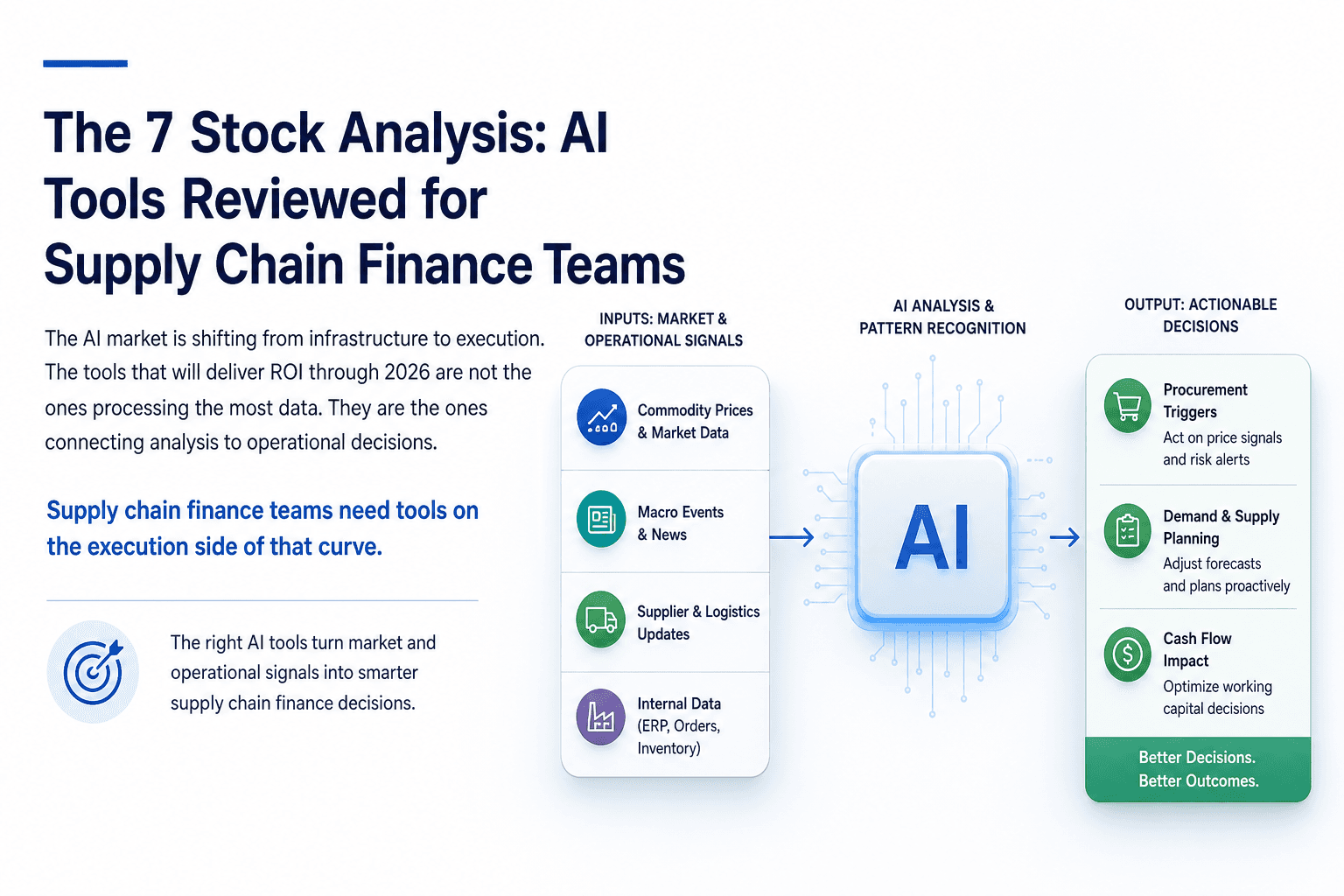
The 7 Stock Analysis: AI Tools Reviewed for Supply Chain Finance Teams
The AI market is shifting from infrastructure to execution. The tools that will deliver ROI through 2026 are not the ones processing the most data. They are the ones connecting analysis to operational decisions. Supply chain finance teams need tools on the execution side of that curve. Here are seven, reviewed against the criteria above.
1. Bloomberg Terminal AI Features — Best for Commodity and Raw Material Price Tracking
Bloomberg's AI features deliver real-time commodity price signals with deep historical context. For supply chain finance teams managing raw material exposure, it provides the market intelligence layer that feeds procurement planning decisions.
It fits into a supply chain finance workflow as the data source for commodity-linked purchase order triggers. Its SAP integration compatibility is limited to data exports and API connections; it does not natively write to SAP procurement workflows.
Limitation: Bloomberg is priced for institutional users. For mid-market manufacturers, the cost-to-signal ratio may not justify the subscription without a clear integration path to operational systems.
2. Kensho (S&P Global) — Best for Macro Signal Monitoring Tied to Procurement Planning
Kensho applies natural language processing to macro economic events and translates them into structured data signals. Supply chain finance teams use it to anticipate supply disruptions before they hit supplier lead times.
It fits into demand planning in SAP as an upstream signal source, helping teams adjust safety stock assumptions before procurement cycles lock in. SAP erp integration requires custom ETL pipeline work; Kensho does not offer native SAP connectors.
Limitation: The macro-to-procurement translation still requires human interpretation. Kensho surfaces the signal; your team decides the procurement response.
3. AlphaSense — Best for Supplier Financial Health Monitoring via Earnings Intelligence
AlphaSense aggregates earnings transcripts, SEC filings, and broker research to track supplier financial health. For AP teams managing supplier risk, it provides early warning signals before a supplier's credit position affects delivery reliability.
It fits into sap s/4hana sourcing and procurement workflows as a supplier risk input layer. It does not integrate directly with SAP ariba supplier management but can feed structured risk scores via API to teams that build that bridge.
Limitation: AlphaSense is document-heavy. Finance teams without a dedicated analyst to interpret supplier intelligence will find the signal volume difficult to operationalize without additional workflow tooling.
4. Visible Alpha — Best for Demand Planning Alignment with Analyst Consensus Models
Visible Alpha disaggregates analyst models to show line-item consensus estimates for revenue drivers. For supply chain finance teams, this means visibility into how analysts are modeling customer demand for key product categories.
It fits into sap scm module planning cycles by providing external demand validation that internal forecasts can be stress-tested against. SAP cloud solutions integration is not native; data export to planning tools is the standard workflow.
Limitation: Visible Alpha's value depends on analyst coverage of your key customers. For mid-market manufacturers with niche customer bases, coverage gaps reduce signal quality.
5. Danelfin — Best for Risk-Weighted Stock Screening in Treasury and Cash Management
Danelfin uses explainable AI to score stocks across technical, fundamental, and sentiment dimensions. For treasury teams managing short-term equity positions or assessing counterparty risk, it provides a transparent scoring layer with clear decision logic.
It fits into treasury cash management workflows where finance teams need to move quickly on investment decisions with defensible, auditable reasoning. ERP integration is not a Danelfin feature; it operates as a standalone analysis tool.
Limitation: Danelfin is built for investment decision support, not operational supply chain finance. Teams expecting it to connect to procurement or AP workflows will need to build that bridge manually.
6. Kavout — Best for Pattern Recognition in Inventory-Linked Equity Positions
Kavout applies machine learning to identify equity patterns and assigns predictive scores to individual stocks. For supply chain finance teams managing inventory-linked equity hedges or tracking competitor positioning, it provides pattern-based signals that complement fundamental analysis.
It fits into sap inventory management workflows as an external signal layer for demand sensing and competitive positioning. What is large language models technology is used in Kavout's document analysis layer, though its core scoring engine remains ML-based.
Limitation: Kavout's pattern recognition works best in liquid, high-coverage equities. For teams tracking small-cap suppliers or niche commodity producers, pattern signal quality degrades.
7. Predflow AI Agents — Best for End-to-End Workflow Automation Connecting Analysis to Action
Every tool reviewed above surfaces signals. None of them closes the loop between a market signal and an operational response inside your SAP environment. That gap is exactly where manual work re-enters the process and where scaling breaks down.
Unlike the six tools above, which surface signals, Predflow builds AI agents that act on them. It maps the process first, then automates handoffs between stock analysis outputs, SAP procurement workflows, and AP automation without requiring manual re-entry or custom integrations. A specific example: an agent monitors commodity price signals from an external data source, checks open purchase orders in SAP MM against current price thresholds, and triggers a procurement review workflow automatically. No human bridge. No delay between signal and action.
For teams dealing with fragmented tool coordination and the inability to scale without adding headcount, Predflow addresses the layer that analysis tools leave open: execution. New sap technologies and sap cloud solutions are only valuable when they connect to the workflows where decisions actually happen.
Limitation: Predflow is designed for teams that have already mapped their existing workflows. Teams with undefined or undocumented processes will need to complete that process mapping step before agents can be configured.
SAP Integration Compatibility: What Supply Chain Finance Teams Must Verify Before Deploying Any AI Tool
Most AI tool deployments fail at integration, not at analysis. Teams select a platform based on a demo, then discover that connecting it to their SAP environment requires months of custom development. Run this checklist before committing.
SAP S/4HANA and BTP Compatibility Questions to Ask Every Vendor
Ask these six questions before signing any AI vendor contract:
Does your platform support native SAP BTP architecture connectors, or does integration require custom middleware?
Can your tool read and write to SAP S/4HANA in real time, or only via scheduled batch transfers?
How does your platform handle SAP basis administration requirements during deployment?
What SAP implementation partners have you worked with, and what is the typical integration timeline?
How does your tool log decisions for SAP auditing and compliance review?
Does your platform support sap automation tools for workflow triggers, or does it require manual action to move data?
ETL Pipeline Requirements for Real-Time Stock and Procurement Data Sync
ETL tools SAP teams use must be configured to move data at the speed the business operates. Real-time stock and procurement data sync requires low-latency pipelines that most standard ETL configurations are not built for. Verify that your integration layer supports event-driven data transfer, not scheduled batch jobs, before going live with any AI analysis tool.
Change Management Steps That Determine Whether AI Adoption Sticks
AI tool adoption fails most often because the rollout treats the tool as a technology project rather than a process change. Agile methodology in SAP implementations works because it phases change into existing sprint cycles rather than deploying everything at once. Apply the same logic to AI tool rollouts. Introduce one workflow connection at a time, measure the impact, and expand from there. Teams that attempt a big-bang AI deployment across all SAP integration services simultaneously create confusion that kills adoption before the tool delivers value.
How Supply Chain Finance Teams Are Measuring ROI from Stock Analysis AI in 2025
The market is rewarding companies that convert AI investment into measurable operational outcomes, not those still in infrastructure mode. Supply chain finance teams that measure AI value in workflow KPIs will outperform those measuring by tool adoption rate alone. Here are three metrics that build an internal business case.
Time-to-Insight Reduction: From Multi-Day Reconciliation to Same-Session Analysis
Teams running manual reconciliation across disconnected systems typically spend two to four days closing the gap between market data and SAP reports. AI-assisted workflows that connect stock analysis outputs directly to sap fi introduction and SAP FICO project data reduce that cycle to same-session analysis. Realistic improvement ranges from 40% to 70% reduction in reconciliation time, depending on integration maturity and starting workflow complexity.
Procurement Cost Variance Improvement Tied to Commodity Signal Integration
When commodity price signals reach buyers before purchase order commitments lock in, teams gain negotiating leverage. Finance teams that connect sap s/4hana sourcing and procurement workflows to real-time commodity monitoring report procurement cost variance improvements in the range of 3% to 8%. That range widens for manufacturers in process manufacturing erp environments where raw material costs represent a larger share of total cost of goods sold.
Cash Flow Forecast Accuracy: What Realistic AI-Assisted Improvement Looks Like
SAP business process operations generate the data that cash flow forecasts depend on. When AI tools automate the collection and normalization of that data, forecast accuracy improves because the inputs are fresher and more complete. Realistic improvement in cash flow forecast accuracy ranges from 10% to 25%, depending on how much of the current forecast process relies on manual data collection. Teams in discrete manufacturing in SAP environments with complex multi-plant operations tend to see improvement at the higher end of that range.
Frequently Asked Questions
What is stock analysis AI and how does it differ from traditional financial modeling tools?
Stock analysis AI uses machine learning and natural language processing to analyze market data, earnings signals, and financial statements faster than manual modeling allows. Traditional financial modeling tools require analysts to build and update models manually. AI tools process larger data sets continuously and flag signals without waiting for scheduled model updates.
Can stock analysis AI tools integrate directly with SAP ERP systems?
Most stock analysis AI tools do not offer native SAP ERP integration. They operate as standalone analysis platforms that require custom ETL pipelines or middleware to connect to SAP procurement, inventory, or AP workflows. A small number of AI agent platforms are designed specifically to map and automate SAP-connected workflows end to end.
Which stock analysis AI tool is best for supply chain finance teams managing commodity exposure?
Bloomberg Terminal AI features provide the deepest commodity price tracking for raw material exposure. Kensho adds macro event signals that feed procurement planning. For teams that need signals to trigger SAP procurement actions automatically rather than inform manual decisions, an AI agent layer is required in addition to either platform.
How do AI agents differ from AI analytics tools in a supply chain finance context?
AI analytics tools surface signals and present analysis. AI agents take action based on those signals, moving data between systems, triggering workflows, and handling exceptions without waiting for human instruction. In a supply chain finance context, the difference is whether a commodity price alert results in a report or a purchase order review.
What is the biggest implementation risk when deploying stock analysis AI alongside SAP workflows?
The biggest risk is integration failure discovered after deployment. Teams that do not verify SAP BTP architecture compatibility, ETL pipeline latency, and audit logging capabilities before signing vendor contracts face months of custom development work that delays ROI and disrupts existing SAP work processes.
How does supervised learning improve stock analysis accuracy for procurement-linked decisions?
Supervised learning in machine learning trains models on labeled historical data, meaning the model learns which signals have historically preceded specific procurement-relevant outcomes, such as supplier price increases or lead time extensions. This produces more targeted predictions for supply chain finance use cases than unsupervised pattern recognition, and the decision logic is traceable for audit purposes.
Conclusion
You now have a five-criterion evaluation framework, seven tools reviewed against it, a pre-deployment integration checklist, and realistic ROI benchmarks. The remaining question is not which tool has the best interface. It is whether you start with a tool that surfaces signals or one that connects signals to action.
Teams that choose analysis-only tools will still face manual handoffs every time a signal needs to reach an SAP workflow. Teams that add an execution layer eliminate that gap permanently. The next step is specific: identify one workflow in your current process where a stock analysis output triggers a manual action, and ask whether that handoff could be automated. That is the process-mapping-first question every AI deployment should start with.
If you want to see what that automated handoff looks like inside your existing SAP environment, request a workflow mapping session with Predflow. No demo deck, just your process on the whiteboard.
Bring 20 NetSuite bills to a 30-minute teardown
We will walk your actual invoices through capture, 3-way match and posting on the call, and tell you which steps an agent can take over. No prep beyond the PDFs.
FAQ
Frequently asked questions
What exactly is an AI agent
An AI agent is an autonomous system designed to handle specific business tasks end-to-end. Unlike simple chatbots, AI agents can reason, take actions, integrate with tools, and follow defined workflows.