Business Ops
7 Optmyzr Alternatives for Operations and Finance Teams
Optmyzr automates your marketing bids overnight — but your AP team is still chasing approvals over email. These 7 alternatives bring that same intelligence to operations and finance.
Sanya Shah
Co-founder, Predflow

Your marketing team has automated bid adjustments running overnight through Optmyzr. Meanwhile, your AP team is still exporting CSVs, manually matching purchase orders, and chasing approvers over email. The intelligence gap is real, and it sits squarely in your back office.
Optmyzr is a strong tool for PPC teams. It catches overspending, flags broken campaign structures, and helps analysts move faster through account management tasks. But it was built for paid search, and that scope is intentional, not an oversight. Operations and finance managers dealing with manual handoffs, fragmented systems, and zero process visibility need a different category of tool entirely.
This article maps seven alternatives built for the workflows Optmyzr does not touch: finance approvals, vendor onboarding, supply chain handoffs, and back-office process automation.
Why Operations and Finance Teams Outgrow Optmyzr
What Optmyzr Actually Automates
Optmyzr automates the repetitive, high-volume decisions inside paid search management. Its budget optimization tools let teams set target budgets and run optimization strategies against them automatically. The Sidekick workspace gives PPC managers a full-screen natural language interface for analyzing and acting on campaign data.
Recent product updates reinforce where Optmyzr is heading. The Shopping Campaign Management tool now covers Microsoft Ads, unifying workflows for Shopping and Performance Max campaigns. Every major update deepens the PPC experience.
That focus delivers real value for marketing teams. The cost-to-performance ratio is strong, and the workspace is built for speed.
Where the Gap Appears for Back-Office and Finance Teams
Optmyzr's roadmap shows no movement toward invoice processing, procurement workflows, or operational handoff automation. That is not a gap waiting to be filled with a future feature. It is a structural boundary.
Finance and operations workflows require different AI agent architecture entirely. They involve conditional logic across multiple departments, exception handling when a vendor invoice doesn't match a PO, and audit trails that compliance teams can read. Optmyzr's ai agent workflow is scoped to ad account environments, not ERP systems or AP queues.
If your pain is manual work between finance systems rather than between ad campaigns, you are in the right comparison set.
The Decision Framework: What to Look For in an Optmyzr Alternative
Picking the wrong tool category wastes more time than staying manual. Use these four criteria before evaluating any platform on this list.
Process Mapping Before Tool Selection
The right platform starts by understanding your process, not by listing integrations. If a vendor leads with their connector library rather than asking how your approval workflow actually runs, that is a warning sign. Manual handoffs between systems get worse, not better, when a tool is bolted on without process clarity first.
Edge Case Handling and Human Oversight
Any automated workflow will hit exceptions. A vendor invoice with a mismatched currency, a purchase order missing a cost center, an approval routed to someone on leave. The platform must handle these gracefully, flag them clearly, and route them to a human without breaking the entire process. Zero visibility into exceptions is the failure mode most operations teams discover after they have already committed to a tool.
Integration Depth With Existing Systems
Fragmented tool coordination gets worse when a new platform requires data to live in yet another silo. Evaluate whether the platform integrates with what you already use, your ERP, your procurement system, your communication tools, not whether it has an impressive integration count on a marketing page.
Visibility and Auditability of Automated Steps
Finance teams need to know exactly what ran, when, and why. Regulatory requirements and internal audit processes demand that automated steps are logged and readable by non-technical reviewers. If a platform cannot show you a clear record of every action an agent took, it is not ready for finance workflows.
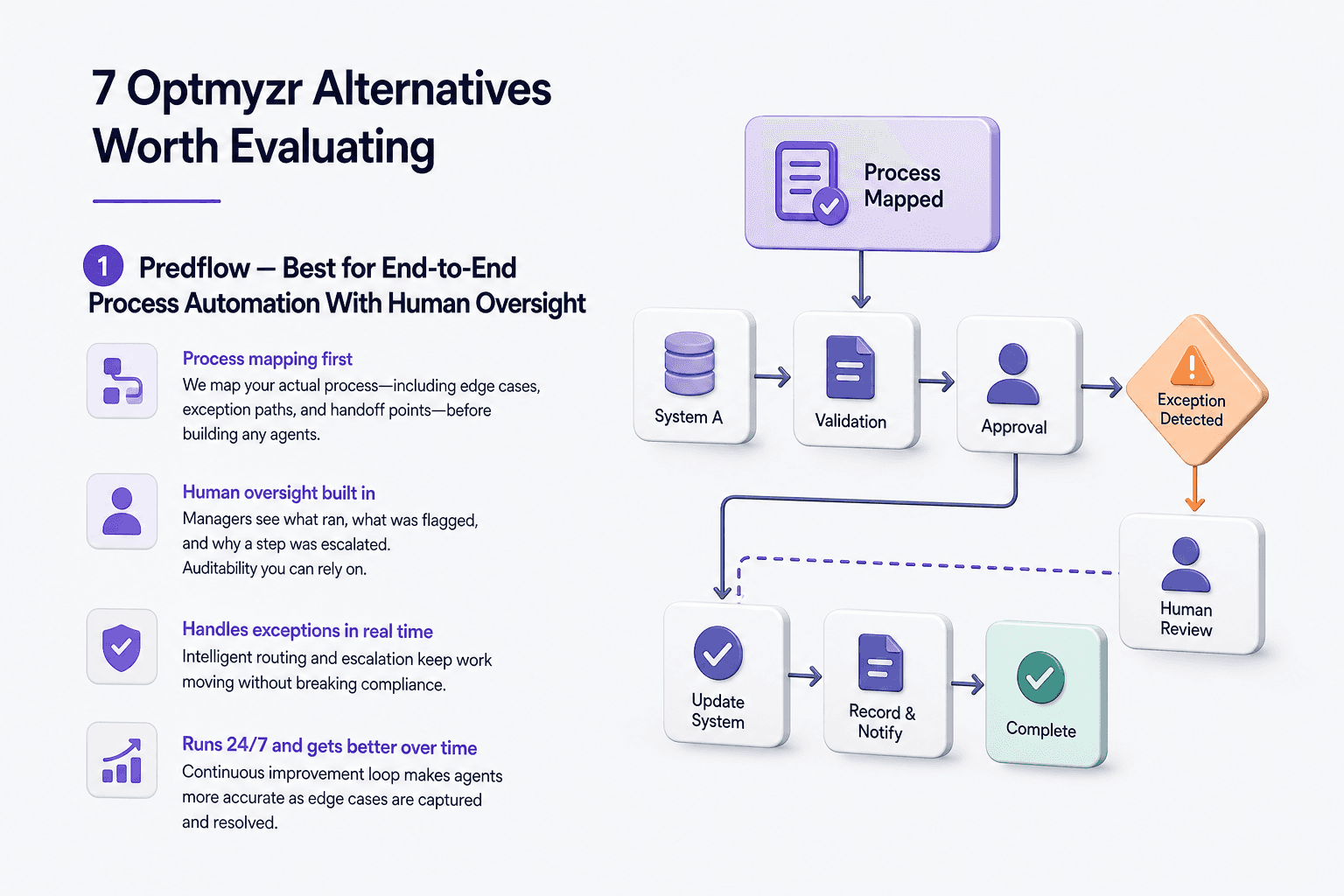
7 Optmyzr Alternatives Worth Evaluating
1. Predflow — Best for End-to-End Process Automation With Human Oversight
Predflow is an AI agent platform that automates complex business workflows end-to-end, built specifically for teams that need reliability across the full process, not just individual tasks.
The core differentiator is that Predflow starts with process mapping before building any agent. Most platforms ask you to configure a tool and then fit your workflow around it. Predflow maps the actual process first, including the edge cases, the exception paths, and the handoff points, then builds agents that reflect how the work actually runs.
For operations and finance teams, this matters when a workflow involves multiple systems, multiple approvers, and occasional exceptions that would otherwise require a human to intervene manually. Predflow embeds human oversight checkpoints directly into the workflow so managers can see exactly what ran, what was flagged, and why a specific step was escalated. That auditability makes it viable for finance environments where compliance is not optional.
The platform runs 24/7, handles real-time exception routing, and is designed to scale without requiring additional headcount. The continuous improvement loop means agents get more accurate over time as edge cases are documented and handled automatically.
Honest limitation: Predflow is better suited for teams ready to invest in proper process documentation upfront. Teams looking for a quick plug-and-play setup will find the process-first approach takes more initial effort.
Not ideal for: Marketing teams managing PPC campaigns or teams with no existing process documentation to build from.
2. Relevance AI — Best for Teams Building Custom AI Agent Workflows
Relevance AI is an agent builder platform that lets operations teams create custom AI agent workflows without writing code. Users chain tools, prompts, and logic into agents that handle specific tasks.
Its strongest use case for operations teams is automating research-heavy or data-gathering tasks where the output feeds into a larger process. The ai agent builder interface is accessible to non-technical users, which lowers the barrier to building workflow automation quickly.
Honest limitation: Relevance AI is strong for building individual agents but requires more manual effort to coordinate multiple agents across a complex, multi-step finance process.
Not ideal for: Teams that need deep ERP integration or a fully managed, monitored automation environment out of the box.
3. CrewAI — Best for Multi-Agent Orchestration on Technical Teams
CrewAI is an open-source multi agent framework that lets developers define teams of AI agents that collaborate on complex tasks. For operations teams with technical resources, it offers significant flexibility in building multi-agent systems that handle sequential or parallel workflows.
Its strongest use case is orchestrating multiple specialized agents, one for data extraction, one for validation, one for routing, that work together inside a single process.
Honest limitation: CrewAI requires developer involvement to set up and maintain. Non-technical operations managers will not get value without engineering support.
Not ideal for: Finance teams that need a managed, auditable solution without internal technical resources.
4. Lyzr AI — Best for Enterprise Agent Deployment With Governance Controls
Lyzr AI is an agent platform designed for enterprise teams that need AI agent deployment with built-in governance, data privacy controls, and compliance frameworks. It targets organizations where security and auditability are prerequisites before any automation goes live.
For supply chain or finance teams operating in regulated industries, Lyzr's governance layer addresses a concern that most agent builders ignore entirely.
Honest limitation: The platform's enterprise focus means the setup and onboarding process is longer and better suited for larger teams with defined IT procurement processes.
Not ideal for: Small teams or teams that need fast deployment without formal procurement cycles.
5. Jasper.ai — Best for Marketing-Adjacent Operations Content Workflows
Jasper.ai is primarily a generative AI content platform, but operations teams that manage content-heavy processes such as vendor communications, internal documentation, or proposal generation find it useful for reducing manual writing work.
Its strongest use case for operations is standardizing written outputs across a team, reducing the time spent drafting repetitive documents.
Honest limitation: Jasper.ai generates content but does not execute multi-step operational workflows, route approvals, or integrate with finance systems. It is a writing assistant, not a process automation platform.
Not ideal for: Any team looking to automate approvals, data processing, or cross-system handoffs.
6. Obviously AI — Best for Finance Teams Needing Predictive Automation Without Data Science Skills
Obviously AI is a no-code predictive analytics platform that lets finance teams build forecasting and classification models without data science expertise. For AP teams or supply chain managers who need to predict payment delays, flag anomalies, or model demand, it fills a gap that most workflow tools do not address.
Its strongest use case is answering recurring finance questions automatically, such as which invoices are likely to be late or which vendors pose payment risk.
Honest limitation: Obviously AI produces predictions and insights but does not execute actions or automate multi-step workflows on its own. It requires integration with other tools to act on its outputs.
Not ideal for: Teams looking for end-to-end process automation rather than analytical decision support.
7. Decagon AI — Best for Customer-Facing Operations and Support Automation
Decagon AI focuses on automating customer-facing support workflows using AI agents that handle inquiries, resolve issues, and escalate exceptions to human agents. For operations teams managing vendor portals, partner communications, or customer order inquiries, it automates the front-line response layer.
Honest limitation: Decagon AI is scoped to support and communication workflows. It does not automate internal finance processes or back-office data handling.
Not ideal for: Finance or AP teams whose primary challenge is internal process automation rather than external communication.
How Agentic AI Differs From the Automation You Already Use
Generative AI vs. Agentic AI: The Operational Difference
Generative AI produces outputs: text, summaries, drafts. It responds to prompts and stops. Agentic AI plans, executes, monitors, and adapts across multiple steps without waiting for a human to trigger each one.
The operational difference becomes clear with a specific example. An invoice approval workflow requires extracting data from a PDF, matching it against a PO, routing it to the right approver based on amount and department, flagging mismatches, and logging the outcome. Generative AI can draft a summary of the invoice. An agentic system can run the entire workflow, handle the mismatch exception, and escalate only what genuinely needs human judgment.
Why Workflow Automation Alone Is Not Enough for Finance Teams
Standard workflow automation tools execute fixed sequences. If the sequence breaks, the automation stops and waits. Finance workflows break regularly: missing fields, wrong cost centers, vendor data that doesn't match internal records.
LLM agents and agentic AI systems handle variability by reasoning about the context, not just following a script. That distinction is what separates tools built for operations from tools built for simpler task automation. For finance teams, the ability to handle edge cases without human intervention on every exception is the difference between a tool that scales and one that creates a new category of manual work.
Matching the Right Optmyzr Alternative to Your Team's Workflow
If Your Problem Is Manual Handoffs Between Finance Systems
Start with Predflow, because it maps the full handoff chain before building agents, which means the automation reflects your actual process rather than a generic template.
If Your Problem Is Scaling Operations Without Adding Headcount
Start with Relevance AI if your team has technical capacity to build agents, or Predflow if you need a managed approach where the platform handles agent design and ongoing optimization.
If Your Problem Is Visibility Into What Automation Is Actually Doing
Start with Lyzr AI for enterprise governance requirements, or Predflow for teams that need human oversight checkpoints and audit logs built into the workflow from the start.
Frequently Asked Questions
Is Optmyzr only for PPC and paid search management?
Yes. Optmyzr is built specifically for paid search automation, including budget optimization, campaign management, and account analysis. Its product roadmap, including the Sidekick workspace and Shopping Campaign Management for Microsoft Ads, confirms its focus is deepening PPC capabilities, not expanding into operations or finance workflows.
What is the difference between an AI agent platform and a workflow automation tool?
A workflow automation tool executes fixed, predefined sequences. An AI agent platform reasons about context, handles variability, and adapts when a step does not go as expected. For finance and operations teams, the distinction matters because real workflows involve exceptions that rule-based automation cannot resolve without human intervention.
Can AI agents handle finance and accounts payable workflows without human supervision?
AI agents can handle the routine, high-volume steps in AP workflows autonomously. However, well-designed agent platforms build in human oversight checkpoints for exceptions, compliance-sensitive decisions, and anomalies. Full autonomy without oversight is not appropriate for finance workflows. The goal is to reduce human involvement on the predictable steps, not eliminate human judgment on the ones that require it.
How do I evaluate an AI agent platform before committing to a vendor?
Use four criteria: whether the platform starts with process mapping, how it handles edge cases and exceptions, how deeply it integrates with your existing systems, and whether it provides a clear audit trail of every automated action. A platform that cannot answer all four confidently is not ready for finance or operations deployment.
What does agentic AI mean compared to standard generative AI tools?
Generative AI produces outputs in response to prompts. Agentic AI plans and executes multi-step tasks autonomously, monitors the results, and handles exceptions without waiting for human input at each stage. For operations teams, this means an agentic system can run an entire approval workflow end-to-end, while a generative AI tool can only assist with one step at a time.
Conclusion
You now have three things: a clear picture of what Optmyzr does and where it stops, a four-criteria framework for evaluating any alternative on process mapping, exception handling, integration depth, and auditability, and seven specific tools mapped to specific situations.
The next step is not to schedule seven demos. It is to pick one manual process in your finance or operations workflow, one that involves at least two systems and at least one human handoff, and ask whether any tool on this list could own it end-to-end without creating new manual work in its place.
Start by mapping one broken handoff in your current workflow, then see how Predflow's process-first approach handles it end-to-end. Request a walkthrough at Predflow.
FAQ
Frequently asked questions
What exactly is an AI agent
An AI agent is an autonomous system designed to handle specific business tasks end-to-end. Unlike simple chatbots, AI agents can reason, take actions, integrate with tools, and follow defined workflows.