



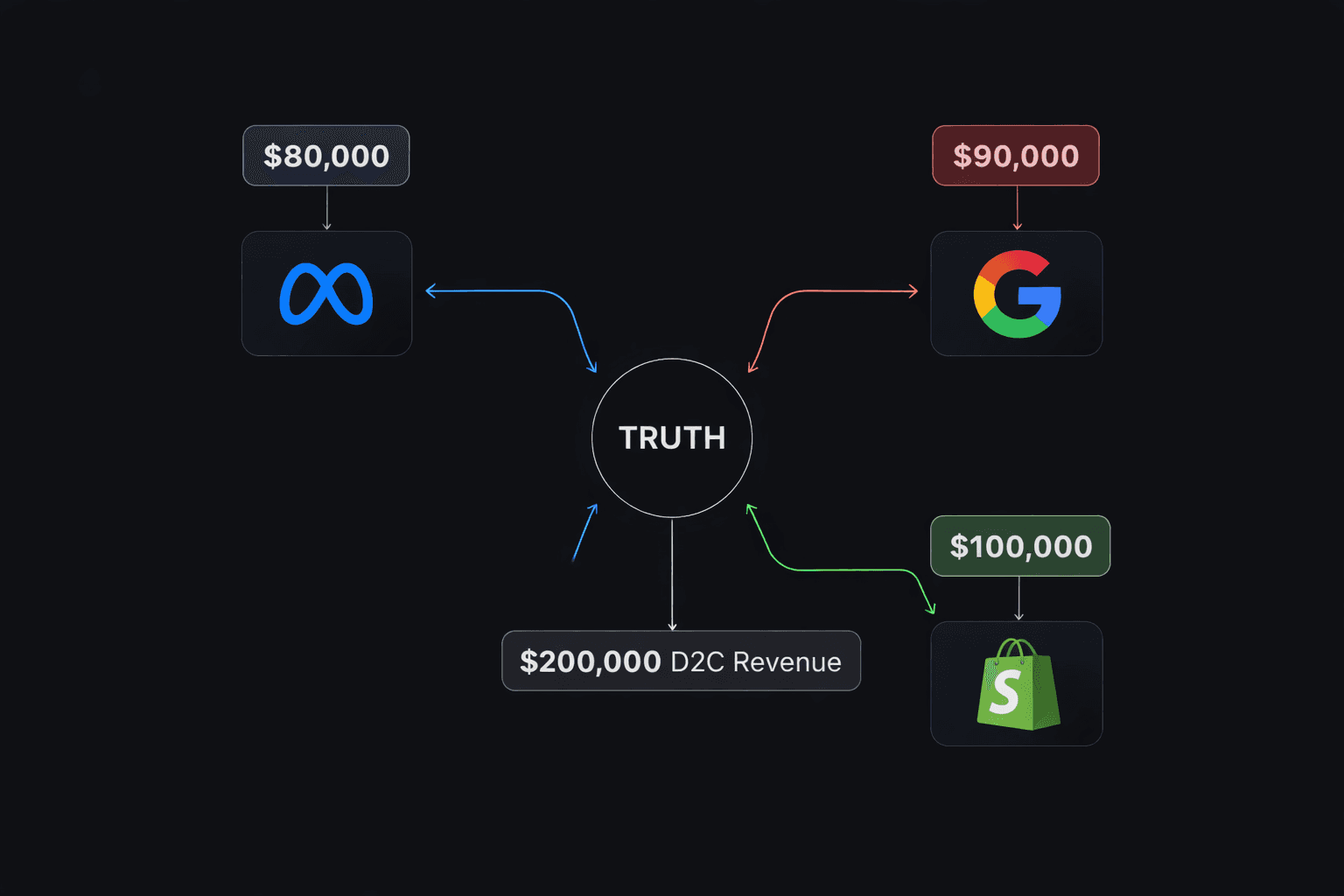
Meta says your campaign drove 200 orders. Google claims 180. Add them up and you have 380 conversions from 250 actual sales. This is not a bug. This is how attribution works when every platform grades its own homework.
For D2C brands spending real money on ads, understanding marketing attribution models is not optional. It is the difference between knowing where your money goes and hoping you are right. Most guides on this topic are written for B2B SaaS companies with 6-month sales cycles. This one is for performance marketers who need to decide tomorrow whether to move budget from Meta to Google.
What Attribution Models Actually Do
An attribution model is a set of rules that decides which touchpoint gets credit when a customer buys something. Your customer sees a Meta ad on Monday, clicks a Google Shopping ad on Wednesday, opens an email on Friday, and buys on Saturday. Four touchpoints. One sale. The question is: who gets the credit?
Different models answer that question differently, and the answer changes how you spend your budget.
The Models You Will Actually Encounter
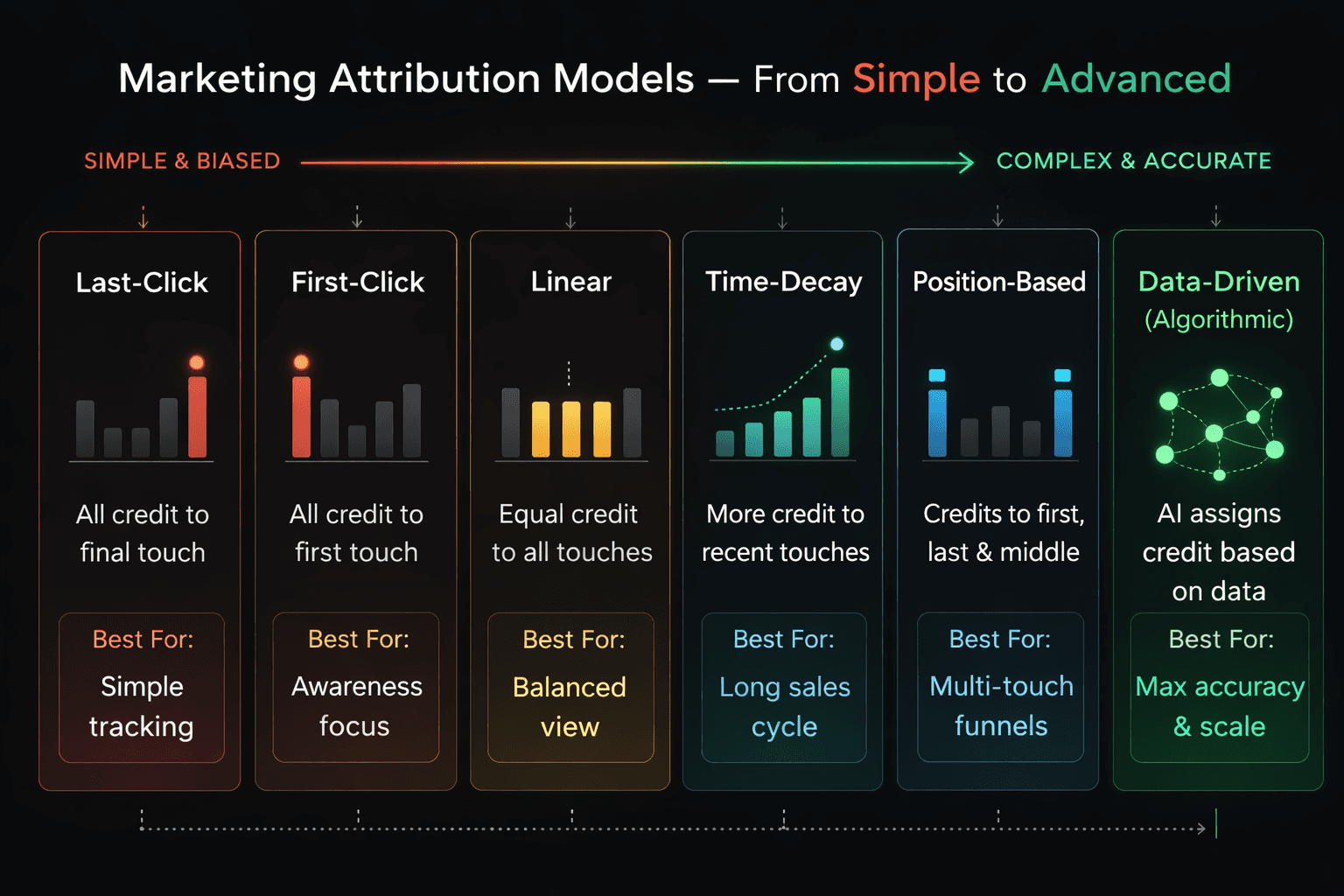
Last-click attribution gives 100% credit to the final touchpoint before purchase. This is what Shopify uses by default and what most D2C brands unknowingly rely on. The problem: it systematically overvalues branded search and retargeting while undervaluing everything that drove awareness in the first place. If you have ever wondered why your Meta prospecting campaigns look weak on paper while Google branded search looks incredible, last-click is likely the reason your analytics are misleading you.
First-click attribution gives all credit to the touchpoint that introduced the customer to your brand. It answers "what is driving discovery?" but ignores everything that happened between discovery and purchase. Useful for understanding top-of-funnel, useless for making budget decisions.
Linear attribution splits credit equally across every touchpoint. If there were five interactions before purchase, each gets 20%. It is democratic but unrealistic. The Meta ad someone scrolled past without engaging did not have the same influence as the product review video they watched three times.
Time-decay attribution gives more credit to touchpoints closer to the conversion. The logic: recent interactions had more influence on the purchase decision. This is closer to reality for most D2C journeys but still follows a fixed formula rather than learning from actual customer behavior.
Position-based (U-shaped) attribution gives 40% to the first touch, 40% to the last touch, and splits the remaining 20% across everything in the middle. It values both discovery and conversion, which makes it one of the better rule-based options for D2C brands. But the 40/40/20 split is arbitrary. Why not 30/30/40? Nobody knows.
Data-driven (algorithmic) attribution uses machine learning to analyze thousands of customer journeys and determine which touchpoints actually influence conversion probability. Instead of applying a fixed formula, it learns from your specific data. Google Analytics 4 offers a version of this, though its accuracy depends heavily on having enough conversion volume and clean tracking.
Why Every Single One of These Models Is Wrong
Here is the uncomfortable truth: no attribution model gives you the "real" answer. They all approximate reality through different lenses.
Last-click tells you what closed the deal but misses what started the conversation. First-click tells you what started it but misses what closed it. Linear pretends everything mattered equally. Time-decay assumes recency always wins. Position-based applies an arbitrary formula. Even data-driven models are only as good as the data they can see, and in 2026, with iOS privacy changes, cookie deprecation, and cross-device behavior, they cannot see nearly as much as they used to.
The right approach is not finding the one perfect model. It is using multiple models to triangulate a closer version of the truth.
The Real Problem for D2C Brands
Most attribution guides stop at explaining the models. For D2C performance marketers, the models are not the hard part. The hard part is that your data is fragmented across platforms that each want to claim credit for your conversions.
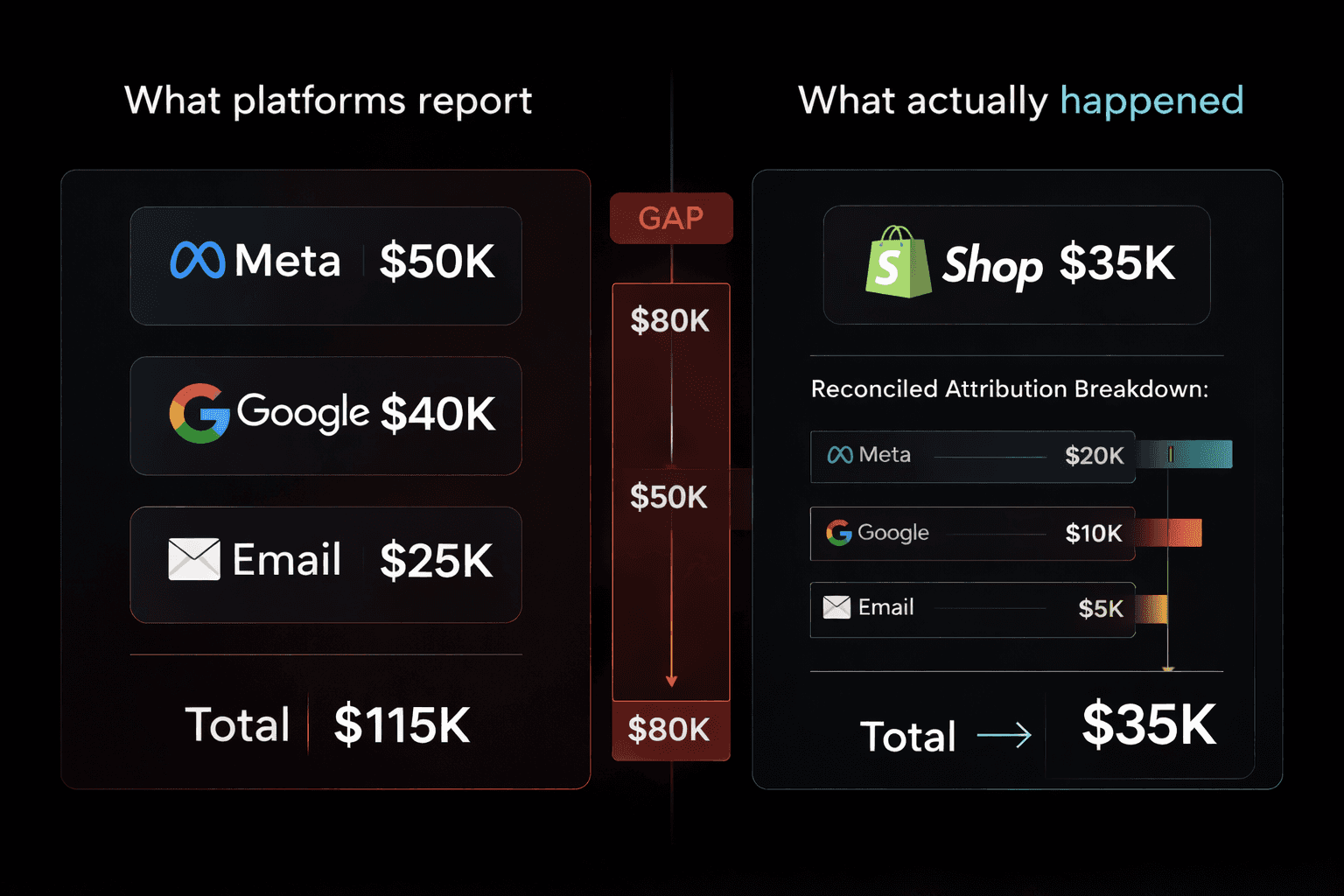
Meta's attribution window defaults to 7-day click and 1-day view. Google uses its own model. Shopify defaults to last-click. Your email platform attributes every sale to the last email opened. When you add up the revenue each platform claims, it exceeds your actual revenue by 20% to 40%. Sometimes more.
This is why performance marketers end up in that painful meeting where the founder asks "so which dashboard should I trust?" and nobody has a good answer. The numbers do not match because each system uses different attribution logic, different lookback windows, and different ways of handling cross-device behavior.
The brands that solve this problem do not rely on any single platform's attribution. They reconcile data across sources into one view that cannot exceed actual revenue. When Meta claims $50K in attributed revenue and Google claims $40K but Shopify only shows $35K in total sales, something has to give. Reconciled attribution takes actual purchase data as the ceiling and distributes credit based on real customer journeys, not platform self-reporting.
Multi-Touch Attribution Is Better. But Still Not Enough.
Most teams that graduate from last-click move to multi-touch attribution. And it is a real improvement. Instead of giving 100% credit to one touchpoint, MTA distributes credit across the journey. Linear, time-decay, position-based models all fall under this umbrella.
The problem is that standard multi-touch models still apply fixed rules. Linear gives equal weight to every touchpoint. Time-decay assumes recency always matters most. Position-based locks you into a 40/40/20 split that someone invented but nobody validated. These are better guesses than last-click, but they are still guesses. They do not learn from your actual customer behavior.
A customer who saw your Instagram ad, browsed Facebook, received an email, and then bought does not follow the same influence pattern as someone who clicked a WhatsApp message and purchased immediately. Standard MTA treats both journeys with the same formula.
True Multi-Touch Attribution Maps Real Influence
True multi-touch attribution goes beyond fixed formulas. Instead of applying predetermined rules, it analyzes actual customer journeys across every touchpoint and assigns influence based on what truly moved each customer toward a purchase.
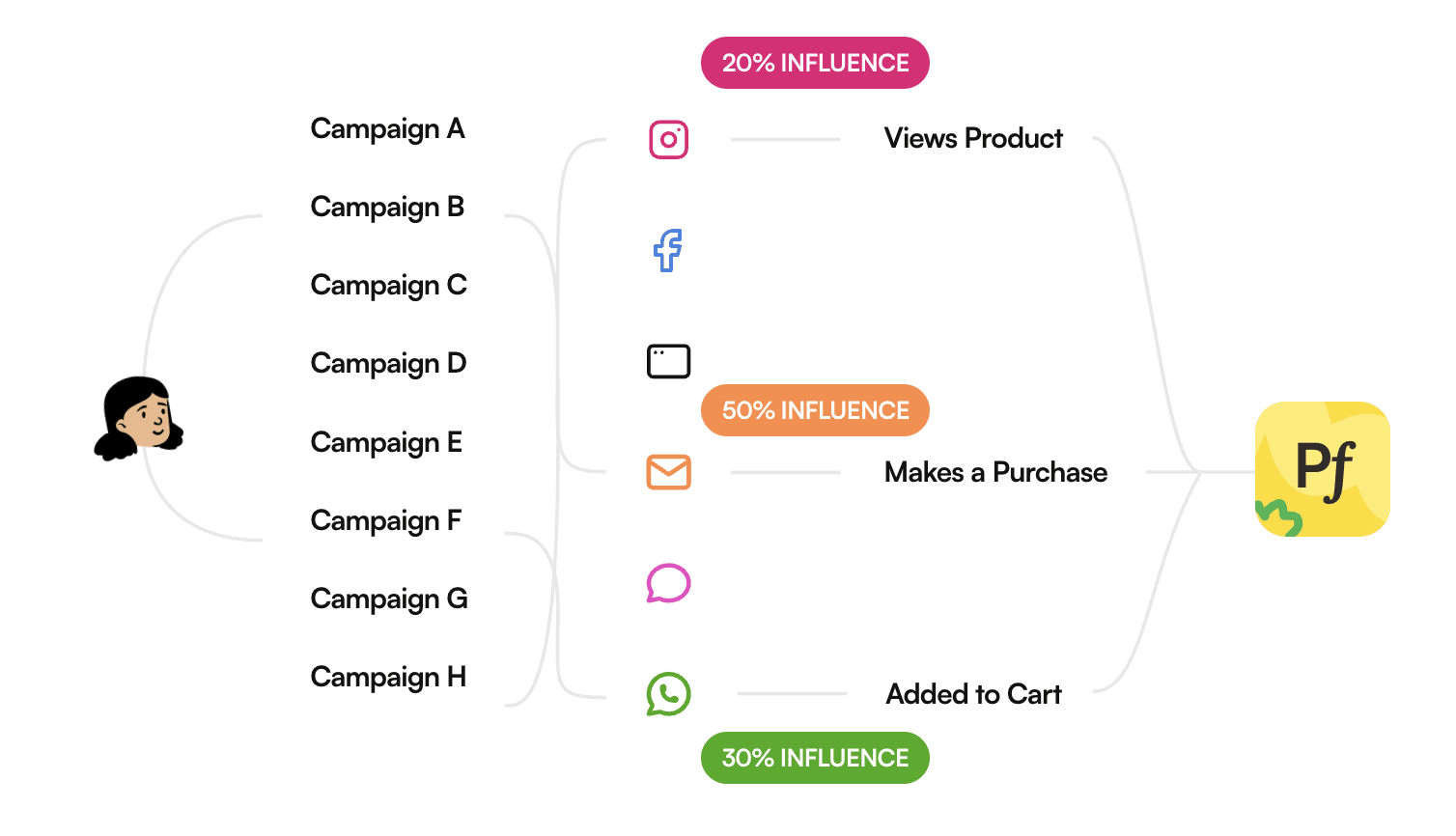
Consider a brand running eight campaigns simultaneously across Instagram, Facebook, email, WhatsApp, and SMS. A customer interacts with multiple campaigns across multiple channels before buying. True MTA does not just count the touchpoints. It measures the actual influence each one had on the outcome.
That Instagram ad view might have carried 20% influence. The email that drove the actual purchase might have carried 50%. The WhatsApp message that prompted an add-to-cart might have contributed 30%. These percentages are not fixed formulas. They are calculated from real behavioral data specific to your customers and your campaigns.
This is the approach Predflow's attribution takes. It connects campaign data, channel interactions, and actual purchase events into one system, then maps influence across the full journey. The output is not just "which channel gets credit" but "which combination of touchpoints actually drives conversions."
The practical difference matters most during budget planning. When a performance marketer asks "which platform should I push harder this festive season?" the answer from last-click tools is almost always "Google branded search" because it captures the last click. The answer from true multi-touch attribution is more nuanced: Meta builds awareness, Google converts high-intent traffic, retargeting closes the loop. Cut top-of-funnel and the whole system collapses, even though last-click attribution would never show you that.
Last-click tools optimize for conversion. They kill demand creation. True multi-touch attribution balances both so your funnel does not collapse.
What Actually Works for D2C
After building attribution systems for dozens of D2C brands, here is what I have learned works in practice.
Start with last-click as your baseline, not your truth. It is simple, available in every platform, and gives you a starting reference point. Just know that it is systematically biased toward bottom-of-funnel channels.
Layer in platform-reported data with skepticism. Meta and Google attribution data is useful as a signal, not as a source of truth. If Meta says a campaign is doing well and your blended ROAS confirms it, trust the signal. If Meta says 4x ROAS but your overall numbers are flat, something is being over-attributed.
Use blended ROAS as your sanity check. Total revenue divided by total ad spend gives you a number that cannot lie. It does not tell you which channel is working, but it tells you whether your overall system is profitable. If blended ROAS is healthy, you can tolerate some uncertainty in channel-level attribution.
Invest in reconciled attribution when spend gets serious. Once you are spending $20K or more per month across multiple channels, the cost of misattribution exceeds the cost of proper tooling. Having one reconciled number that maps platform data to actual revenue changes how confidently you make budget decisions.
If you are in that awkward middle ground where ROAS looks good but you cannot seem to scale, misattribution is one of the most common hidden causes. You might be scaling the wrong campaigns because the attribution model is pointing you in the wrong direction.
Attribution Is the Starting Point, Not the Destination
The purpose of attribution is not to produce a perfect report. It is to give you enough clarity to make better decisions faster.
When your ad intelligence shows which creatives are working, your attribution tells you which channels are actually driving revenue, and your anomaly detection catches drops before they become expensive, you stop reacting to dashboards and start making decisions with confidence.
Before you make your next budget allocation, make sure your creatives are actually strong enough to deserve the spend. Predflow's free ad analysis tool scores your hook, visual, CTA, and audience fit in seconds, so you are not pouring budget behind a creative that was never going to convert regardless of which attribution model you use.
The brands that grow profitably are not the ones with the fanciest attribution model. They are the ones who understand what their numbers can and cannot tell them, and build systems to fill the gaps.
Improve Ad performance with Predflow
Diagnose performance drops, creative fatigue, and attribution shifts