Business Ops
What Is Gnani and How It Works in Business Operations
Finance and ops teams are losing hours daily to calls that a smarter system should handle automatically. Here is how Gnani makes that possible without disrupting your existing workflows.

Gautam Borad
Founder, Predflow

Customer-facing teams in finance, supply chain, and operations are losing hours daily to repetitive call handling, manual data entry between voice and ticketing systems, and follow-up calls that should never require a human in the first place. When an inbound call about an invoice status requires three system lookups and a callback, the problem is not the call. It is the absence of a system that can handle it end to end.
Gnani enters this conversation as a voice-first AI platform built specifically to automate these interactions at scale. The platform recently closed a Series B funding round, signaling that enterprise demand for this category is accelerating beyond early adoption. The core question this article answers is practical: how does Gnani actually work, what operations can it automate, and is it the right fit for your workflow environment?
What Is Gnani? A Plain-Language Definition
Gnani.ai as a Voice-First Generative AI Platform
Gnani.ai is an enterprise voice AI platform that automates customer interactions across voice, chat, and messaging channels. Founded in 2016 and headquartered in Bengaluru, the company has built its product around one specific problem: high-volume, repetitive human communication that costs businesses time and money without adding decision-making value.
The platform is voice-first by design, meaning its core architecture prioritizes spoken language processing rather than treating voice as a secondary channel bolted onto a text-based chatbot. This distinction matters operationally. Voice interactions carry different data signals, interruption patterns, and language variability than text, and a platform built around voice handles those variables differently than one adapted for it.
Core Focus: Automating Customer Interactions Across Voice, Chat, and Messaging
Gnani's current operating scale gives it credibility beyond a pilot-stage product. The platform serves over 200 enterprise customers, supports more than 40 languages, and processes over 30 million voice interactions daily. Those numbers reflect deployed, operational usage rather than theoretical capacity.
The platform's focus is automation of customer interactions: inbound queries, outbound follow-ups, status checks, verification workflows, and escalation routing. It sits at the intersection of ai automation and artificial intelligence for call centers, specifically targeting the interaction layer where manual effort is highest and the work is most repetitive.
How Gnani Works: The AI Agent Architecture Behind the Platform
Voice Recognition and Multilingual NLP Processing
Every interaction on Gnani begins with voice recognition: converting spoken audio into structured text the system can process. Gnani's multilingual NLP, which stands for natural language processing, then interprets that text to identify intent, extract entities like account numbers or dates, and determine what the caller needs.
Parsing in NLP refers to the step where the system breaks down sentence structure to extract meaning accurately. Gnani's multilingual model handles this across 40-plus languages, which is operationally significant for businesses serving diverse customer bases or operating across geographies.
AI Agent Workflow: From Inbound Trigger to Resolution
The ai agent workflow inside Gnani follows a clear sequence for each interaction.
Trigger. An inbound call or message arrives and is routed to the Gnani platform.
Intent recognition. The NLP layer identifies what the caller wants: a status update, a payment confirmation, a complaint escalation.
Context retrieval. The system pulls relevant data from connected business systems such as CRM or ERP to personalize the response.
Response generation. The AI agent constructs and delivers a response, either completing the interaction or routing it appropriately.
Resolution or handoff. The interaction closes with a logged outcome, or transfers to a human agent with full context preserved.
This sequence describes the ai agent architecture that distinguishes an agentic platform from a basic IVR or static chatbot. Each step involves active decision-making rather than scripted branching.
How Knowledge-Based Agents Handle Edge Cases
Knowledge-based agents in artificial intelligence are systems that use a structured store of domain information to reason through situations that fall outside standard patterns. In Gnani's context, this means the platform can handle calls where the caller's situation does not match a simple template.
Agentic RAG, short for retrieval-augmented generation, extends this further. It allows the agent to retrieve specific information from a connected knowledge base in ai at runtime, rather than relying only on what was baked into the model during training. This is how Gnani can answer a question about a specific invoice status rather than giving a generic payment policy response.
Integration Layer: Connecting to Existing Business Systems
Gnani connects to existing CRM, ERP, and ticketing systems through an integration layer. This is what allows the agent workflow to pull live data during an interaction rather than operating in isolation.
The environment in artificial intelligence refers to all the external systems and data sources an agent can perceive and act on. For Gnani, that environment includes the caller, the connected business systems, and the outcome logs that feed back into continuous improvement. The structure of ai agents on the platform reflects this: perception, reasoning, action, and feedback operating in a continuous loop.
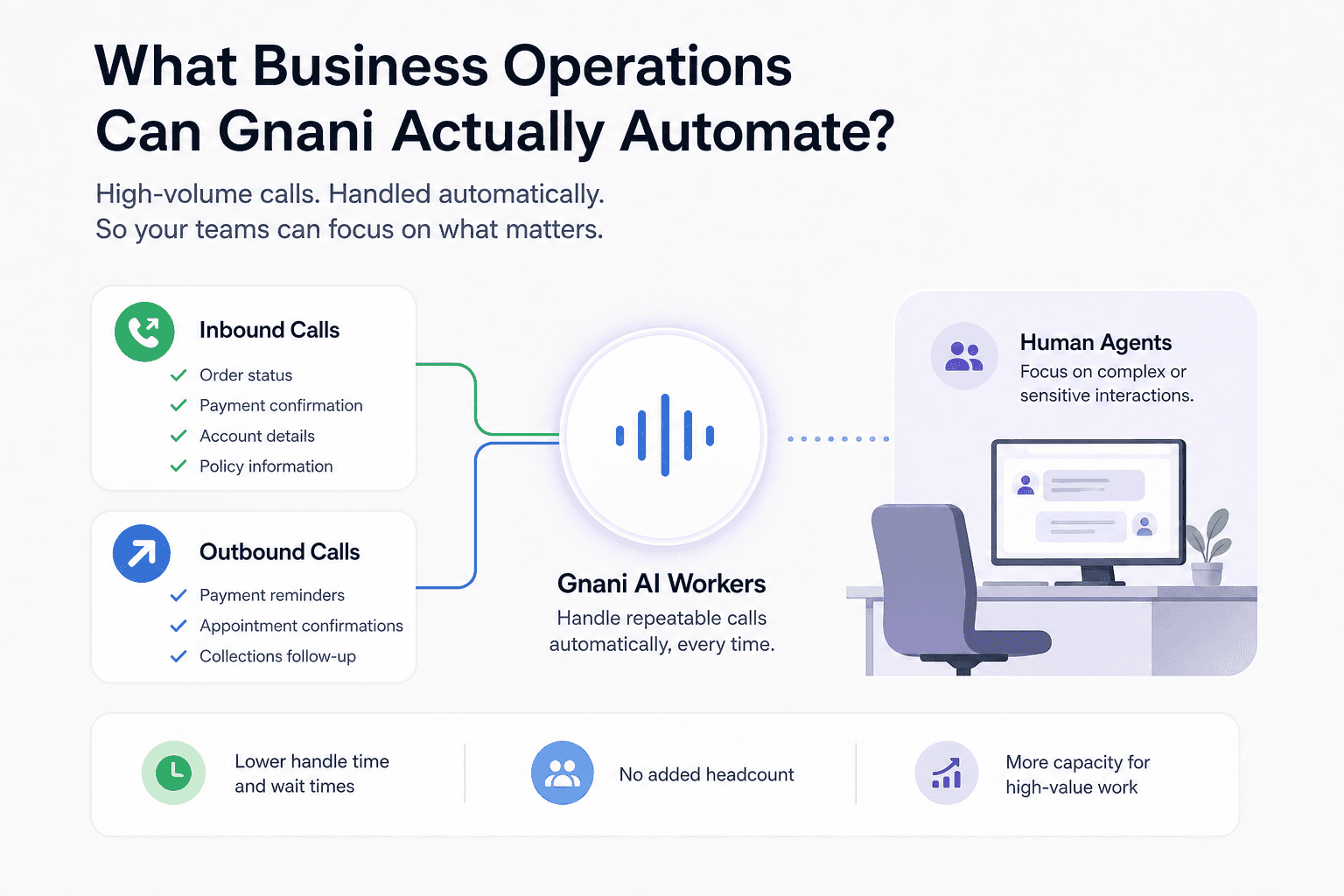
What Business Operations Can Gnani Actually Automate?
Customer Interaction Automation: Inbound and Outbound Calls
Gnani's clearest use case is high-volume call automation. Inbound queries about order status, payment confirmation, account details, and policy information are handled without a human agent. Outbound campaigns for payment reminders, appointment confirmations, and collections follow-up are triggered and executed automatically.
For operations teams running contact centers, this reduces average handle time and queue wait times without adding headcount. The platform functions as ai workers handling the repeatable tier of call volume so human agents focus on complex or sensitive interactions.
Finance and Accounts Payable: Reducing Manual Follow-Up Calls
Finance teams spend a disproportionate amount of time on outbound follow-up: calling vendors about invoice statuses, confirming payment receipt, and chasing approvals. These are ai agents for finance use cases where the interaction is structured, the data is available in existing systems, and the outcome is binary.
Gnani automates these outbound call sequences, logs the response, and updates the relevant system record. An accounts payable team that previously spent two hours daily on vendor call-backs can redirect that time to exception handling and reconciliation.
Supply Chain and Operations: Status Queries and Exception Handling
Supply chain teams field status queries from carriers, customers, and internal stakeholders at volume. Gnani handles inbound status queries against live shipment or inventory data and routes exception cases to the right human contact with context already attached.
This matters specifically during peak periods when query volume spikes without warning. A voice AI platform running 24/7 absorbs that spike without degradation, which a human team cannot do without overtime or temporary staffing.
Scaling Without Headcount: Where Gnani Replaces Repetitive Labor
The scaling argument for voice AI is straightforward: each additional call handled by the platform costs a fraction of what a human agent costs, and that ratio improves as volume grows. One pattern that consistently creates problems in deployments like this is teams adopting an AI tool without first mapping the underlying process. When that happens, the tool automates a broken workflow rather than a functional one, producing technically operational results that do not move business metrics.
That distinction matters when evaluating Gnani or any voice AI layer. The voice automation is only as effective as the process it sits on top of.
If your team's challenge extends beyond the voice layer into the full workflow behind each interaction, Predflow is worth evaluating alongside Gnani. Predflow maps the end-to-end process first, then deploys AI agents that handle edge cases and preserve full context at every handoff point. Where Gnani addresses the voice and conversation layer, Predflow addresses what happens across the entire workflow connected to that interaction.
Gnani vs. Comparable Voice AI and AI Agent Platforms
Gnani vs. ElevenLabs: Voice Synthesis vs. Conversational Automation
ElevenLabs is a voice synthesis platform. It generates realistic human-sounding audio from text. Gnani automates two-way conversations. These are different products solving different problems.
Dimension | Gnani | ElevenLabs |
|---|---|---|
Primary function | Conversational voice AI automation | Text-to-speech synthesis |
Two-way dialogue | Yes | No |
Enterprise call center use | Yes | Limited |
Multilingual NLP | Yes, 40+ languages | Voice output in multiple languages |
AI agent workflow | Full agent architecture | Audio generation only |
ElevenLabs is the right fit for content production, voiceovers, and audio generation. Gnani is the right fit for automating live customer interactions at scale.
Gnani vs. Lyzr AI and Decagon AI: Narrow Agent Platforms vs. Voice-First Scale
Lyzr AI and Decagon AI are ai agent builders focused on building custom agents for specific enterprise workflows. Both operate primarily in text-based interaction environments. Gnani's differentiation is voice-first design at operating scale, specifically the 30-million-daily-interaction volume that reflects real enterprise deployment.
If your primary channel is digital messaging or internal workflow automation, Lyzr AI or Decagon AI may be a better fit. If your bottleneck is voice-channel volume across multiple languages, Gnani's architecture is built for that specific environment.
Gnani vs. Jasper.ai and Marketing-Focused AI Agents
Jasper.ai is a content generation tool aimed at marketing teams. It produces written content, not automated conversations. Comparing Gnani to Jasper.ai is a category error: one is a marketing agent for content production, the other is an operational platform for interaction automation.
Marketing agents and voice AI platforms serve different buyer problems. The overlap is only in the broad label of "AI platform."
What Gnani Does That General-Purpose LLM Agents Do Not
General-purpose llm agents are powerful but not optimized for real-time voice processing, multilingual call handling, or the latency requirements of live telephone interactions. The difference between generative ai and agentic ai is relevant here: generative AI produces outputs on demand, while agentic AI takes sequences of actions to complete a goal in a live environment.
Gnani is agentic by design. It does not just generate a response. It retrieves data, makes routing decisions, updates records, and manages the full interaction lifecycle.
Key Limitations and Risks to Evaluate Before Adopting Gnani
Integration Complexity with Legacy Back-Office Systems
Gnani requires integration with existing systems to deliver value. If your ERP, CRM, or ticketing infrastructure is fragmented or runs on legacy architecture, integration scoping becomes the most complex part of deployment.
The same principle that applies to expert-led assessments applies here: identifying the data requirements early determines whether the engagement delivers useful outcomes or creates expensive misalignment. AI platforms need early integration scoping with the same rigor. Leaving it until post-contract is where most deployment delays originate.
Language and Dialect Coverage: Where Gaps Can Occur
Supporting 40-plus languages is significant. However, dialect variation within a language, regional accent handling, and code-switching between languages mid-call are different challenges. Evaluate specific language coverage against your actual customer population, not the headline language count.
Process Visibility and Debugging When Interactions Fail
When an AI agent misroutes a call or fails to resolve an interaction, operations managers need to identify where in the agent workflow the failure occurred. The ai agent workflow must produce interpretable logs, not just outcome records, for debugging to be practical.
Ask vendors specifically about interaction replay, failure tagging, and exception reporting before deployment. Agent orchestration without visibility into failure modes creates the same zero-visibility problem that voice AI was meant to solve.
Vendor Dependency and Data Governance Considerations
Voice interactions contain sensitive customer data. Evaluate Gnani's data residency options, retention policies, and compliance certifications against your industry requirements. In regulated sectors like financial services or insurance, this is not optional due diligence. It is a procurement requirement.
Multi agent architectures also create dependency chains: if the voice AI platform goes down, the downstream systems dependent on its outputs are affected. Assess redundancy and SLA terms accordingly.
Frequently Asked Questions
What is Gnani.ai and what does it do?
Gnani.ai is a voice-first generative AI platform that automates customer interactions across voice, chat, and messaging channels. It processes spoken and text-based queries, retrieves relevant data from connected business systems, and resolves or routes interactions without human involvement. The platform is designed for enterprise-scale deployment, handling over 30 million voice interactions daily.
How many languages does Gnani support?
Gnani supports over 40 languages. The platform is built for multilingual enterprise environments where customers interact in regional languages across geographies. Dialect and accent coverage within specific languages should be validated against your actual customer base during the evaluation process.
Is Gnani an AI agent platform or a traditional chatbot?
Gnani is an AI agent platform, not a traditional chatbot. A chatbot follows scripted decision trees. Gnani uses an agentic architecture where the system retrieves data, reasons through context, and takes action sequences to complete an interaction. This makes it capable of handling variable, real-world call scenarios rather than only pre-defined paths.
What types of businesses use Gnani?
Gnani serves over 200 enterprise customers across industries that manage high-volume customer interactions. Common use cases appear in financial services, insurance, telecommunications, and retail operations where inbound call volume is high and interaction types are structured but variable.
How does Gnani differ from agentic AI versus generative AI tools?
Generative AI tools produce content or responses on demand. Agentic AI takes sequences of actions to achieve a goal in a live environment. Gnani is agentic: it does not just generate a reply. It retrieves data, makes routing decisions, logs outcomes, and manages the full interaction lifecycle in real time.
Can Gnani integrate with existing ERP or CRM systems?
Yes, Gnani includes an integration layer designed to connect with existing business systems including CRMs and ERPs. The complexity of that integration depends on your existing system architecture. Legacy or fragmented infrastructure increases integration effort and should be scoped in detail before deployment commitments are made.
Is Gnani the Right Platform for Your Operations?
If your primary pain is high-volume repetitive voice interactions across multiple languages, and you need enterprise-grade reliability at operating scale, Gnani is a credible option to evaluate seriously. Its architecture is purpose-built for the voice channel, its deployment scale is verified, and its multilingual coverage addresses a real gap in most contact center environments.
If the pain extends beyond the voice layer into end-to-end workflow automation, multi-system handoffs, or full process visibility from trigger to resolution, a voice AI layer alone will not solve it. The next evaluation cycle for operations leaders should prioritize platforms that address not just the conversation, but the complete workflow connected to that conversation.
If your team is mapping AI automation across more than just the voice layer, explore how Predflow builds agents that handle the full process, from inbound trigger to resolution, without losing context at handoff points. See how Predflow works.
Bring 20 NetSuite bills to a 30-minute teardown
We will walk your actual invoices through capture, 3-way match and posting on the call, and tell you which steps an agent can take over. No prep beyond the PDFs.
FAQ
Frequently asked questions
What exactly is an AI agent
An AI agent is an autonomous system designed to handle specific business tasks end-to-end. Unlike simple chatbots, AI agents can reason, take actions, integrate with tools, and follow defined workflows.