Finance
AI Agents for Finance: How to Choose and Use Them
Learn how to choose and deploy ai agents for finance ops that fix broken workflows, cut manual work, and fit the systems your team already uses.

Denisha R
Product, Predflow

A finance team spends three days every month reconciling invoices across four disconnected systems. Not because the work is complex. Because the ERP does not talk to the ticketing system, the ticketing system does not talk to email, and nothing writes back to the spreadsheet automatically.
AI agents for finance promise to fix exactly this. But most teams deploy the wrong type of agent for the wrong process and see little ROI. They pick a tool because it looked good in a demo, then discover it cannot handle their approval hierarchy or falls silent when an invoice arrives in an unexpected format.
Every major finance platform, including Microsoft Office, SAP, Workday, and BlackLine, shipped embedded agent capabilities recently. That signals agents are no longer experimental. The question is not whether to use them. It is which type of agent fits your process, and how to deploy without breaking what already works.
This article is a decision guide. By the end, you will know how to map your process, match it to the right agent type, evaluate platforms honestly, and sequence deployment so the first result lands within your first quarter.
What AI Agents for Finance Actually Do (Beyond the Chatbot)
Most tools called "AI agents" in finance are not agents at all. They are chatbots with memory, or RPA scripts dressed in a language model. Knowing the difference prevents a costly mismatch.
The difference between agentic AI and generative AI in a finance context
Generative AI responds. You give it a prompt, it produces an output, and the interaction ends. Agentic AI acts. It takes a goal, breaks it into steps, executes those steps across systems, checks its own output, and continues until the task is complete or it hits a decision it cannot make alone.
In finance, the difference is operational. A generative AI tool can draft a vendor payment email. An agentic AI system can receive an invoice, match it to a purchase order in your ERP, flag a price discrepancy, route it to the right approver, and update the GL when approval is confirmed, without a team member touching it at each step.
What a finance AI agent can and cannot do autonomously
A finance AI agent can execute rule-based workflows end-to-end: invoice matching, payment scheduling within set thresholds, balance reconciliation across defined accounts, and compliance checks against known policy rules.
What it cannot do reliably is handle ambiguity without clear guardrails. One of the most common failure points is an agent providing inaccurate or incomplete information when queried about policy-specific fees or approval thresholds that exist in a document but were never structured as machine-readable rules. This is not a technology failure. It is a deployment failure. The agent was given access to a system it was not properly configured to interpret.
Why multi-step execution across ERPs and ticketing systems matters
Single-step automation is RPA. Finance AI agents create value through multi-step execution: reading from one system, reasoning about what the data means in context, writing to a second system, and triggering a third action based on the outcome.
An agent that only works inside your ERP is limited. The real workflow lives across your ERP, your email, your ticketing system, and sometimes a spreadsheet someone has not moved off their desktop yet. An AI agent workflow that cannot cross those boundaries will stall at the same handoff points your team stalls at today.
The Four Types of AI Agents Used in Finance Workflows
Matching agent type to process type is the most important decision you will make before evaluating any vendor. The taxonomy below maps to real finance use cases, not academic AI theory.
Reactive agents: good for rule-based invoice matching
What it is: A reactive agent follows fixed if-then rules. It reads inputs and responds based on predefined conditions, with no memory of previous interactions.
Where it fits: Three-way matching in accounts payable. Invoice arrives, agent checks PO number, quantity, and price against the purchase order and goods receipt. If all three match within tolerance, it routes for payment. If not, it flags for review.
Where it fails: Any process that requires context from previous transactions or judgment about exceptions. A reactive agent cannot decide whether a new vendor's slightly different invoice format is a data entry error or a genuine policy violation.
Knowledge-based agents: handling policy exceptions and compliance lookups
What it is: A knowledge-based agent uses a structured knowledge base to reason through situations where rules alone are not enough. It understands relationships between data points, not just individual conditions.
Where it fits: Policy exception handling, compliance checks, and vendor classification. When an invoice falls outside standard approval thresholds, a knowledge-based agent in artificial intelligence terms can cross-reference company policy, vendor history, and contract terms before deciding whether to escalate or auto-approve.
Where it fails: Dynamic environments where policy changes frequently and the knowledge base is not kept current. Stale data produces confident but wrong decisions, which is more dangerous than a simple rule failure.
Planning agents: multi-step close processes and reconciliation sequences
What it is: A planning agent in artificial intelligence decomposes a goal into an ordered sequence of actions, accounts for dependencies, and adapts the plan if an intermediate step fails.
Where it fits: Month-end close sequences. The agent knows that accruals must post before the trial balance runs, and the trial balance must be reviewed before the consolidation package is generated. It manages the sequence, not just individual tasks.
Where it fails: Processes where the sequence itself is contested or changes based on business unit input. Planning in AI works best when the order of operations is agreed upon and documented before the agent is deployed.
Multi-agent systems: orchestrating across AP, GL, and reporting simultaneously
What it is: A multi-agent system runs multiple specialized agents in parallel or in sequence, each handling a defined subprocess, with an orchestration layer managing handoffs between them.
Where it fits: End-to-end finance operations where AP, GL, and reporting must stay in sync without manual handoffs. One agent processes invoices, a second posts journal entries, a third generates a payment run summary for the treasury team. Each agent type is matched to its subprocess. The orchestration layer ensures outputs flow correctly between them.
Where it fails: When the orchestration layer is poorly designed. If agent handoff logic is brittle, one agent's error cascades into the next. Multi-agent architectures require the strongest upfront process mapping of all four types.
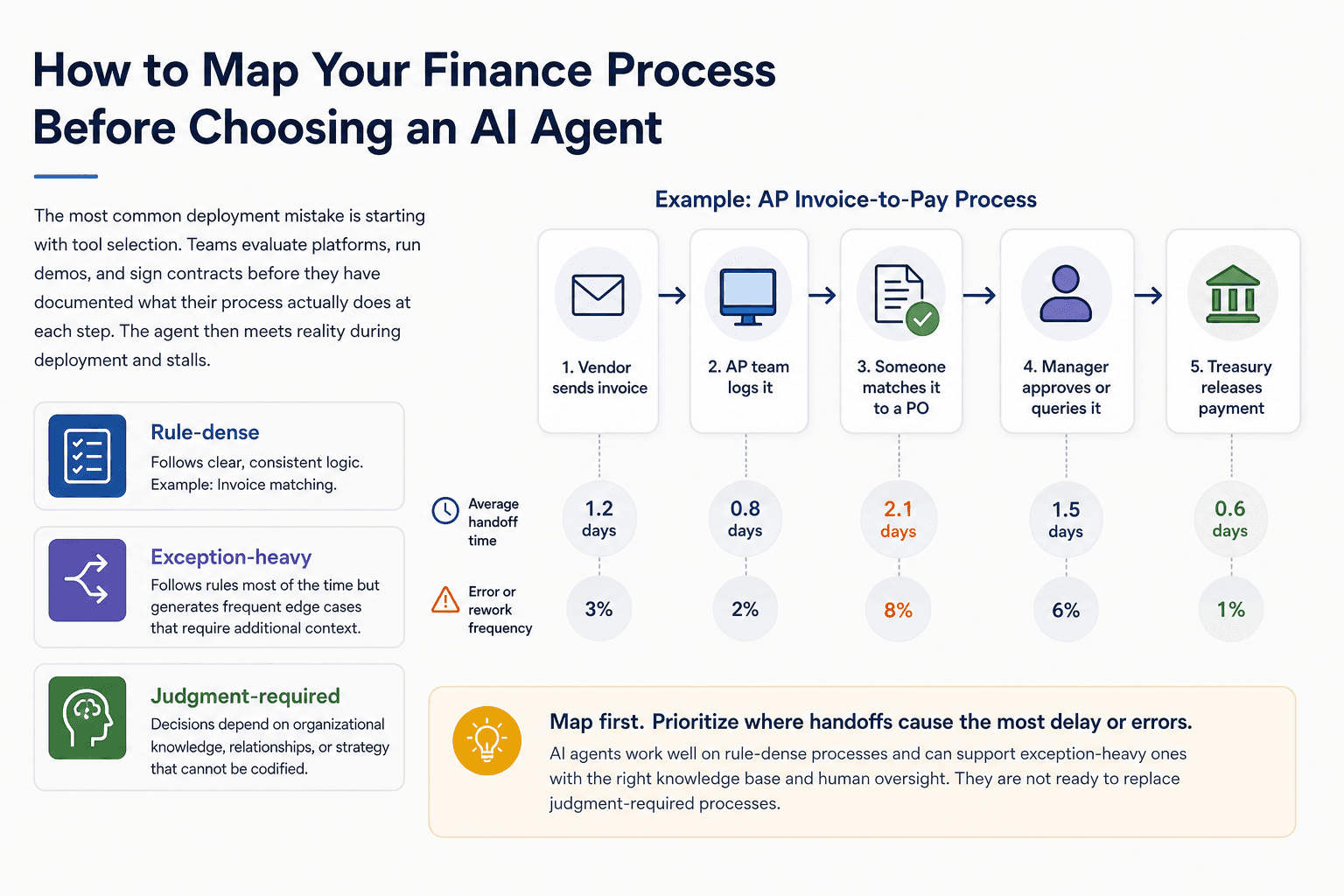
How to Map Your Finance Process Before Choosing an AI Agent
The most common deployment mistake is starting with tool selection. Teams evaluate platforms, run demos, and sign contracts before they have documented what their process actually does at each step. The agent then meets reality during deployment and stalls.
Identify the handoff points that create the most delay or error
Start by listing every point where work moves from one person, system, or team to another. In AP alone, this typically includes: vendor sends invoice, AP team logs it, someone matches it to a PO, a manager approves or queries it, and treasury releases payment.
Each of those transitions is a handoff. Map how long each handoff takes on average and how often it produces an error or rework cycle. That data tells you where an agent will deliver the most measurable impact, not where automation sounds appealing in theory.
Classify your process: rule-dense, exception-heavy, or judgment-required
Rule-dense processes follow clear, consistent logic. Invoice matching is rule-dense. Exception-heavy processes follow rules most of the time but generate frequent edge cases that require additional context. Judgment-required processes involve decisions that depend on organizational knowledge, relationships, or strategy that cannot be codified.
AI agents work well on rule-dense processes and can support exception-heavy ones with the right knowledge base and human oversight. They are not ready to replace judgment-required processes.
This is where platforms like Predflow differentiate. Rather than handing you a builder and expecting you to figure out the workflow, Predflow's onboarding begins with process mapping, identifying edge cases your team already handles manually before a single agent is deployed. That upfront work is what separates a deployment that delivers ROI in the first quarter from one that stalls in configuration.
Define the environment your agent must operate in (systems, data sources, permissions)
In practical terms, the environment in artificial intelligence means the actual systems your agent must read from and write to. For a finance team, that list typically includes: your ERP (SAP, Workday, NetSuite), your email platform, a ticketing or workflow system, and possibly shared spreadsheets or a document management system.
Before selecting an agent platform, document this list explicitly. Then ask every vendor to confirm native integration or API availability for each system. An agent that cannot write back to your ERP is not automating your workflow. It is automating a fragment of it.
Set human oversight checkpoints before automation begins
Human oversight is not a fallback for when things go wrong. It is a designed feature of every reliable AI agent workflow. Before deployment, define these four checkpoint types:
Approval thresholds: At what invoice value or exception type does a human always review before the agent proceeds?
Exception escalation rules: Which exception categories trigger automatic escalation, and to whom?
Audit log access: Who can view a full record of every agent action, decision, and data point accessed?
Rollback triggers: What conditions allow a human to reverse an agent action, and how quickly can that happen?
These checkpoints are not optional. They are what make autonomous finance workflows auditable and defensible.
Comparing AI Agent Platforms Built for Finance Operations
The platform you choose should match your process type, your existing stack, and your team's capacity to manage exceptions. Evaluating platforms against generic feature lists wastes time. Evaluate against criteria that reflect how finance workflows actually fail.
Evaluation criteria: integration depth, edge-case handling, and audit trail quality
Four dimensions separate platforms that work in finance from platforms that demo well:
Integration depth means native, bidirectional connections to your ERP, not a generic API connector that requires custom development for every field. Shallow integrations break when your ERP updates and create maintenance work your team did not budget for.
Edge-case handling is where most platforms underdeliver. A finance workflow generates exceptions constantly. The platform must have a clear mechanism for catching edge cases, routing them to a human, and logging the outcome so the agent learns from the escalation pattern over time.
Audit trail quality determines whether you can use the platform in an environment subject to regulatory review. Every agent action must be logged with timestamps, the data inputs used, the decision taken, and the outcome. Incomplete audit logs are a compliance liability.
Human override capability means a team member can stop, reverse, or reroute an agent action without IT involvement. If overriding the agent requires a developer, the platform is not designed for operational finance teams.
Platforms built for structured finance workflows vs. general-purpose agent builders
Finance-specific platforms prioritize pre-built connectors to ERP systems, compliance-grade audit logging, and approval workflow integration. They require less configuration but cost more and offer less flexibility for unusual processes.
General-purpose agent builders like Relevance AI or Lyzr AI offer more flexibility and lower entry cost. They work well for teams with technical resources who need to build custom workflows. They require significantly more upfront configuration and offer less native finance compliance support.
Decagon AI sits closer to the customer support and resolution end of the agent spectrum. It is worth evaluating if your finance team's agent need involves high-volume query resolution, such as vendor payment status inquiries, rather than core transaction processing.
Where open-source frameworks (CrewAI vs LangGraph) fit in enterprise finance
If your IT team has raised CrewAI or LangGraph in evaluation conversations, the relevant question is not which framework is better. The relevant question is whether your finance deployment requires a developer-maintained custom build or a managed platform.
CrewAI and LangGraph are agent frameworks designed for development teams. They offer maximum control over agent behavior and multi-agent orchestration logic. In enterprise finance, they are appropriate when your workflow is genuinely unique and no existing platform covers it, and when your organization has engineering resources to build, test, and maintain the implementation.
For most finance and operations teams without dedicated AI engineering capacity, these frameworks create more risk than value. The build time delays ROI, and maintenance falls back on IT teams already stretched thin.
Red flags: agents that skip process mapping and go tools-first
The clearest red flag in any vendor conversation is when the first question is about your tech stack rather than your process. A platform that leads with integrations before understanding your workflow is optimized for implementation speed, not operational fit.
Other red flags include: no native audit log functionality, human override requiring IT access, no mechanism for agents to escalate edge cases, and demo environments that do not reflect the variability of real finance data. Agents that skip process mapping almost always surface their limitations after go-live, not before.
How to Deploy AI Agents for Finance Without Breaking Existing Workflows
A phased deployment reduces risk, builds team trust, and creates measurable wins early. Each phase has a clear entry condition and exit milestone.
Phase 1: Automate one rule-dense process end-to-end before expanding
Start with accounts payable invoice matching. It is rule-dense, high-volume, and requires minimal judgment for standard cases. The agent reads incoming invoices, matches them against purchase orders and goods receipts in your ERP, auto-approves matches within policy, and flags exceptions for human review.
This phase should run in parallel with your existing process for the first two to four weeks. Compare agent outputs against your team's outputs daily. Document every discrepancy. Fix configuration issues before switching to agent-primary processing.
Phase 2: Add exception handling and human-in-the-loop checkpoints
Once your rule-dense process runs cleanly, introduce exception logic. This is where knowledge-based agent capabilities become relevant. The agent now needs to do more than match. It needs to reason about why an invoice does not match and decide whether to escalate, query the vendor, or apply a policy exception.
Map your exception types before building this phase. Every exception your team currently handles manually should be classified: does it follow a consistent rule, or does it require genuine judgment? Consistent-rule exceptions can be automated. Judgment exceptions need a human checkpoint with a clear escalation path.
Phase 3: Introduce multi-agent orchestration across connected processes
Multi-agent orchestration means connecting specialized agents so they hand off work without a human in the middle. In operational terms for a finance team: one agent monitors the AP queue and processes invoices, a second agent posts approved entries to the GL, and a third agent triggers a payment approval notification to the treasury team when a batch is ready.
Each agent handles its subprocess. The orchestration layer manages sequencing and error handling between them. AI orchestration at this level requires the most upfront design, but it is where the largest time savings appear, because it eliminates the manual handoffs between departments that generate the most delay.
Measuring success: cycle time, error rate, and team hours recaptured
Three KPIs tell you whether the deployment is working:
Cycle time reduction: In AP invoice processing, a well-deployed agent typically reduces end-to-end cycle time by 40 to 60 percent. Measure from invoice receipt to payment release before and after deployment.
Error rate drop: Track exceptions and rework cycles per 100 invoices. A functioning agent should reduce rework-triggering errors significantly within the first full month of operation.
Hours recaptured per FTE per month: Measure the time your team spent on the automated subprocess before deployment and track it monthly after. This is the number that builds internal support for expanding to Phase 3.
FAQ: AI Agents for Finance Operations
What are the four core characteristics of an AI agent used in finance?
A finance AI agent is autonomous (it acts without step-by-step human instruction), goal-directed (it works toward a defined outcome), reactive (it responds to changes in its environment, such as a new invoice or a failed match), and capable of multi-step execution across connected systems. These four characteristics distinguish a true agent from a chatbot or a single-step automation script.
What is the difference between agentic AI and generative AI for finance teams?
Generative AI produces outputs in response to prompts. It does not take action in external systems. Agentic AI executes multi-step workflows: it reads data, makes decisions, writes outcomes back to systems, and continues working until the task is complete. For finance teams, the difference is between a tool that helps you draft a vendor email and one that processes the invoice behind that email end-to-end.
Can AI agents integrate with existing ERP systems like SAP or Workday?
Most enterprise-grade agent platforms offer integration with SAP, Workday, and similar ERP systems, either through native connectors or API-based connections. The depth of that integration matters. Confirm that the platform supports bidirectional data flow, not just read access, before committing to a deployment.
How do I know if my finance process is ready for AI agent automation?
A process is ready when it meets three conditions: the steps are documented and consistent, the rules governing decisions are explicit rather than based on individual judgment, and the systems involved have accessible APIs or data exports. If your team struggles to explain the process in writing, the process is not yet ready for agent deployment.
What happens when an AI agent makes an error in a financial workflow?
The answer depends on whether you designed the workflow with rollback triggers and human oversight checkpoints. Agents with proper exception escalation routes flag errors before they propagate. Agents without those guardrails can write incorrect entries to your ERP before anyone notices. Design for failure first. Every agent deployment should define exactly what triggers a stop, who is notified, and how quickly an action can be reversed.
Conclusion
There is a fork in the road every finance team faces after evaluating AI agents. One path starts with tool selection: pick a platform, connect it to your systems, and figure out the workflow during implementation. The other starts with process mapping: document what your workflow actually does, where it breaks, and what type of agent logic it requires before opening a single vendor conversation.
Teams that take the first path almost always stall during deployment. The agent meets an edge case nobody planned for, the IT team gets pulled in, and the project loses momentum before it produces a result. Teams that start with process mapping move faster, hit fewer surprises, and see measurable ROI within the first quarter. The technology is not what fails in most finance agent deployments. The deployment approach is.
The one actionable step you can take today without a vendor conversation: print your current AP or reconciliation workflow, mark every handoff point, and classify each step as rule-dense, exception-heavy, or judgment-required. That map is what separates a deployment that succeeds from one that stalls.
If you want to see how Predflow approaches process mapping before agent deployment, request a workflow audit, not a demo.
Bring 20 NetSuite bills to a 30-minute teardown
We will walk your actual invoices through capture, 3-way match and posting on the call, and tell you which steps an agent can take over. No prep beyond the PDFs.
FAQ
Frequently asked questions
What exactly is an AI agent
An AI agent is an autonomous system designed to handle specific business tasks end-to-end. Unlike simple chatbots, AI agents can reason, take actions, integrate with tools, and follow defined workflows.