


Every ad platform tells you a different story about what drove the sale. Meta claims credit. Google claims credit. Add up the numbers and you have more conversions than actual customers. Campaign attribution tracking tools exist to cut through this noise and give you one version of the truth.
But not all attribution tools solve the same problems. Some are built for Shopify-only brands spending $10K a month. Others need a six-figure monthly ad budget to even make sense. This guide breaks down seven tools worth considering, with honest takes on where each one shines and where it falls short.
If you want to understand the underlying models these tools use before evaluating the tools themselves, start with our guide to marketing attribution models.
1. Predflow
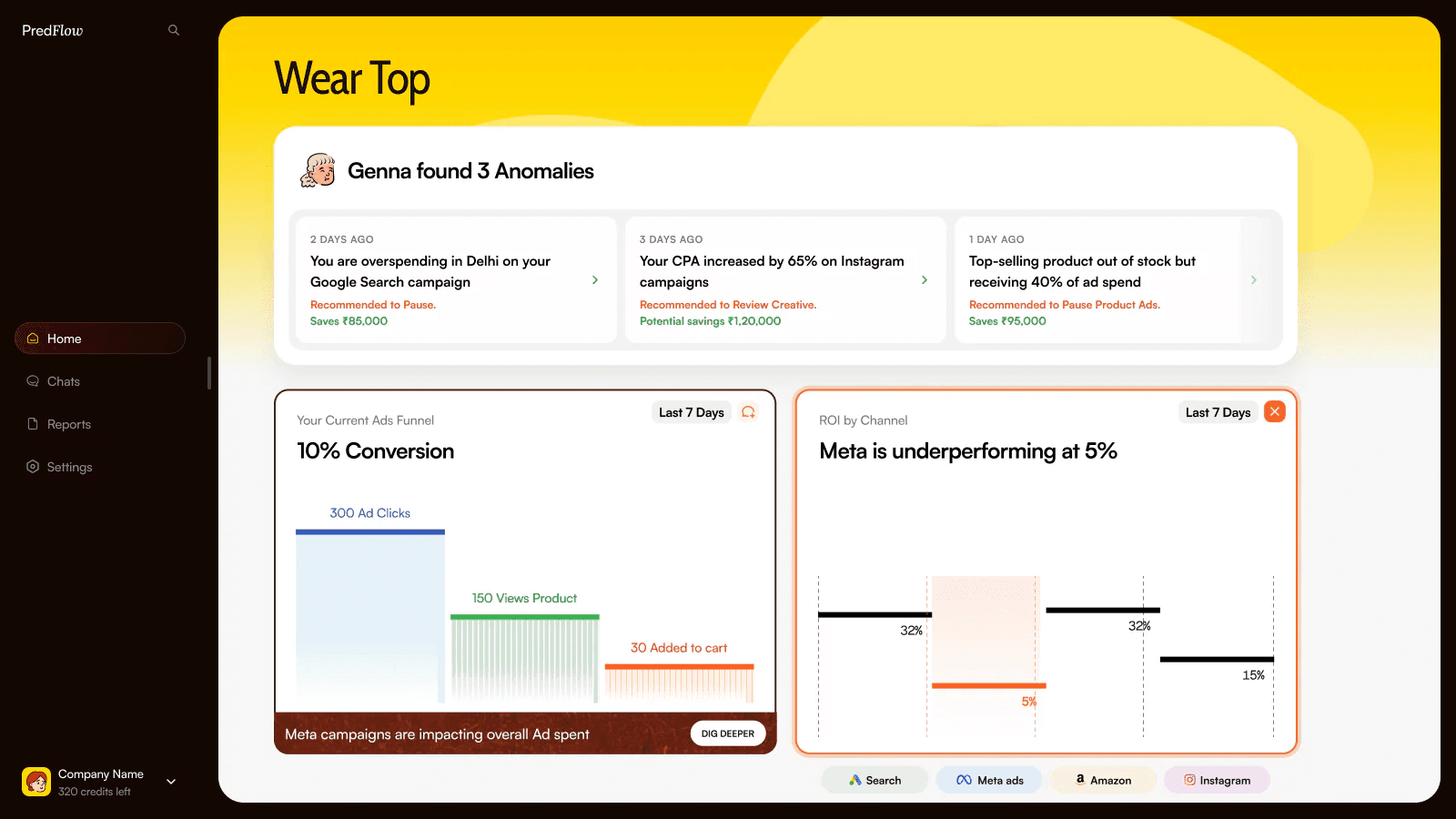
Predflow takes a different approach from most tools on this list. Instead of being a pure attribution platform, it combines true multi-touch attribution with ad intelligence and anomaly detection under one roof. The attribution layer reconciles revenue across Meta, Google, and Shopify so your total attributed revenue never exceeds actual sales. That sounds obvious but most tools still let platforms over-claim.
What sets it apart is the influence-based model. Rather than applying fixed formulas (40/40/20 splits or equal distribution), Predflow maps actual influence percentages across touchpoints based on real customer behavior. An Instagram view might get 20% influence, an email click 50%, and a WhatsApp message 30%, all calculated from your specific data rather than a predetermined formula.
The anomaly detection layer is genuinely unique in this category. No other attribution tool on this list alerts you when ROAS drops with a root cause diagnosis attached. Most tools tell you what happened. Predflow tells you why.
Also worth noting: Predflow offers a free ad analysis tool that scores any creative on hook, visual, CTA, and audience fit. No signup required. Useful even if you use a different attribution platform.
Key Features
True Multi-Touch Attribution: Maps real influence percentages across every touchpoint in the customer journey, calculated from your actual data instead of fixed formulas.
Reconciled Cross-Platform Revenue: Ensures attributed revenue across Meta, Google, and Shopify never exceeds actual sales, eliminating the over-claiming problem most platforms have.
Creative Performance Analysis: Breaks down which ad creatives are driving results and which are fatiguing, connecting creative intelligence directly to attribution data.
Anomaly Detection with Root Cause: Automatically alerts you when ROAS drops or cancellations spike, with a diagnosis of why it happened, not just that it happened.
AI Budget Recommendations: Suggests where to shift spend based on true attributed revenue, not platform-reported numbers.
Pricing
Starts at $99/month (PredMini) with a 14-day free trial. Includes 500 AI credits, 2 users, 4 connectors (Shopify, Google Ads, Meta Ads, GA4), creative analysis, and custom reports. PredMax at $299/month adds anomaly detection, up to 8 connectors, dedicated account manager, and 4-hour support. PredPro is custom-priced for teams needing unlimited users, custom integrations, SSO, and workflow agents. 15% off on yearly plans.
Best For
D2C performance marketers managing $20K to $2M/month who want attribution plus ad intelligence without buying two separate tools.
Limitations
Newer platform with a smaller user base compared to Triple Whale or Northbeam. Less established brand recognition in the attribution space, though the product covers more ground.
2. Triple Whale
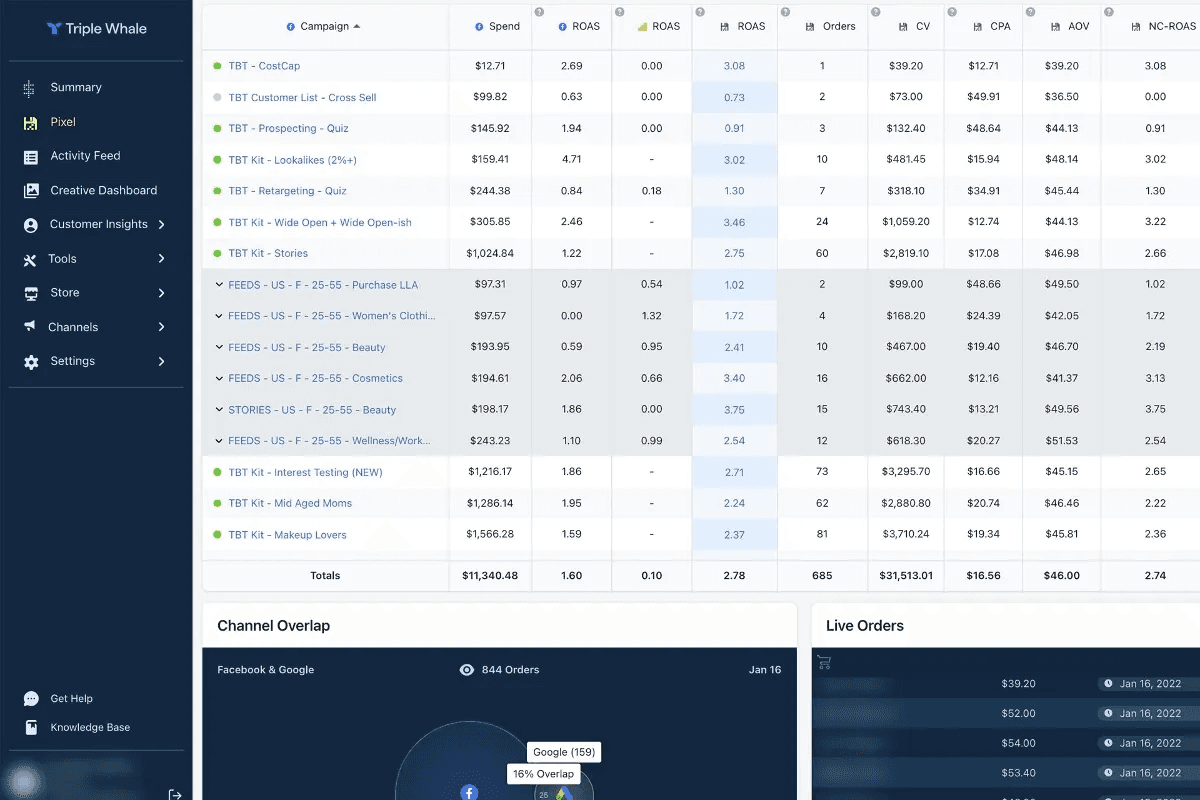
Triple Whale built its reputation by making attribution accessible to Shopify-first D2C brands. Install the app, connect your pixel, and you have blended ROAS, CAC, and profit data within an hour. For brands spending under $50K a month that just want to stop switching between platform dashboards, it does the job well.
The creative analytics feature deserves credit. You can see which specific ad creatives drive revenue, not just clicks. The AI assistant (Moby) lets you ask questions about your data in plain language.
The catch is transparency. Triple Whale's "Total Impact Attribution Model" blends pixel data, platform APIs, and modeled estimates into a single number, but the methodology behind that number is not visible to users. You have to trust the output without being able to audit how it got there.
Key Features
Shopify-Native Integration: One-click installation through the Shopify app store with automatic data syncing. No developer required to get started.
Triple Pixel Tracking: First-party pixel that captures customer journey data across devices and sessions, even when third-party cookies fail.
Creative Analytics: Track performance at the individual creative level to identify which ad variations drive the most revenue, not just clicks or impressions.
Profit Dashboard: Real-time profit calculations that factor in COGS, shipping, and ad spend for true ROI visibility across all channels in one view.
AI Assistant (Moby): Ask questions about your data in plain language and get answers without building custom reports.
Pricing
Starts around $129/month. Scales with monthly store revenue, with higher tiers adding advanced features and longer data retention.
Best For
Shopify brands under $50K/month ad spend who prioritize speed and simplicity over attribution depth.
Limitations
Shopify only. No support for WooCommerce, Magento, or custom storefronts. Attribution methodology is a black box with no way to audit how credit is distributed. Limited cross-platform depth compared to enterprise tools.
3. Northbeam
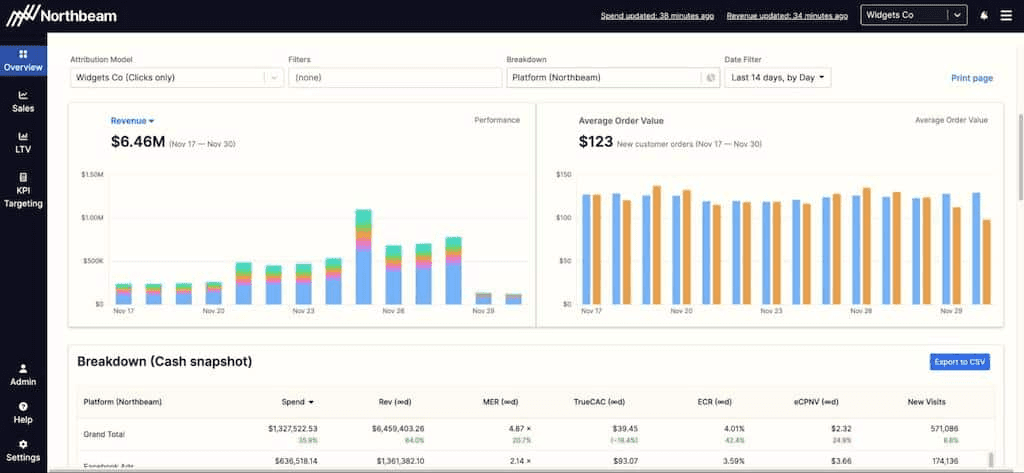
Northbeam is the "serious spend" option. Where Triple Whale groups attribution by ad account, Northbeam assigns it by individual ad and audience cohort. If you are running 100 Meta ad creatives and need to know which specific ones influence buyers, not just which campaigns, Northbeam provides that granularity.
The platform combines multi-touch attribution with media mix modeling (MMM) and incrementality testing. This hybrid approach helps brands understand both direct-response performance and the broader impact of brand-building campaigns. Data refreshes daily or near-real-time, which matters when you are making budget decisions at scale.
The tradeoff is complexity. Northbeam requires a skilled analyst to build and interpret cohort models. The interface is powerful but dense.
Key Features
Creative-Level Attribution: Tracks which specific ads, audiences, and creatives drive purchases, not just which channel or campaign gets credit.
Media Mix Modeling: Combines multi-touch attribution with MMM to understand how upper-funnel brand activity influences lower-funnel conversions.
Incrementality Testing: Measures the true "lift" of your ads, helping you avoid spending money on customers who would have bought anyway.
Configurable Attribution Windows: Set different lookback windows per channel instead of one global rule, reflecting how different platforms influence at different speeds.
Multi-Platform Coverage: Unified view across Meta, TikTok, Pinterest, Snap, Google, and Microsoft in a single dashboard.
Pricing
Starts at $1,000/month for growth-stage brands. Scales with pageviews and data volume. Enterprise tiers available for larger operations.
Best For
Brands spending $100K+/month across 4+ channels with a data-savvy team that can interpret cohort models and configure complex attribution setups.
Limitations
Steep learning curve. Requires a skilled analyst to get full value. Expensive for smaller brands. Needs meaningful traffic volume for ML models to produce reliable insights.
4. Cometly
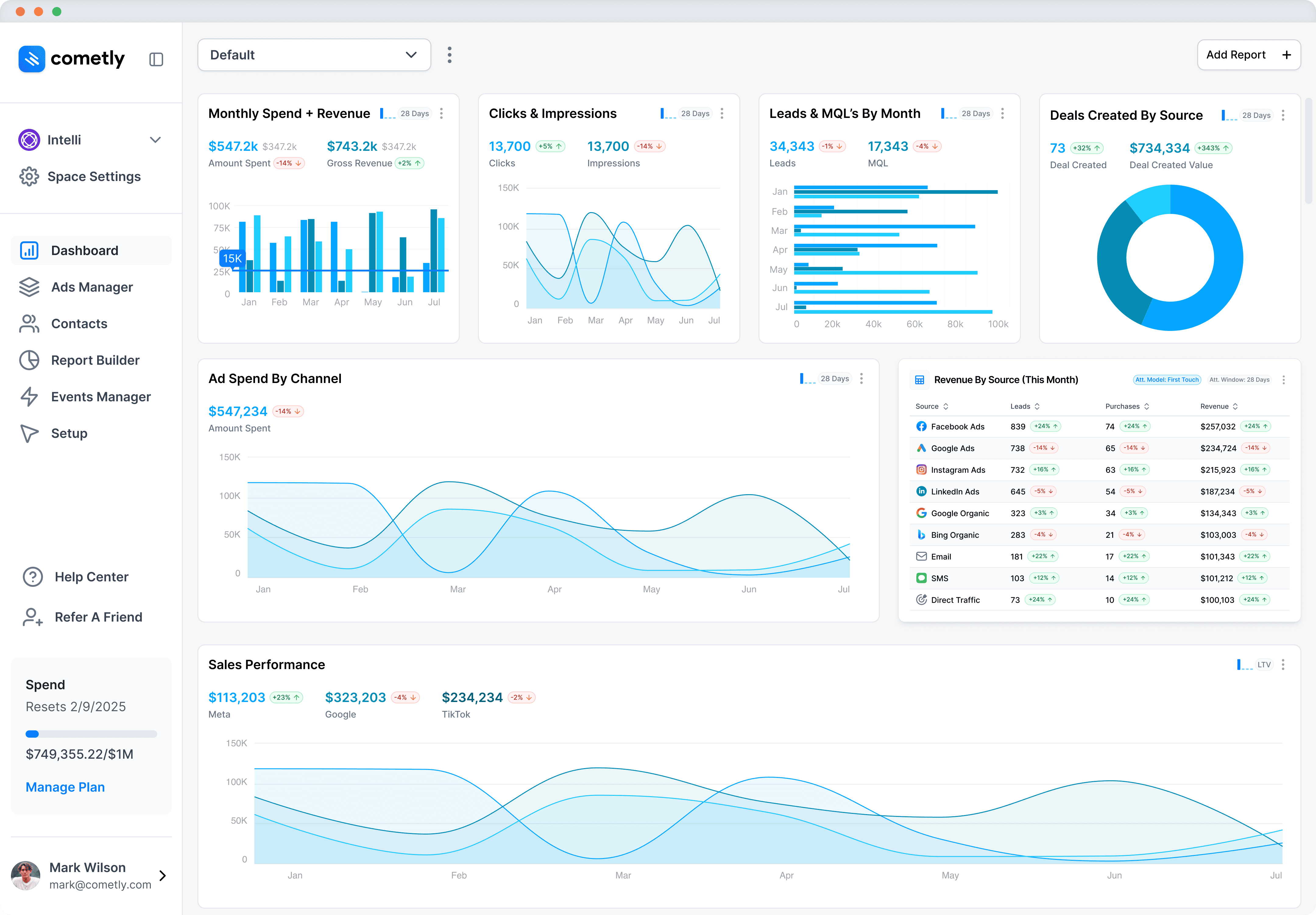
Cometly has earned a strong reputation for making attribution accurate in a post-iOS 14 world. Its server-side tracking captures conversion data that browser-based pixels miss, then feeds enriched event data back to Meta, Google, and TikTok to improve their optimization algorithms.
This conversion sync creates a feedback loop that most attribution tools lack. Better data goes into the platform, the platform optimizes better, and your campaigns improve as a direct result of the attribution tool, not just the reporting from it.
Key Features
Server-Side Tracking: Bypasses iOS tracking limitations and ad blockers by capturing conversion data directly from your server, not browser pixels.
Conversion Sync: Feeds enriched, accurate conversion data back to Meta, Google, and other ad platforms to improve their targeting algorithms. This is the key differentiator.
Multi-Touch Attribution: Track customer journeys across all marketing channels with customizable attribution models that match your business logic.
AI Ads Manager: Get actionable optimization recommendations based on real attribution data, helping you identify which ads and campaigns to scale.
Real-Time Analytics Dashboard: Access customizable attribution reports that connect ad spend to actual revenue, not just vanity metrics.
Pricing
Quote-based. Plans reportedly start around $199 to $500/month for smaller teams, with mid-tier plans around $500 to $1,000/month. Pricing scales with monthly ad spend.
Best For
D2C brands spending $10K to $100K/month who want attribution that actively improves ad platform optimization through the conversion sync feedback loop.
Limitations
Pricing not publicly listed, so early budgeting requires a sales conversation. Documentation described by some users as incomplete. Setup can be complex with larger tech stacks. Learning curve during initial implementation.
5. Rockerbox
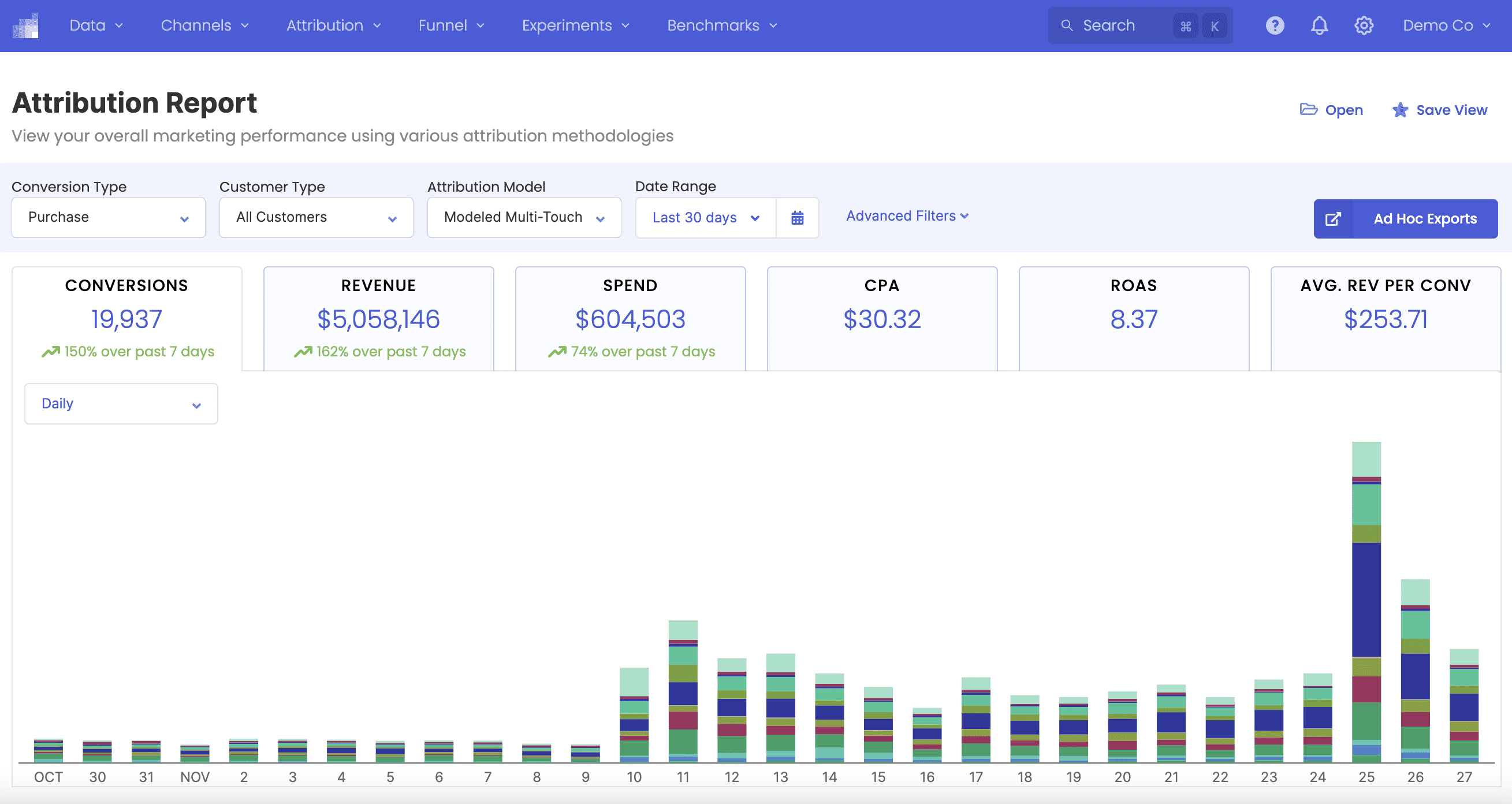
If your marketing mix includes TV, podcasts, direct mail, or influencer campaigns alongside Meta and Google, Rockerbox is one of the few tools that tracks it all in one place. Most attribution tools focus exclusively on digital channels. Rockerbox was built to include offline from the start.
The platform combines MTA, MMM, and incrementality testing under one roof with strong path-to-purchase visualization. This makes it particularly useful for CMO-level decisions about cross-channel budget allocation rather than day-to-day campaign optimization.
Key Features
Digital + Offline Attribution: Tracks TV, radio, podcasts, direct mail, influencer campaigns, and digital ads in one unified view. Few tools offer this breadth.
Path-to-Purchase Visualization: Maps the complete customer journey across channels, showing how touchpoints work together to drive conversions.
Multi-Touch and Media Mix Models: Combines MTA for digital granularity with MMM for understanding broader media impact, including offline channels.
Incrementality Testing: Validates whether campaigns are actually driving new revenue or just capturing customers who would have converted anyway.
Pricing
Custom pricing (enterprise). Requires a sales conversation.
Best For
Enterprise brands with complex media mixes spanning online and offline at scale. Particularly strong for brands spending on TV, podcasts, or direct mail alongside digital.
Limitations
Overkill for most D2C brands running purely digital campaigns. Primarily a measurement and reporting tool, not an optimization platform. Enterprise pricing makes it inaccessible for smaller teams.
6. SegmentStream
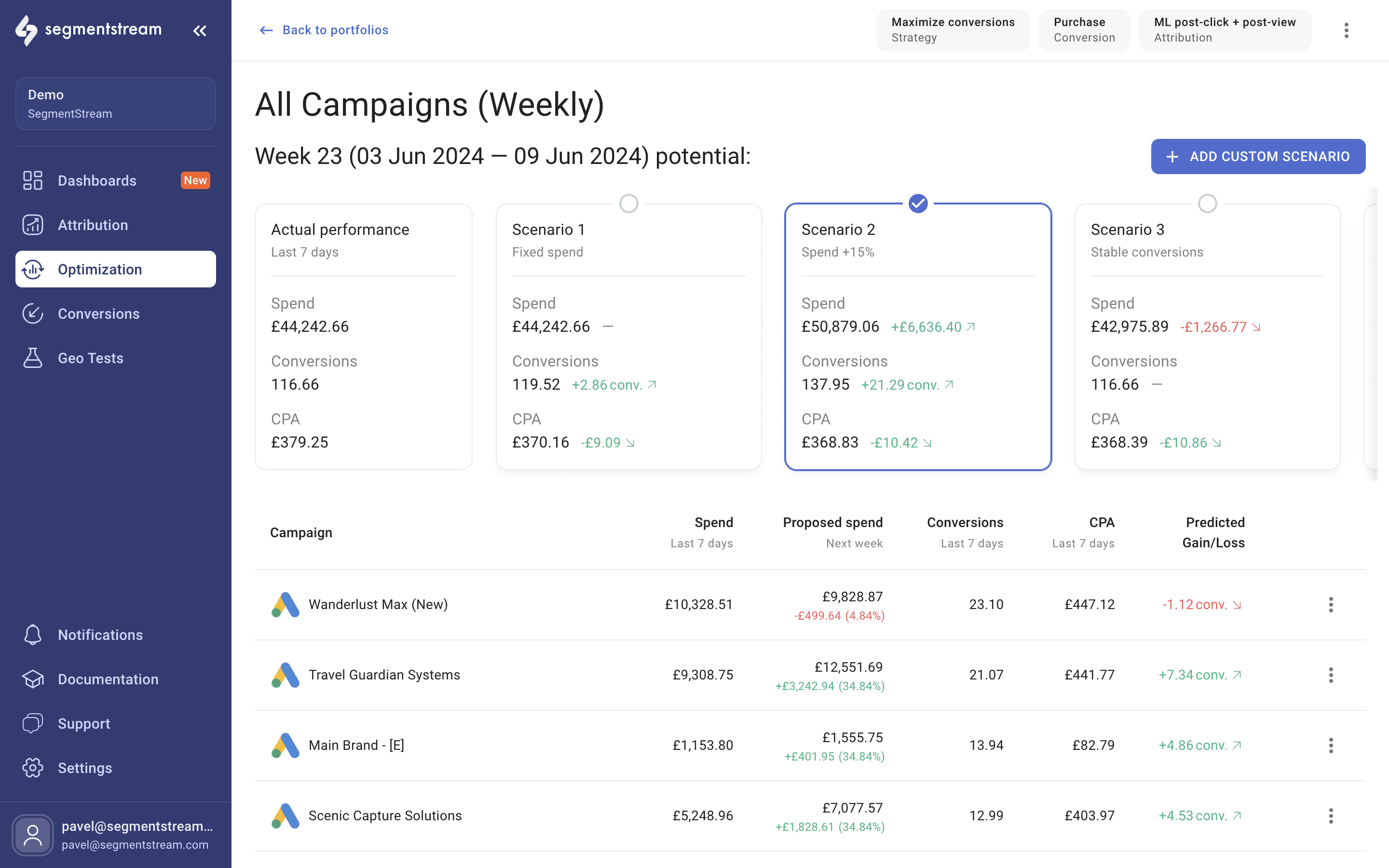
SegmentStream stands out because it closes the loop between measurement and action. Most tools on this list tell you what happened. SegmentStream acts on it. The platform combines ML-powered attribution with geo holdout incrementality testing and automated weekly budget optimization that executes without manual spreadsheet work.
The geo holdout experiments provide causal proof that a campaign is actually driving revenue rather than just correlating with it. This is a level of rigor that most D2C attribution tools do not attempt.
Key Features
ML-Powered Behavioral Attribution: Uses machine learning to analyze customer behavior patterns and assign attribution credit, going beyond static rule-based models.
Geo Holdout Incrementality Testing: Proves whether campaigns cause incremental revenue by running controlled geographic experiments. Causal proof, not just correlation.
Automated Budget Optimization: Executes weekly budget reallocation automatically based on attribution data. No spreadsheet layer or manual meetings required.
Cross-Channel Measurement: Unified view across paid, organic, and owned channels with methodology that adapts as your channel mix evolves.
Pricing
Custom (enterprise). Typically suited for brands spending $100K+/month on paid media.
Best For
Mid-market to enterprise brands that need proof of incrementality and want attribution that automatically adjusts budgets without human intervention.
Limitations
Enterprise pricing and implementation timeline. Not suitable for early-stage brands. Requires significant ad spend volume for ML models to produce reliable outputs.
7. Google Analytics 4
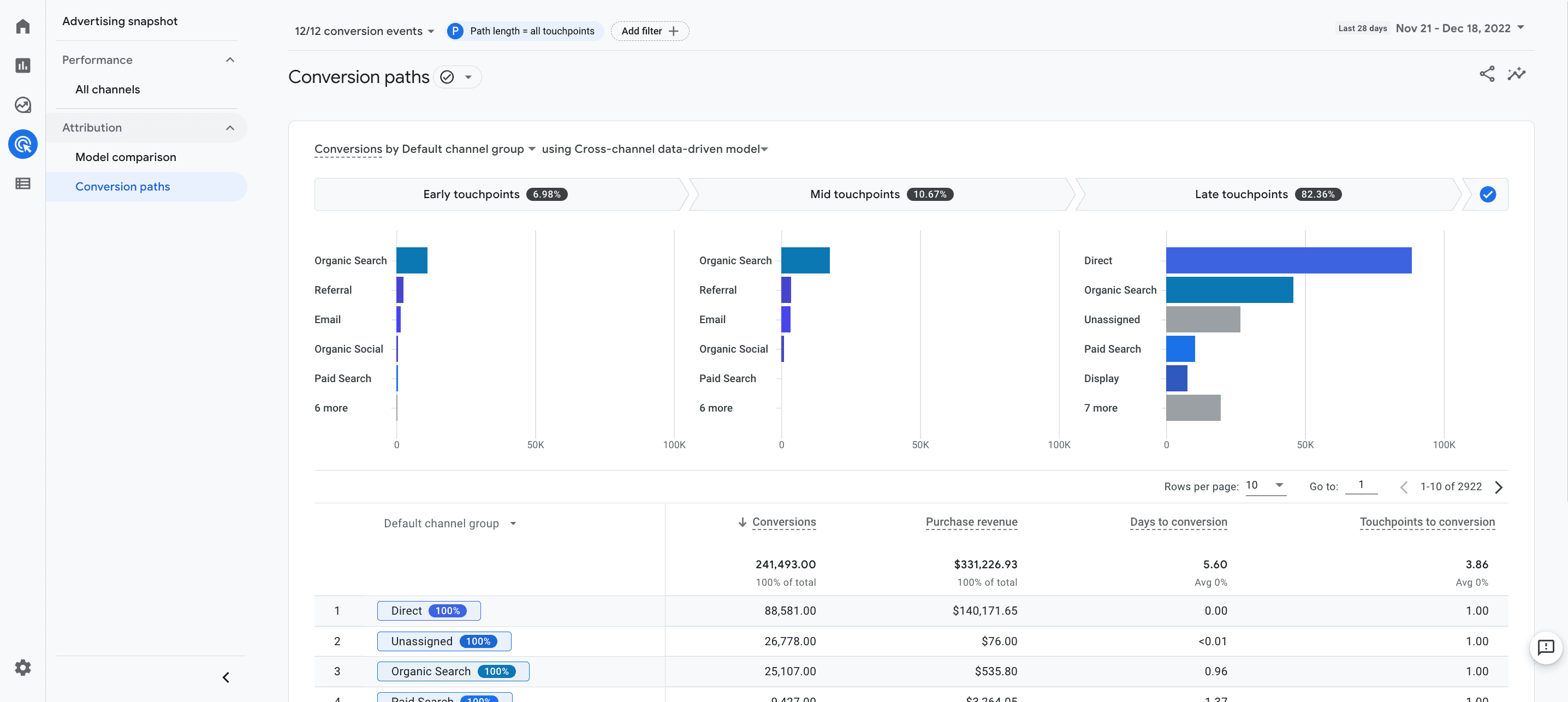
GA4 belongs on this list because every brand should have it running regardless of what other attribution tool they use. It offers data-driven attribution modeling, basic path analysis, audience insights, and conversion tracking at no cost.
That said, treating GA4 as your source of truth is how analytics start lying to you. It defaults to last-click outside of Google's own ecosystem, underreports paid social, and struggles with cross-device tracking.
Key Features
Data-Driven Attribution Model: Uses machine learning to distribute conversion credit across touchpoints, available for free to accounts with enough conversion volume.
Path Analysis: Visualize the steps customers take before converting, including which channels appear most frequently in conversion paths.
Audience Insights: Build and analyze audience segments based on behavior, demographics, and acquisition source.
BigQuery Export: Export raw event data to BigQuery for custom analysis and integration with data warehouses.
Pricing
Free.
Best For
Every brand as a foundational analytics layer alongside a dedicated attribution tool.
Limitations
Underreports paid social. Limited cross-device tracking. Provides aggregate data only, with no creative-level insights, no anomaly detection, and no reconciliation across platforms. A useful baseline, not a decision-making tool for budget allocation.
How to Pick the Right Tool
The decision comes down to three questions.
How much are you spending? Under $20K/month, start with GA4 plus one affordable tool (Predflow's free tier, Triple Whale, or Cometly). Over $50K/month, the cost of getting attribution wrong exceeds the cost of any tool on this list.
How complex is your media mix? If you run Meta and Google only, most tools here will serve you. If you add TikTok, email, SMS, influencers, or offline channels, you need something with real multi-channel depth (Northbeam, Rockerbox, or SegmentStream).
Do you need attribution alone, or attribution plus intelligence? If your problem is only "which channel gets credit," a pure attribution tool works. If your problem is "which channel gets credit AND which creatives are fatiguing AND why did ROAS drop on Thursday," you need a system that connects attribution to creative analysis and anomaly detection.
No attribution tool gives you perfect numbers. The goal is to get close enough to the truth that your budget decisions are better than guessing. Pick the tool that matches your spend level, your channel complexity, and your team's ability to act on the data it produces.
Improve Ad performance with Predflow
Diagnose performance drops, creative fatigue, and attribution shifts