Finance
ZAM's: What It Is and How AP Teams Use It
AP teams spend hours every week on manual entry, email approvals, and late-stage discrepancies. Here's how ZAM's are changing that workflow for good.

Khusbu Adav
Product at Predflow

Every week, AP teams lose hours to the same cycle: keying invoice data by hand, chasing approvals across email threads, and finding discrepancies only after month-end close has already started. The time cost is visible. The visibility cost is worse. When no one can tell where a transaction is in the process, errors compound quietly until they become expensive.
ZAM's is a structured system designed to eliminate exactly this kind of repetitive, rules-bound coordination failure. It organizes users, devices, and data synchronization into a trackable workflow that reduces manual handoffs. This article explains what ZAM's actually is, how it structures back-office processes, the errors AP teams most commonly hit, and where its limits are so you can decide whether it solves your specific problem.
What ZAM's Actually Is (and What the Name Refers To)
ZAM's as a Workflow and Device Management System
ZAM's, in an AP and operations context, refers to the Zebra Access Management System (ZAMS). It is a portal and device management platform that controls user access, kiosk devices, and data synchronization across defined sites. AP and operations teams use it to coordinate structured, repeating processes where consistent access control and real-time data accuracy matter.
Direct definition: ZAMS is a device and access management system that organizes users into sites, assigns privileged roles, and synchronizes data across kiosk devices. It removes manual handoffs by enforcing structured rules for who can do what, on which device, and when.
Where the Confusion Comes From: Other Uses of the Name
The name ZAM's also appears in an unrelated context. ZAM's Bowls and Burritos is a restaurant in Pensacola, Florida, which recently opened a location featuring a self-order display. That ZAM's has nothing to do with workflow coordination or AP processes. If you landed here looking for the restaurant, you are in the wrong place. If you landed here looking for the access and device management system used in operations environments, you are in the right one.
The Core Function: Structured Process Coordination
ZAMS works by assigning users to sites, connecting those sites to physical kiosk devices, and keeping data synchronized across all of them. Every transaction, access event, and status update flows through this structure. The result is a traceable chain of activity rather than a collection of disconnected manual steps.
How ZAM's Structures a Back-Office Workflow
Sites, Devices, and User Roles: The Building Blocks
ZAMS organizes its environment around three core elements:
Sites. A site is a logical grouping of users and devices. Each site has its own configuration, access rules, and synchronization schedule.
Devices (Kiosks). Physical kiosk devices connect to the site and serve as the operational touchpoints where users interact with the system.
User Roles. Roles define what each user can see and do. The most significant role is ROLE_DEVICE_INTERNAL_USER, a privileged role limited to five users per site.
This structure creates a clear hierarchy. Actions are traceable, access is bounded, and configuration changes at the site level flow down to every connected device.
Synchronization Settings and Why They Matter for AP Teams
Synchronization settings control how often data updates flow between the portal and kiosk devices. When those settings are too low for the volume of activity on a site, the system starts showing incorrect data. For an AP team, this is a concrete problem: an invoice that appears unprocessed may already be approved, or a count that looks accurate at 9 a.m. may be stale by noon.
Getting synchronization right means matching the sync frequency to the actual transaction volume at each site. High-volume sites need more frequent syncs. A configuration that worked six months ago may no longer be sufficient as transaction volume grows.
Privileged Roles and Access Control in ZAMS
The five-user limit on ROLE_DEVICE_INTERNAL_USER per site is not arbitrary. It reflects the access control logic built into ZAMS: privileged roles are constrained to prevent configuration conflicts and unauthorized changes. For AP team leads, this means planning role assignments carefully before deployment, not after problems appear.
If a site needs more than five privileged users to function, the right solution is splitting the site, not overloading the role. This is a scaling decision with real operational implications, covered in a later section.
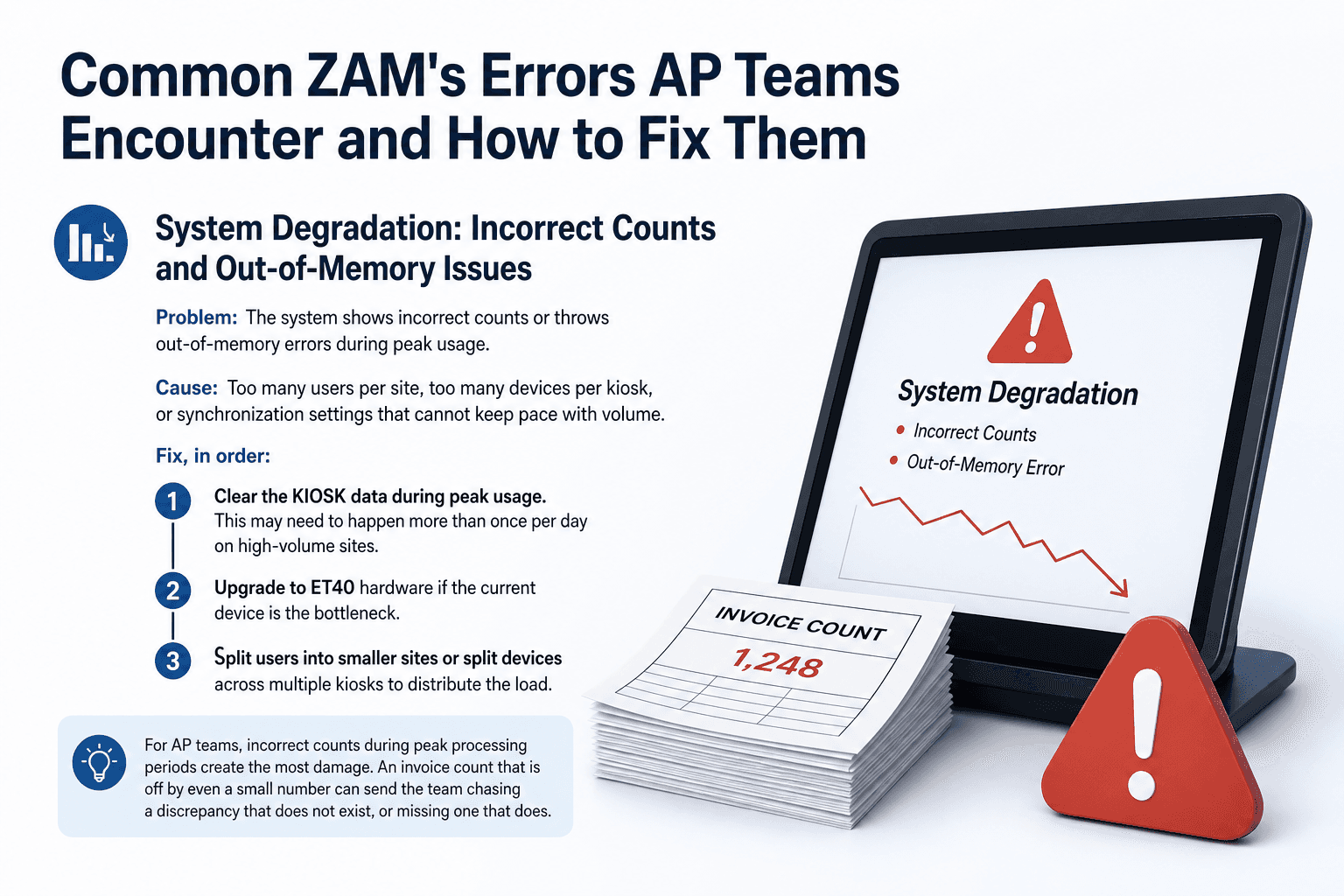
Common ZAM's Errors AP Teams Encounter and How to Fix Them
System Degradation: Incorrect Counts and Out-of-Memory Issues
Problem: The system shows incorrect counts or throws out-of-memory errors during peak usage.
Cause: Too many users per site, too many devices per kiosk, or synchronization settings that cannot keep pace with volume.
Fix, in order:
Clear the KIOSK data during peak usage. This may need to happen more than once per day on high-volume sites.
Upgrade to ET40 hardware if the current device is the bottleneck.
Split users into smaller sites or split devices across multiple kiosks to distribute the load.
For AP teams, incorrect counts during peak processing periods create the most damage. An invoice count that is off by even a small number can send the team chasing a discrepancy that does not exist, or missing one that does.
Forgotten Passwords and One-Time URL Errors
Problem: A user clicks a one-time reset URL, which immediately expires. They are now locked out with no valid credentials and no way to reset the password themselves.
Cause: The one-time URL is consumed on click. If the user does not set a new password in that same session, the URL no longer works and the account is effectively frozen.
Fix: Escalate to the ZAMS Database owner. Only the database owner has the permissions to reset the password and issue new credentials. This is not something an admin user or site manager can resolve independently.
The practical lesson: AP team leads should document who holds the ZAMS Database owner role before this situation occurs, not during it.
KIOSK or Wi-Fi Down: What to Do Without Logging In
Problem: The kiosk goes offline or Wi-Fi drops. The device alarms when removed.
Reality: ZAMS requires an active Wi-Fi connection to function. Without it, the PIN screen will not display, and users cannot log in.
Fix: Admin users can generate a ZAMS Master Unlock Code from the portal. This code disables the alarm without requiring login on the device itself. It is the only way to safely handle a downed kiosk without escalating to on-site support.
The important preparation step: ensure at least one admin user knows where to generate the Master Unlock Code in the portal before a kiosk goes down during a critical processing window.
Where ZAM's Fits in a Broader AI Agent Workflow
What ZAM's Handles Well: Defined Rules and Device Coordination
ZAMS is built for structured, rules-based environments. It excels at enforcing who can access what, keeping devices synchronized, and maintaining a consistent record of activity across sites. For processes that follow a defined path with predictable inputs, ZAMS provides the coordination layer that manual workflows cannot.
This makes it genuinely useful for AP operations that run on repetitive, high-volume transactions where access control and data accuracy are the primary concerns.
Where Manual Gaps Remain: Edge Cases and Cross-System Handoffs
Rules-based systems handle defined scenarios well. They do not handle exceptions. When an invoice arrives with line items that do not match the purchase order exactly, ZAMS flags it or stops it. What happens next is still a manual decision.
The same gap appears in cross-system handoffs. If a vendor portal does not connect natively to ZAMS, someone is copying data by hand. If an approval needs to route to a different manager based on invoice value or vendor category, a static role structure does not make that call. These are the moments where AP teams lose the time and visibility that a structured system was supposed to provide.
How AI Agents Complement ZAM's in AP and Operations Workflows
AI agents work differently from rules-based systems. An AI agent can read an invoice where line items are formatted inconsistently, match it to the correct PO based on context, and route the exception to the right approver based on dollar amount and vendor history. It does not need a perfect data structure to function. It handles the ambiguity that ZAMS cannot.
This is the gap that agent-based automation fills: not replacing structured coordination, but extending it into the decisions that still require judgment. Predflow builds AI agents designed specifically around these edge cases, starting with process mapping rather than tool deployment. For AP teams that have already configured ZAMS but still find manual work piling up at the exception layer, that process-first approach means agents are built around the actual handoffs that break down, not generic templates.
Scaling ZAM's: When to Split Sites Versus When to Add Automation
The Splitting Threshold: Signs Your ZAM's Configuration Is Overloaded
Not every performance problem in ZAMS is a sign that the system is the wrong tool. Some problems are configuration problems. The signals that your current ZAMS setup is overloaded include:
Incorrect counts appearing during peak usage hours
Out-of-memory errors on kiosk devices under normal transaction volume
Synchronization delays that cause data to be stale at processing time
KIOSK data clearing becoming a daily operational task rather than an occasional one
If these symptoms appear, the first response is configuration adjustment, not a platform change.
Hardware Upgrades vs. Process Automation: A Decision Checklist
Use this checklist to separate configuration fixes from automation needs:
Symptom | First Action |
|---|---|
Out-of-memory on kiosk devices | Upgrade to ET40 |
Too many users causing degradation | Split into smaller sites |
Too many devices per kiosk | Split devices across multiple kiosks |
Sync settings too low for volume | Increase sync frequency |
Manual exceptions piling up post-processing | Add AI agent layer |
Cross-system data gaps requiring manual entry | Add AI agent layer |
Approval routing requiring contextual judgment | Add AI agent layer |
The first four symptoms are ZAMS configuration problems. The last three are not. No hardware upgrade or site split resolves a process gap that the system was never designed to handle.
What "Scaling Without Hiring" Actually Requires
Splitting sites and upgrading hardware scales the infrastructure. It does not scale the work. If your team is processing 30% more invoices than last quarter and the bottleneck is human judgment at the exception layer, adding a kiosk or splitting a site does not reduce that load.
Scaling without hiring means automating the decisions that currently require a person. That requires a different layer than ZAMS provides. Structured coordination handles volume. Context-aware automation handles complexity. AP teams that are hitting both limits at the same time need both layers working together.
Frequently Asked Questions
What does ZAM's stand for in an AP or operations context?
ZAM's stands for Zebra Access Management System (ZAMS). It is a portal and device management platform that organizes users, kiosk devices, and data synchronization into sites. AP and operations teams use it to enforce structured access control and maintain data accuracy across high-volume, repeating workflows.
What is the ZAMS Master Unlock Code and when do you need it?
The ZAMS Master Unlock Code is a code generated by admin users from the ZAMS portal. You need it when a kiosk device goes offline or is removed and triggers an alarm, and you cannot log in because Wi-Fi is unavailable. The code disables the alarm without requiring device login.
How many users can a ZAM's site support before performance degrades?
ZAMS limits the privileged ROLE_DEVICE_INTERNAL_USER role to five users per site. Beyond that threshold, system degradation becomes a risk. If a site requires more users, the recommended fix is splitting users into smaller sites rather than overloading a single site configuration.
Can ZAM's integrate with AI agents or automation platforms?
ZAMS handles structured device and access coordination. AI agents can be layered on top of ZAMS workflows to handle the edge cases and cross-system decisions that rules-based systems cannot manage. The integration point is at the process handoff level, where unstructured decisions or external system connections create gaps.
What should I do if a user gets locked out of the ZAM's portal after clicking a one-time reset link?
Escalate to the ZAMS Database owner immediately. The one-time URL is consumed on click, and no admin or site manager can reset the account independently. Only the ZAMS Database owner has the permissions to issue new credentials. Document who holds this role before the situation occurs to avoid delays during active processing windows.
Where This Leaves Your AP Team
ZAMS solves a real problem. It brings structure to environments where uncoordinated device access and data synchronization failures create noise that costs time and accuracy. For teams running high-volume, repeating processes, that structure matters.
But rules-based systems have a ceiling. When the volume of exceptions grows, when cross-system handoffs multiply, or when approval logic requires context that a static role structure cannot provide, configuration fixes stop being the right answer. At that point, the question is not how to reconfigure what you have. It is what layer of automation handles the decisions that fall outside defined rules.
If you are mapping out where your AP or operations workflow still breaks down despite your current tools, explore how Predflow's process-first AI agents are built to handle exactly those gaps, without ripping out what is already working.
Bring 20 NetSuite bills to a 30-minute teardown
We will walk your actual invoices through capture, 3-way match and posting on the call, and tell you which steps an agent can take over. No prep beyond the PDFs.
FAQ
Frequently asked questions
What exactly is an AI agent
An AI agent is an autonomous system designed to handle specific business tasks end-to-end. Unlike simple chatbots, AI agents can reason, take actions, integrate with tools, and follow defined workflows.