Supply Chain
The Best ZAMS Alternatives for AP and Supply Chain Teams
If ZAMS isn't the right fit for your AP or supply chain operation, you're not out of options. Here are the alternatives worth a serious look.

Khushbu Adav
Product, Predflow

Your AP team has three invoices stuck in approval limbo, vendor records split across two ERPs and a spreadsheet, and no clear way to trace where the process broke down. ZAMS is one platform some teams have turned to for automating these kinds of workflows. But it does not fit every operation, budget, or tech stack.
If you have evaluated ZAMS and found it too rigid for your process, too expensive for your team size, or simply not the right architectural fit, this article gives you a practical comparison of alternatives that handle real workflow complexity. Not a feature checklist. A guide to what each tool actually does well in AP and supply chain contexts, and where each one falls short.
What ZAMS Does and Where Teams Hit Its Limits
What ZAMS Is Built For
ZAMS is an AI agent workflow platform designed to automate repetitive business processes. Its core value proposition centers on reducing manual handoffs across structured, rule-based operations. Teams in procurement, AP, and vendor management have used it to handle tasks like invoice routing, approval chains, and data entry between systems.
The platform appeals to operations leaders who want AI automation without building from scratch. It provides an agent platform with preconfigured workflows that can be adapted to common back-office scenarios.
Common Friction Points Teams Report
The most common fit issue is workflow rigidity. Teams with non-standard approval logic, complex vendor hierarchies, or frequent exceptions find that ZAMS requires significant workarounds to handle edge cases outside its default configurations.
Integration depth is another pressure point. Connecting ZAMS to enterprise ERP systems like SAP or Oracle often demands more technical lift than initial estimates suggest. For teams mid-migration or running hybrid systems, this creates friction rather than reducing it.
One mistake teams make repeatedly is choosing an automation tool before mapping the process it will automate. This leads to configuring a platform around assumptions rather than actual workflow logic, which surfaces problems only after deployment. If you recognize this pattern, the alternatives below are evaluated with that risk in mind.
How to Evaluate Any ZAMS Alternative Before You Commit
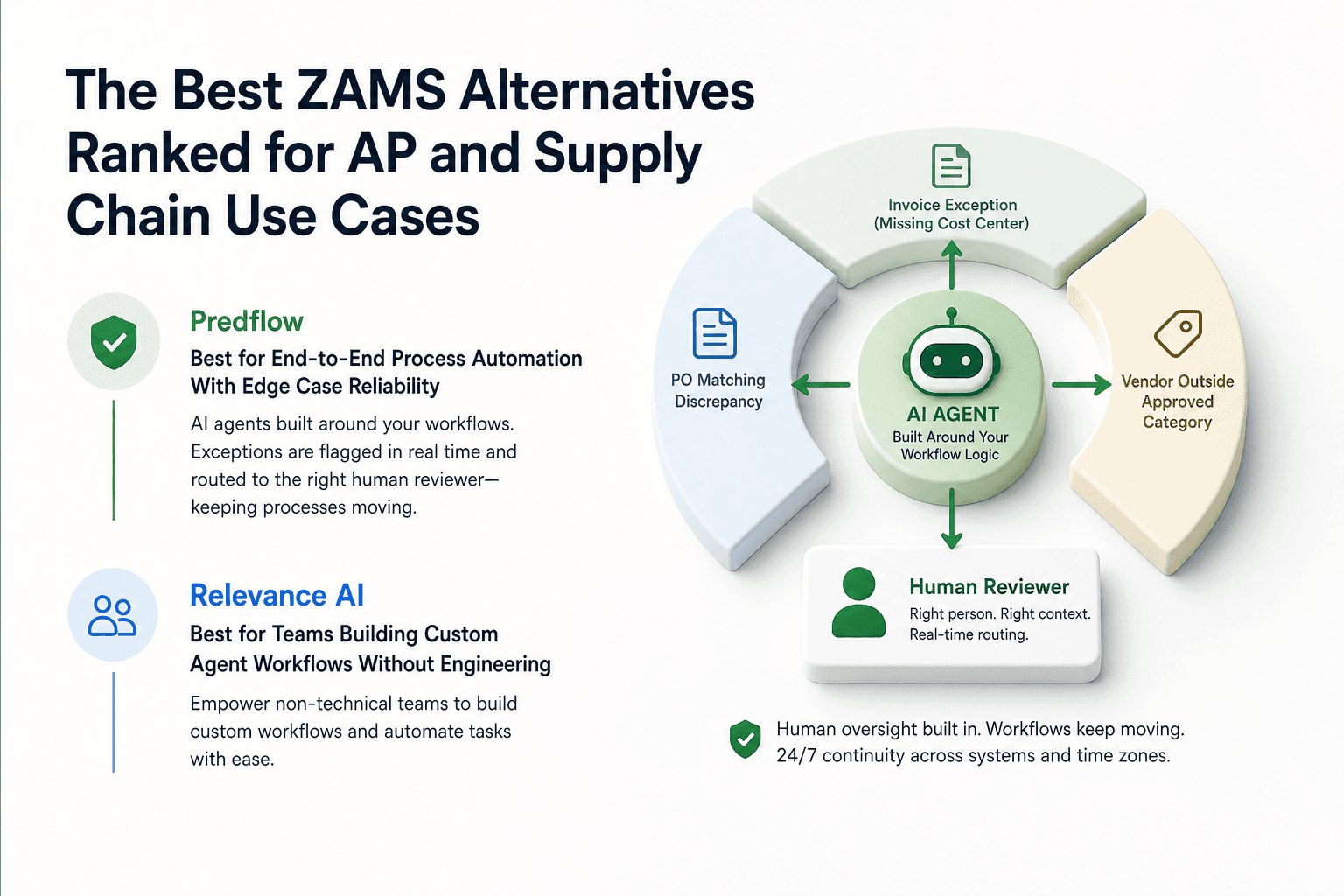
A ZAMS alternative that looks clean in a demo can create new manual work six weeks after deployment. These four criteria help you assess fit before you commit.
Process-First vs. Tools-First Architecture
Some platforms hand you a set of agent tools and expect you to assemble your workflow. Others start by mapping your process and then build agents around it. In AP and supply chain environments, where exception handling is the norm rather than the exception, process-first architecture reduces the gap between what the tool promises and what it delivers on day one.
Edge Case Handling and Human Oversight
The question is not whether the agent handles standard invoices. It is what happens when a PO has a line-item discrepancy, a vendor submits a duplicate, or an approval chain includes a substitution. Platforms without built-in human oversight escalation routes these exceptions back to email. Look for tools where exception flagging and human review are designed into the workflow, not added as an afterthought.
Integration Depth With ERP and Procurement Systems
Surface-level connectors that push and pull data are not the same as deep ERP integration that reads approval hierarchies, cost center rules, and vendor master data. Ask specifically how the platform handles bidirectional sync with your ERP. Shallow integrations create data reconciliation work that offsets any automation gains.
Visibility and Debugging When Something Breaks
When an automated workflow fails at 2 a.m., your team needs to know exactly which step broke, why, and what data was in the system at the time. Platforms that provide full process logs and real-time exception dashboards reduce debugging from hours to minutes. If a tool cannot show you step-level audit trails, treat that as a significant operational risk.
The Best ZAMS Alternatives Ranked for AP and Supply Chain Use Cases
Relevance AI — Best for Teams Building Custom Agent Workflows Without Engineering
Relevance AI is an AI agent builder that lets non-technical teams create custom agent workflows through a visual interface. It suits AP teams that need flexibility without depending on a developer for every configuration change.
Its key strength is the low barrier to building and modifying agents. Teams can create multi-step workflows that pull data, apply logic, and trigger actions across connected tools without writing code. For supply chain teams experimenting with automation before committing to enterprise contracts, this makes iteration fast.
The main limitation is that Relevance AI is optimized for workflow construction, not deep ERP integration. Teams running complex procurement systems may find the native connectors insufficient for their data environment.
Lyzr AI — Best for Enterprises Needing Agent Governance and Compliance
Lyzr AI is an enterprise-grade agent framework focused on governance, audit trails, and compliance controls. It fits regulated industries where AI agent actions need to be logged, reviewable, and auditable.
For AP teams in industries with strict financial controls, Lyzr AI’s governance architecture means every agent action is traceable. This reduces compliance risk when automating payment approvals or vendor data updates.
The main limitation is implementation complexity. Lyzr AI requires meaningful technical resources to deploy and configure, which puts it out of reach for smaller operations teams without dedicated IT support.
CrewAI — Best for Multi-Agent Orchestration on Technical Teams
CrewAI is an open-source multi-agent framework that allows technical teams to build systems where multiple AI agents collaborate on a shared task. It suits supply chain teams with engineering resources who want fine-grained control over agent orchestration.
Its key strength is flexibility. Technical teams can define agent roles, task delegation, and communication patterns precisely. For complex procurement workflows involving multiple data sources and decision points, this level of control is hard to replicate in no-code tools.
The main limitation is the technical requirement. CrewAI is not built for operations teams without developer support. Deployment, maintenance, and debugging require coding competency, which limits adoption outside technical environments.
Decagon AI — Best for Customer-Facing Automation Alongside Back-Office Workflows
Decagon AI is an AI agent platform built primarily for customer-facing interactions, with the ability to connect front-end workflows to back-office processes. It suits supply chain teams that handle vendor or supplier communication as part of their workflow.
Its key strength is bridging customer-facing and internal automation. For teams managing supplier queries, order confirmations, or dispute resolution alongside internal AP tasks, Decagon reduces the number of separate tools required.
The main limitation is that its back-office automation depth is secondary to its customer-facing capabilities. For teams focused purely on internal AP and supply chain workflows, more specialized platforms deliver more relevant features.
Obviously AI — Best for Finance Teams Wanting Predictive Automation
Obviously AI is a predictive analytics and automation platform aimed at finance teams that want to add forecasting and prediction to their workflow automation. It suits AP teams looking to anticipate cash flow issues, payment timing, or vendor risk rather than purely react to them.
Its key strength is accessible predictive modeling. Finance teams without data science resources can build predictive workflows that flag likely late payments or supplier delays before they escalate.
The main limitation is that Obviously AI is better at generating predictions than executing end-to-end process automation. Teams that need full workflow automation alongside prediction will need to pair it with another platform.
What Makes a ZAMS Alternative Actually Work for Supply Chain Automation
The AI agent platforms that succeed in supply chain and AP automation share three traits: they map the process before deploying the agent, they handle exceptions without defaulting to human escalation for every edge case, and they provide full audit visibility so teams can debug failures without reverse-engineering logs. Tools that skip process mapping and jump straight to automation deployment consistently hit edge cases they cannot resolve without human escalation.
Why Most Automation Tools Stall at the Edge Cases
Standard invoices are not the problem. The problem is the invoice with a line-item discrepancy, a duplicate PO reference, or a vendor who submitted in the wrong currency. Rule-based automation systems handle the 80 percent of transactions that fit the expected pattern. They stall on the 20 percent that do not.
This is where the difference between traditional automation software and context-aware AI agents becomes operational rather than theoretical. Knowledge-based agents in artificial intelligence can apply conditional logic across multiple variables simultaneously, recognizing that an invoice flagged for duplicate submission is different from one flagged for budget overrun, and routing each accordingly. Rule-based systems treat both as errors and stop.
The Role of Context-Aware Agents vs. Rule-Based Automation
The difference between agentic AI and generative AI matters here. Generative AI produces outputs. Agentic AI takes actions, evaluates outcomes, and adjusts based on context. In supply chain automation, agentic systems can hold context across a multi-step process, recognize when a step has failed due to missing data rather than incorrect data, and retrieve the missing information rather than abandoning the task.
Agentic RAG (retrieval-augmented generation for agents) extends this further by allowing agents to pull from your internal knowledge base, vendor records, or contract terms before making a routing decision. This is what separates platforms that genuinely reduce manual work from those that shift it to a different inbox.
Quick Comparison Table: ZAMS Alternatives at a Glance
Each tool below is evaluated on the criteria most relevant to AP and supply chain teams. See the FAQ below for specific questions about deployment, integration, and team readiness.
Tool | Best For | Deployment Complexity | ERP Integration | Human Oversight Built In | Pricing Model |
|---|---|---|---|---|---|
Relevance AI | Custom agent workflows without engineering | Low | Partial | Partial | Subscription |
Lyzr AI | Enterprise governance and compliance | High | Deep | Yes | Custom |
CrewAI | Multi-agent orchestration for technical teams | High | Partial | Partial | Open source |
Decagon AI | Customer-facing + back-office workflow bridge | Medium | Partial | Partial | Custom |
Obviously AI | Predictive automation for finance teams | Low | Partial | No | Subscription |
Frequently Asked Questions
What is ZAMS used for in business operations?
ZAMS is an AI agent workflow platform used to automate structured, repetitive business processes, primarily in back-office functions like accounts payable, procurement, and vendor management. It helps teams reduce manual data entry and handoffs between systems. Teams that outgrow its default configurations or need deeper ERP integration typically begin evaluating alternatives.
Which ZAMS alternative is best for accounts payable automation?
Relevance AI is a practical fit for AP teams dealing with invoice exceptions, PO matching, and multi-step approval workflows, especially for smaller teams that need flexibility without engineering resources.
Can AI agent platforms integrate with existing ERP systems like SAP or Oracle?
Yes, but integration depth varies significantly. Platforms like Lyzr AI offer deeper ERP integration that reads approval hierarchies and cost center rules. Others provide surface-level connectors that transfer data without interpreting your ERP’s logic, which creates reconciliation work downstream.
What is the difference between agentic AI and traditional automation software?
Traditional automation software follows fixed rules. It executes the same steps every time and stops when conditions fall outside its ruleset. Agentic AI takes actions, evaluates outcomes, and adjusts based on context. In AP workflows, this means an agentic system can recognize why a step failed and attempt to resolve it, rather than simply flagging an error and waiting for a human.
How do I know if my team is ready to deploy an AI agent for supply chain workflows?
The clearest signal is whether your team has documented the workflow you want to automate, including its exceptions. If you cannot describe what happens when an edge case occurs today, an AI agent will not handle it reliably. Teams that have mapped their process, identified their exception types, and quantified where manual work concentrates are ready to evaluate platforms.
Are there free AI agent platforms suitable for small AP teams?
CrewAI is open source and free to use, but it requires technical resources to deploy. For small AP teams without engineering support, the effective cost is the developer time required to build and maintain it. Relevance AI offers entry-level subscription tiers that reduce the technical barrier. Fully free platforms with enterprise-grade ERP integration do not currently exist.
Conclusion
Two types of teams read this article. The first needs something deployable quickly across structured, predictable workflows with minimal process documentation. Relevance AI or Obviously AI fit this path. The second needs a platform that can handle genuine complexity, route exceptions reliably, and scale without adding headcount. Lyzr AI fits this path.
Neither path succeeds without understanding your own process first. Most automation projects fail not because the tool was wrong, but because the team deployed it against workflows they had not fully mapped. The platform choice matters less than that foundation.
If your team is dealing with broken handoffs and exception-heavy workflows that simpler tools keep bouncing back to humans, explore how Predflow maps your process before building the agent. Start with a free workflow assessment.
Bring 20 NetSuite bills to a 30-minute teardown
We will walk your actual invoices through capture, 3-way match and posting on the call, and tell you which steps an agent can take over. No prep beyond the PDFs.
FAQ
Frequently asked questions
What exactly is an AI agent
An AI agent is an autonomous system designed to handle specific business tasks end-to-end. Unlike simple chatbots, AI agents can reason, take actions, integrate with tools, and follow defined workflows.