



A few years ago, running Meta ads meant choosing your audience, setting your placements, managing bids, testing creatives, and adjusting budgets manually. It was time-consuming and often wrong. But it felt like control.
That era is effectively over.
Meta Advantage+ now handles targeting, placements, budget distribution, and creative optimisation automatically. 65% of Meta advertisers are already scaling through it. Meta has publicly stated its goal is to get to a point where an advertiser provides a budget, a goal, and a single product image — and the AI builds and runs everything else.
For D2C performance marketers, this raises a question that most people are not asking loudly enough: if the platform is making all the campaign decisions, what is the human actually responsible for?
The answer matters because it determines what skills stay relevant, where human effort creates leverage, and what the performance marketer's job actually looks like from here.
What Advantage+ Actually Controls Now
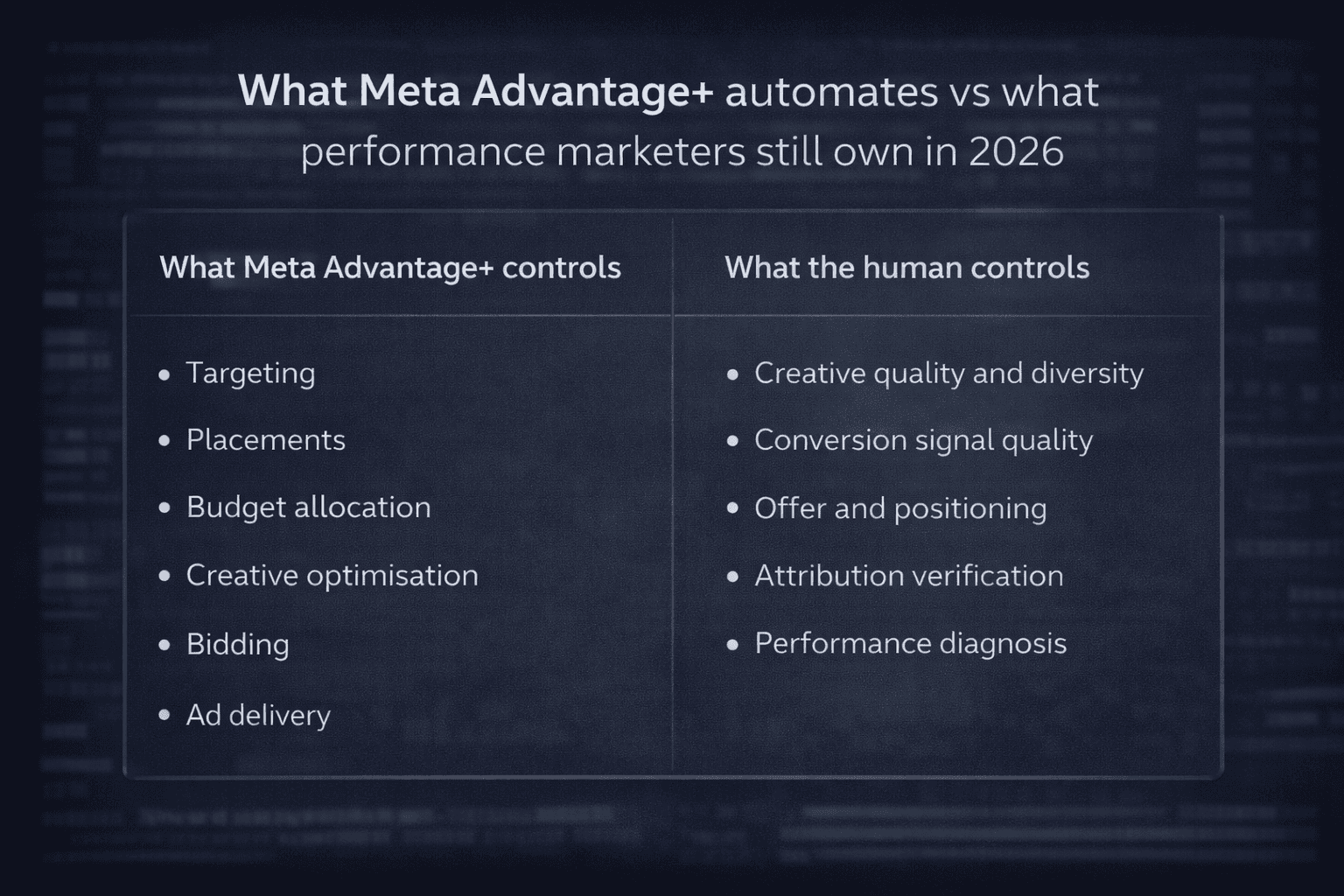
To understand what is left for humans, you first need to be clear about what Advantage+ has already taken over.
Targeting. Advantage+ Sales Campaigns (ASC) do not let you define specific audiences by interest, behaviour, or demographic beyond basic parameters like age and country. The AI decides who sees your ads based on your conversion signals and creative inputs. Manual audience building — the thing performance marketers spent years learning — is largely irrelevant inside ASC.
Placements. You cannot choose whether your ad runs on Feed, Stories, Reels, or Audience Network. Advantage+ Placements handles that automatically, allocating impressions to wherever the algorithm predicts the highest conversion probability. The human input is gone.
Budget allocation. You set a total budget. The algorithm distributes it across products, audiences, and placements in real time. You do not control which product gets how much spend at any given moment.
Creative optimisation. Advantage+ Creative tests multiple combinations of your assets — different headlines, images, cropping ratios, colour treatments — and automatically serves whichever version it predicts will perform best for each individual viewer. The platform is now running its own creative tests without asking you.
Bidding. Cost caps and manual bids still exist but are increasingly discouraged. The default is automated bidding, and most best-practice guidance now pushes toward giving the algorithm full control here too.
What is left is inputs, measurement, and strategy. Those three things are what the human performance marketer now owns.
The New Job Description: Inputs, Not Dials
The reframe that Meta itself keeps pushing is this: the question is no longer "how do we manage our campaigns?" It is "how do we give the AI the best possible inputs?"
That sounds like a downgrade. In practice, it is a different kind of hard.
Creative is now the primary lever. When the algorithm controls targeting, your creative is doing the targeting. The people your ad reaches are largely determined by the signals in the creative itself — the hook, the visual, the angle, the problem it surfaces. A creative built for a 35-year-old skincare buyer will find her not because you targeted her but because the algorithm reads the content and matches it to audience patterns.
This means creative quality and creative volume matter more than they ever did under manual targeting. Advantage+ needs a portfolio of genuinely different assets — different formats, different angles, different emotional approaches — to do its job well. Feeding it 10 variations of the same video with different captions is not diversity. The algorithm will treat it as one creative and your campaign will plateau.
The red flags in ad creatives that used to just affect individual ad performance now affect the entire campaign's ability to find new audiences. A weak hook does not just lose that impression. It teaches the algorithm the wrong pattern.
Data signals are now the second lever. Advantage+ learns from your conversion data. The quality and completeness of that data directly determines the quality of the algorithm's decisions. If your Conversions API is misconfigured, if purchase events are firing inconsistently, or if your attribution window is set incorrectly, the algorithm is optimising toward a distorted version of your real customers.
This is a problem that does not show up in your dashboard. Your ROAS might look fine. But if the signal feeding the algorithm is wrong, the people it finds and the creatives it serves will gradually drift away from what actually converts for your business.
Offer and product positioning are the third lever. In a world where you cannot micro-target by interest, the offer in your ad needs to work harder. "20% off" on a cold audience with no brand awareness rarely converts regardless of how well Advantage+ distributes it. The performance marketer who understands their customer well enough to construct an offer that lands with a cold audience is more valuable than ever. The platform can find the right person but it cannot fix a weak offer.
What Advantage+ Does Not Solve
The automation covers campaign execution. It does not cover the measurement problem that sits underneath all of it.
Advantage+ reports its own ROAS. Like any Meta campaign, it attributes conversions using its own attribution window, including view-through conversions that other channels may have actually driven. When 65% of advertisers are running Advantage+, the platform's incentive is to show those campaigns performing well — and its attribution model obliges.
The gap between what Advantage+ reports and what your Shopify account actually shows in revenue is the same gap that exists with manual campaigns. Often wider, because Advantage+ is running across more placements and formats where view-through attribution is more prevalent.
This is where the performance marketer's accountability role becomes critical. Someone needs to check what Advantage+ says it drove against what the store actually earned. Someone needs to run incrementality tests periodically to confirm the campaign is generating new demand rather than claiming credit for organic and direct traffic. And when performance drops, someone needs to diagnose whether the problem is in the creative inputs, the signal quality, or the offer — because the algorithm will not tell you.
Predflow's anomaly detection tracks when platform-reported performance diverges from actual revenue, which is often the first signal that Advantage+ attribution is inflating its numbers rather than the campaign genuinely scaling. And the ad intelligence layer gives you the creative performance breakdown — hook rate, format performance, fatigue signals — that Advantage+ does not surface in its own reporting but that directly determines how well the algorithm can do its job.
The Attribution Problem Gets Harder, Not Easier
There is a secondary effect of Advantage+ that most performance marketers are not thinking about yet.
When campaigns were more manual, underperformance was traceable. You could look at a specific ad set, a specific audience, a specific creative and diagnose what broke. The levers were visible.
Advantage+ is designed to be a black box. Meta explicitly does not expose how budget was distributed, why the algorithm made a particular creative or placement choice, or which signals drove a specific optimisation decision. The trade-off for efficiency is legibility.
This makes diagnosing a ROAS drop harder than it used to be. When performance falls in an Advantage+ campaign, the usual playbook of checking audience overlap, bid changes, or creative frequency does not apply cleanly. The variables that changed are inside the algorithm and you cannot see them.
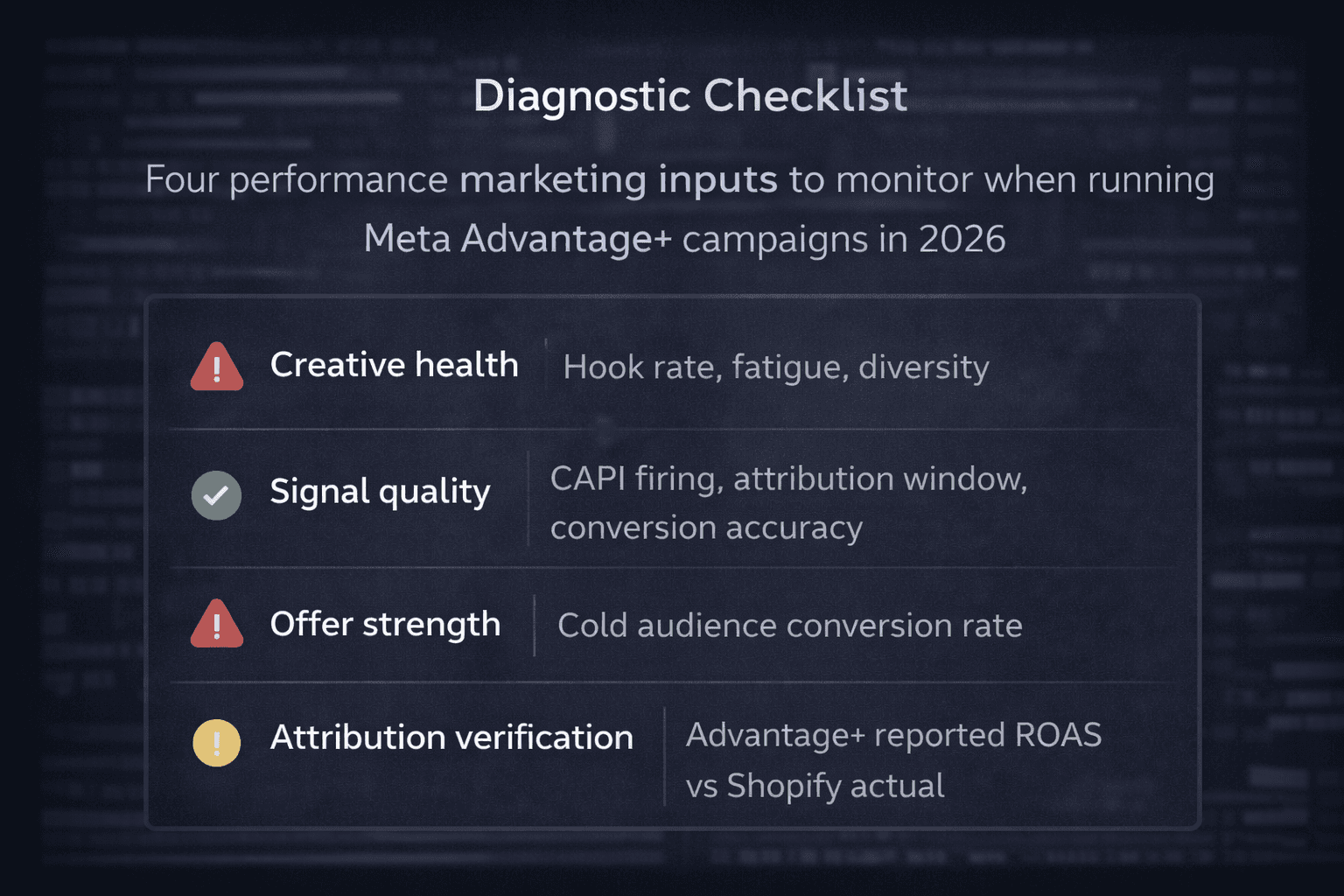
What you can do is look at the inputs you control: creative health, signal quality, offer strength, and whether the ROAS the campaign reports actually reconciles with what Shopify shows. Those four diagnostics will catch most Advantage+ performance problems even when the algorithm itself gives you nothing to work with.
What This Means Practically for Your Role
The performance marketer who thrives in an Advantage+ world is not the one who fights the automation. Trying to restrict the algorithm with tight audience overlays, manual bids, and placement exclusions is increasingly a losing battle against a system that was designed to work without those constraints.
The marketer who wins is the one who treats Advantage+ like a high-powered tool that requires high-quality inputs to produce high-quality outputs. That means:
Producing genuinely diverse creative — different formats, angles, and hooks, not variations of the same concept.
Maintaining clean conversion signals through server-side tracking so the algorithm is learning from accurate data.
Constructing offers that work on a cold audience, not just on warm retargeting pools.
Measuring what the algorithm reports against what actually happened in the store, and running periodic incrementality tests to confirm the campaign is driving new revenue.
Diagnosing performance problems through creative and signal quality rather than campaign structure.
These are harder skills than audience targeting. They require deeper understanding of your customer, your creative, and your data than the old manual approach demanded.
The job did not get simpler when Meta took over the dials. It got more strategic. Which is either threatening or exciting depending on how much of your current value lives in the tactical execution the algorithm just automated away.
Improve Ad performance with Predflow
Diagnose performance drops, creative fatigue, and attribution shifts