


There is a honest comment buried in a Reddit thread about AI tools for performance marketing that captures the state of things better than any blog post: "most AI tools help with speed, not strategy."
That is the real framing. A lot of what gets called AI for performance marketing is just automation wearing a different badge. Schedule posts faster, generate copy variants, resize images. Useful, but not what a performance marketer managing ₹50L+ in monthly ad spend actually needs.
The marketers who are genuinely benefiting from AI in 2026 have figured out where the real leverage is. Not in generating more content. In understanding what is actually happening inside their ad accounts — which creatives are winning and why, where revenue is actually coming from, and what is quietly draining budget before anyone notices.
This guide breaks down the AI tool stack by job-to-be-done, not by category. Because the question is not "which AI tools exist" — it is "which tools solve the specific problems that cost performance marketers the most time and money."
What Performance Marketers Actually Need AI For
Before listing tools, it helps to be clear about where AI genuinely moves the needle versus where it is just noise.
The Reddit threads on this topic are useful here. The practitioners who have found real value describe three consistent themes: separating analysis from execution, reducing time spent reconciling dashboards, and catching performance problems earlier. One media buyer put it simply: "the win is not full automation, it's faster decisions and cleaner reporting."
The five areas where AI tools have real leverage for performance marketers are: creative intelligence (understanding why ads work), ad account monitoring and anomaly detection, attribution and revenue reconciliation, copy and creative generation, and competitive research. This guide covers each one with the tools that actually do the job.
1. Creative Intelligence: Understanding Why Ads Work
This is the area where the gap between what most teams do and what they could do is largest. Most performance marketers track which ads are winning. Very few understand why — which hook format, which angle, which visual approach is driving the result.
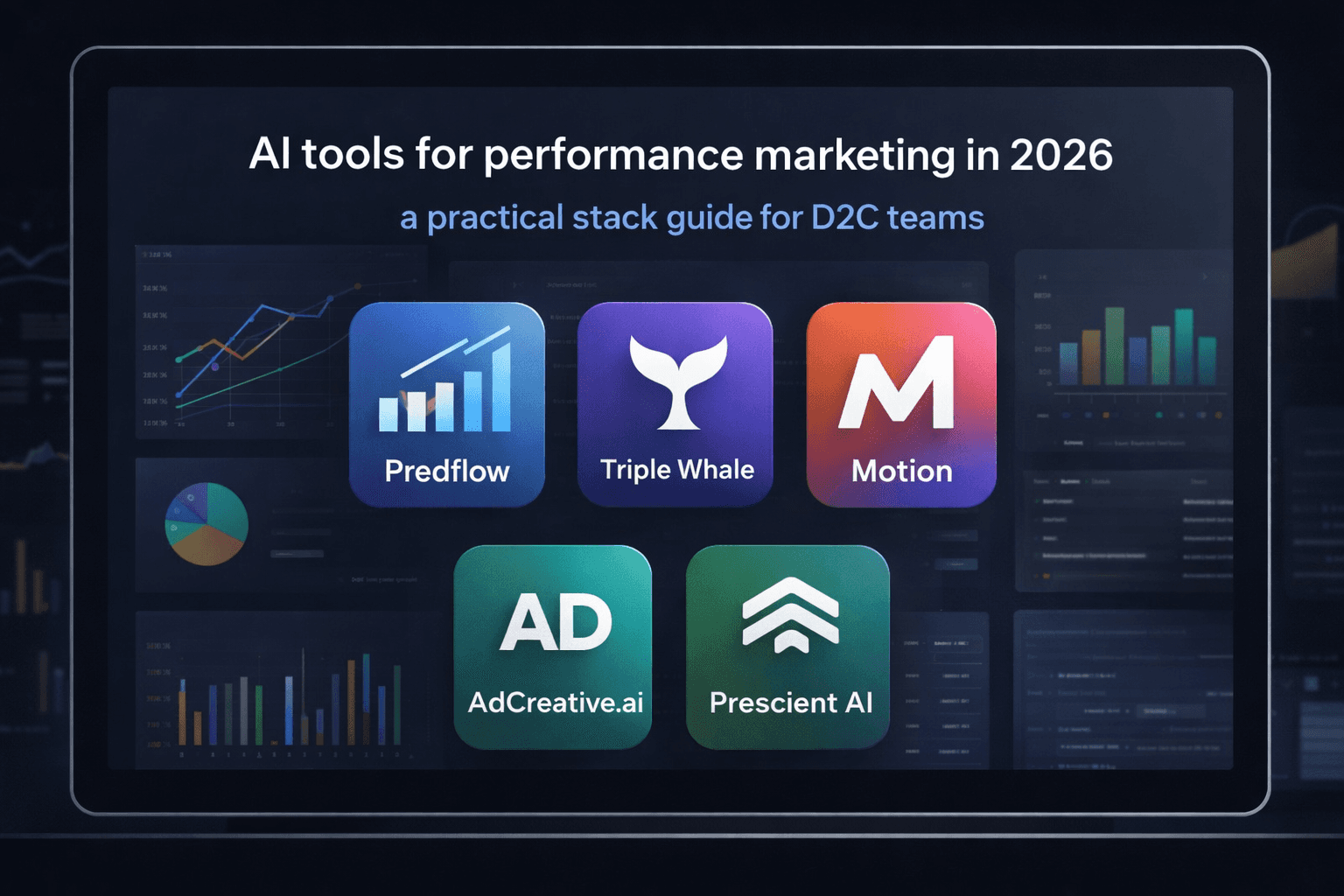
Predflow Ad Intelligence Predflow's ad intelligence layer connects to your Meta and Google accounts and breaks down creative performance at the element level — hook, visual format, CTA, angle. Instead of knowing that "Ad 1234 got 2.3x ROAS," you know that problem-solution hooks with static visuals are outperforming UGC on cold audiences by 40%. That is the difference between a useful insight and an actionable brief.
Predflow Free Ad Analyzer Before spending money testing a creative, run it through the free Ad Analyzer. It scores your hook, visual impact, and CTA against benchmarks and tells you what to fix before launch. No signup required. Takes 30 seconds. Useful for anyone briefing designers or approving creatives before they go live.
Meta's own creative tools Meta Advantage+ Creative Optimisation and Dynamic Creative Testing are underused by most teams. If you are running static image campaigns, Meta's native tools can automatically generate video variants and test multiple headline and description combinations. Not sophisticated intelligence, but free and worth using as a baseline testing layer.
2. Ad Account Monitoring and Anomaly Detection
The most expensive problems in performance marketing are the ones nobody notices for three days. A creative starts fatiguing on Thursday. ROAS drops Friday. By Monday standup, four days of budget have gone into a declining campaign.
AI monitoring tools exist to catch these drops early — not just flag that something changed, but help diagnose why.
Predflow Anomaly Detection Predflow's performance alert system monitors your ad accounts continuously and surfaces likely root causes alongside alerts. When ROAS drops, it tells you whether it looks like creative fatigue, audience saturation, a budget pacing issue, or something on the revenue side. The difference between an alert and a diagnosis is significant — one tells you something happened, the other tells you what to do about it.
Revealbot Revealbot is strong on rule-based automation — "if ROAS drops below X and frequency exceeds Y, pause and alert me." It integrates with Slack so alerts hit your team chat in real time. Good for teams that want automated rules rather than AI diagnosis. The pricing model scales with ad spend, which becomes expensive at higher budgets.
Optmyzr Optmyzr produces deep performance reports and can identify which specific keyword or campaign caused a revenue drop on Google Ads. Strong on Google, weaker on Meta. Useful for search-heavy accounts. At $249/month it is one of the more expensive options in this category, but the reporting depth is genuinely good.
3. Attribution and Revenue Reconciliation
This is the area where most tools disappoint. Every platform reports its own ROAS. Meta claims credit for conversions. Google claims credit for the same conversions. Add them together and the combined total almost always exceeds actual Shopify revenue.
If you want to understand how to set up accurate tracking across platforms before adding an attribution layer, the D2C ad tracking guide covers the full setup from server-side tracking to UTM conventions.
For attribution tools, the question is whether they reconcile platform claims against actual revenue or just present platform data in a cleaner interface.
Predflow Predflow reconciles your Meta, Google and Shopify data into one view where attributed revenue cannot exceed actual revenue. This is the core constraint the platform is built around. The semantic layer that sits under the data ensures platform claims get checked against what actually hit your Shopify orders. Useful for any team that has experienced the "Meta says 4.2x but Shopify is flat" problem.
Triple Whale Triple Whale is strong for Shopify brands wanting a clean single-dashboard view of profitability. It has multiple attribution models and good creative analytics. Strong UX, fast setup. The attribution methodology is more closely aligned with platform numbers than Predflow's reconciliation approach, which some teams prefer and others find too optimistic.
Northbeam Built for larger teams managing significant spend across multiple channels. Machine-learning attribution that distributes credit across touchpoints. Strong on granular creative-level attribution. Expensive (entry-level around $1,500/month) and requires analyst-level capability to operate properly. Best for brands spending $250K+ per month.
4. Copy and Creative Generation
This is the category where the most AI tools exist and where the gap between hype and reality is largest. ChatGPT and Claude are genuinely useful for copy drafts, angle brainstorming, and brief writing. But as one builder in the Reddit thread noted: "to get quality above junior employee and closer to senior marketer level, you have to ride the hallucination line a bit."
The honest framework: use AI for speed and volume in copy generation, but keep a human in the loop for judgment on what actually fits the brand and the brief.
Claude / ChatGPT Best used for: generating 10 hook variants to test, rewriting angles in different tones, drafting creative briefs based on performance data, summarising competitor ad copy from the ad library. Not a replacement for creative strategy — a tool to accelerate the execution of creative strategy you have already formed.
Jasper Jasper is designed specifically for marketing copy and has templates for ad headlines, descriptions, and CTAs. More structured than Claude or ChatGPT, which helps teams that want guardrails. Good for agencies managing copy across multiple client accounts.
Canva AI and Adobe Firefly For creative production rather than copy, Canva's AI tools are strong for resizing, background removal, and generating image variants quickly. Useful for D2C teams where the designer and media buyer are often the same person or where freelancers need fast turnaround on format adaptations.
5. Competitive Research and Market Intelligence
Understanding what is working in your category before spending on creative tests is one of the highest-leverage uses of AI for performance marketers. The tools in this category connect to ad libraries and surface patterns in what competitors are running.
Perplexity Fast, accurate, cites sources. Useful for researching competitor brand positioning, product category trends, and industry benchmarks quickly. Several Reddit users flagged it as their go-to for "fast research on competitors and trends." Better than Google for synthesis, though it should not be your only source for data you plan to act on.
Meta Ad Library + Claude The free approach: pull competitor ads from Meta Ad Library, export or screenshot the top performers, then use Claude to analyse patterns across hooks, formats, and angles. Takes more time than a dedicated tool but costs nothing and often surfaces insights that paid tools miss because you can ask more specific questions.
What to Ignore (For Now)
A few categories that are generating noise but do not solve real problems for performance marketers yet:
Fully autonomous campaign management. Tools that claim to run your Meta or Google campaigns without human input. The underlying platforms (Meta Advantage+, Google PMax) already do a version of this, and adding another automation layer on top creates accountability gaps when things go wrong. Use AI for intelligence and alerts, keep humans in the decision seat.
AI UGC video generators. Several tools can generate avatar-led ad videos quickly. Potentially useful for volume testing of angles before investing in real UGC production. Not a replacement for authentic creator content, which continues to outperform synthetic alternatives on trust signals.
Generic AI reporting dashboards. Tools that connect your ad accounts and produce AI-generated summaries. Most of these are Supermetrics with a ChatGPT wrapper. They centralise data but do not reconcile it or tell you anything you could not see in a spreadsheet.
The Stack That Actually Works
Based on what practitioners are using and what the data supports, here is a lean AI tool stack for a D2C performance team in 2026:
For creative intelligence and pre-launch scoring: Predflow or GoMarble, with the free Ad Analyzer for quick checks before any creative goes live.
For account monitoring and anomaly detection: Predflow's performance alerts or Revealbot for rule-based automation, depending on whether you want AI diagnosis or manual rule triggers.
For attribution: Predflow for D2C brands wanting reconciled numbers against actual Shopify revenue, Triple Whale for teams prioritising UX and dashboard simplicity.
For copy and research: Claude or ChatGPT for drafting and angle iteration, Perplexity for fast competitive research, Meta Ad Library for raw competitor data.
The honest truth from practitioners who have been through the tool evaluation cycle is this: AI supports good performance marketing fundamentals, it does not replace them. The teams getting the most from AI are the ones who already understood what questions to ask. They are just getting answers faster.
If you want to discuss what is working (and what is not) with other performance marketers using AI tools, the 10x Marketers community is where that conversation is happening. We have also put together a full tool stack resource in Notion — The Performance Marketer's Tool Stack — which gets updated as new tools are tested and validated.
Improve Ad performance with Predflow
Diagnose performance drops, creative fatigue, and attribution shifts