Supply Chain
Purchase Order Process: Steps, Approvals, and Common Pitfalls
A purchase order stuck in someone's inbox for three days can derail deliveries and leave finance scrambling. Here's how to fix the process before it breaks down.

Gautam Borad
Founder at Predflow

A purchase order sits in someone's inbox for three days. The supplier misses the delivery window. Finance scrambles to reconcile an invoice that doesn't match the original order. Nobody flagged it earlier because nobody knew it was stuck.
This is the hidden cost of a purchase order process most teams assume is under control. The process exists, the forms are in place, and yet the same breakdowns repeat: missing approvals, incomplete fields, unacknowledged terms, and invoices that don't match what was ordered.
Small mistakes in a PO create expensive downstream problems. Budget overruns, incorrect deliveries, and a lack of visibility cause delays and unnecessary costs that compound with volume.
By the end of this article, you will know exactly where your PO process breaks down, why approval chains stall, and what to fix first without rebuilding your entire procurement setup.
What a Purchase Order Actually Does (Beyond the Paper Trail)
Most teams treat the purchase order as a formality. It is not. It is the control mechanism that governs spending, creates a legal commitment, and makes invoice reconciliation possible.
PO as a Spending Control Mechanism
A PO commits budget before money moves. It forces the requesting team to specify what they need, at what price, and from which supplier, before the organization is obligated to pay.
Without that commitment documented in advance, finance has no baseline to verify against. Spend control only works if the PO is accurate and complete.
How a PO Creates a Legal Commitment Between Buyer and Supplier
When a supplier accepts a purchase order, both parties are bound by its terms. The PO defines quantity, price, delivery date, and payment terms.
If the supplier delivers late or substitutes a different item, the buyer has documented grounds to dispute or reject the delivery. That protection disappears when POs are vague or informal.
There are different PO types, including standard, blanket, and contract POs, but all of them serve the same core function: locking in terms before goods or services change hands.
Why the PO Is the Foundation of Three-Way Matching
Three-way matching compares the PO, the goods receipt, and the supplier invoice. All three must align before payment is approved.
If the PO is missing a line item or contains the wrong unit price, the match fails. That failure generates manual review work, delays payment, and creates friction with the supplier. The PO is where that chain begins, which is why accuracy at creation determines the effort required at the end.
The Purchase Order Process Step by Step
Understanding each step in the PO lifecycle helps teams identify exactly where their handoffs break down. Each step depends on the one before it.
Step 1: Purchase Requisition — Internal Request Initiated
A purchase requisition is the internal request submitted before a PO is created. The requestor specifies what is needed, the estimated cost, and the business justification.
When this step is skipped or rushed, POs get created without budget confirmation, and finance has no record of who initiated the spend.
Step 2: Approval Routing — Who Reviews and Why It Gets Stuck
Once a requisition is submitted, it routes to the appropriate approver based on dollar value, spend category, or department. Many organizations formalize this path inside their procurement system, defining which request types follow which approval path and which contract routing channel.
For example, some organizations maintain separate routing paths for standard catalog purchases versus non-catalog or contract-based requests, each with its own approval chain and cost thresholds. When requests enter the wrong channel, they stall waiting for someone to redirect them manually.
When approval routing is undefined or inconsistent, POs park in inboxes for days with no escalation trigger.
Step 3: PO Creation — What Must Be Included to Avoid Downstream Errors
The approved requisition becomes a formal purchase order sent to the supplier. This document must include the item description, quantity, unit price, delivery date, payment terms, and the correct supplier contact.
Missing any of these fields creates ambiguity. The supplier defaults to their own assumptions, and the mismatch surfaces later during receiving or invoicing.
Step 4: Supplier Acknowledgment — Confirming Terms Before Goods Ship
Supplier acknowledgment is the step most teams skip. The supplier must confirm they have received the PO and agree to its terms before the order is fulfilled.
Without acknowledgment, the buyer assumes alignment that may not exist. The supplier ships on a different timeline, at a slightly different price, or substitutes a product variant, and the discrepancy only appears at the dock or on the invoice.
Step 5: Goods Receipt and Three-Way Match
When goods arrive, the receiving team records what was actually delivered. That receipt is compared against the PO and the incoming invoice.
If quantities, descriptions, or prices differ, the match fails and the invoice goes into manual review. The accuracy of steps one through four determines how often this happens.
Step 6: Invoice Approval and PO Closure
Once the three-way match is confirmed, the invoice is approved for payment and the PO is closed in the system. Any open POs that were partially filled or cancelled must be formally closed to keep budget records accurate.
Leaving POs open after fulfillment creates phantom budget encumbrances that distort spend reporting.
Approval Workflows: Where the Purchase Order Process Stalls Most Often
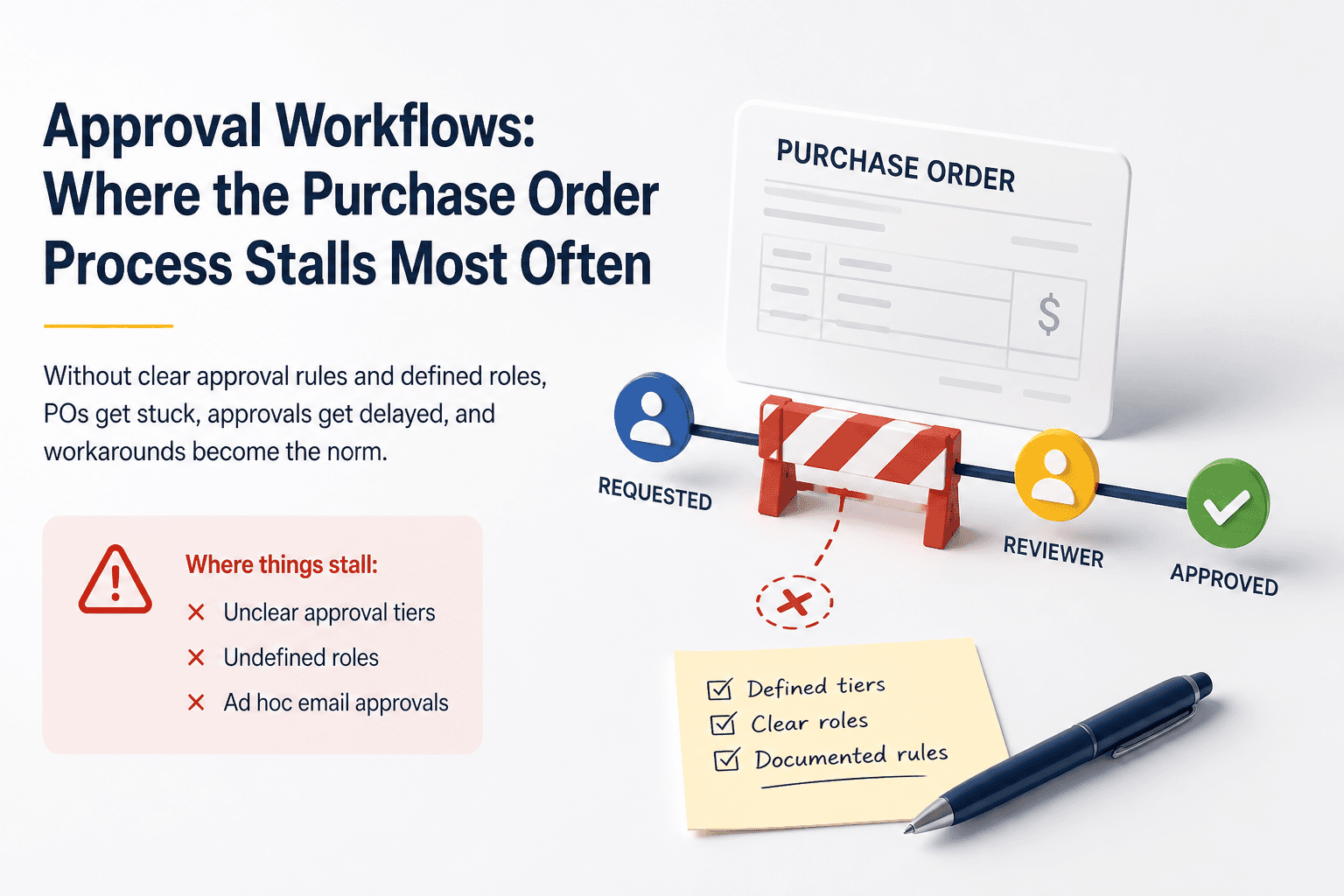
Purchase order approval works by routing a submitted requisition or PO to a designated reviewer based on predefined criteria, typically dollar amount, spend category, or department. The reviewer either approves, rejects, or escalates the request according to documented authority rules. Without those rules defined and enforced, approvals default to whoever responds to an email first.
Defining Approval Tiers by Dollar Threshold and Category
Spend authority should be tiered. A department manager approves purchases under a certain threshold. Finance or procurement reviews larger amounts. Executive sign-off applies above a higher ceiling.
The same logic applies by category. IT purchases, professional services, and facilities spend carry different risk profiles and often require different approvers even at the same dollar value.
Document these tiers explicitly. An undocumented approval tier is the same as no tier at all because people will route around it.
The Cost of Undefined Roles: Who Can Request, Who Can Approve
Without defined roles, it is unclear who is authorized to request, who is authorized to approve, and who is accountable when something goes wrong. The result is inconsistent processes and confusion that slows every order.
Undefined roles also create compliance exposure. If anyone can approve a PO, there is no audit trail that demonstrates proper authorization. That becomes a problem during any internal or external review.
Assign roles in your procurement system, not just in a policy document. Policy documents get ignored. System-enforced roles do not.
Building Escalation Rules That Don't Create New Bottlenecks
Escalation rules determine what happens when an approver is unavailable. Without them, a single person's absence can hold a PO for a week.
Set a time threshold. If an approval is not actioned within a defined period, it escalates to the next level automatically. This keeps the process moving without requiring a requestor to chase manually.
Avoid building escalation chains that are too long. Each added tier is another place for a PO to wait.
Common Purchase Order Mistakes That Create Downstream Chaos
Every PO error has a downstream consequence. The goal is to catch errors at creation, not during invoice reconciliation.
Incomplete PO Fields That Invalidate the Document
Missing item numbers, vague delivery dates, or absent payment terms are not minor omissions. They transfer decision-making to the supplier.
Missing delivery date means the supplier defaults to their standard lead time, not yours. Missing unit price means the invoice amount is a surprise. Required fields must be enforced at the point of creation, not corrected after the fact.
Skipping Supplier Acknowledgment and Assuming Alignment
Sending a PO and assuming the supplier agrees to its terms is one of the most common and most avoidable errors. Confirmation must be explicit.
A supplier who has not acknowledged the PO is not bound by its delivery date or pricing. Disputes that arise from this assumption consume far more time than the acknowledgment step would have.
Mismatched Line Items That Trigger Manual Invoice Review
When the PO says one thing and the invoice says another, the three-way match fails and the invoice moves into a manual review queue. At low volume, this is an inconvenience. At scale, it consumes significant AP hours every week.
Catching these mismatches manually at scale is where most AP teams lose hours each week. Predflow builds AI agents that understand the context of a PO, including line items, supplier terms, and exception rules, and route anomalies automatically rather than parking them in a shared inbox. The result is that edge cases get resolved faster without adding headcount.
Routing Non-Standard Requests Through the Wrong Channel
Not every purchase follows the same path. Contract-based requests, lease agreements, and high-value services require different routing than standard catalog orders. When non-standard requests are submitted through a general purchasing channel, they get processed incorrectly or kicked back for manual correction.
Some organizations address this by removing non-standard request types from general intake forms entirely, forcing those requests into the correct contract routing channel from the start. That structural fix eliminates a category of routing errors before they happen.
How to Strengthen Your Purchase Order Process Without Rebuilding From Scratch
These three improvements work inside your existing systems. None of them require a new platform to start.
Standardize PO Templates With Required Fields and Drop-Down Validation
A PO template with enforced required fields eliminates the most common creation errors. Drop-down menus for supplier names, item categories, and cost centers reduce free-text mistakes that cause mismatches later.
This week: audit your current PO template and identify which fields are free-text that should be constrained to a validated list.
Map Your Approval Chain Before You Automate It
Automation makes a broken approval chain faster and harder to fix. Before configuring any workflow tool, draw the approval chain on paper. Define who approves what, at which thresholds, in which categories, and what happens if they are unavailable.
This week: document your current approval tiers and identify any gaps where authority is assumed but not formally assigned.
Add Exception Handling Rules So Mismatches Route Automatically
Every mismatch needs a default destination. Define where it goes and who resolves it based on the type of discrepancy. If a PO specifies one product description and the invoice shows a different one, that document should route automatically to the department that can resolve it, not sit in a general AP queue.
For example, a description mismatch on a facilities order routes to the facilities team. A price variance above a set threshold routes to procurement. This week: identify your three most common mismatch types and assign a named owner and resolution path for each one.
Frequently Asked Questions
What is the difference between a purchase order and an invoice?
A purchase order is issued by the buyer before goods or services are delivered. It documents what is being ordered, at what price, and under what terms. An invoice is issued by the supplier after delivery, requesting payment. The PO comes first and sets the terms; the invoice is validated against it.
Who is responsible for approving a purchase order?
Approval responsibility depends on the dollar value, spend category, and organizational policy. Smaller purchases are approved at the department level. Larger or more complex orders route to finance, procurement, or executive reviewers. Defined authority tiers, not individual discretion, should determine who approves what.
What happens if a purchase order and invoice don't match?
The invoice is held and moved into exception handling or manual review. The AP team investigates the discrepancy, contacts the supplier or internal requester, and either corrects the PO, requests a revised invoice, or rejects the line item. Unresolved mismatches delay payment and can damage supplier relationships.
Can a purchase order be cancelled after it's been sent to a supplier?
A PO can be cancelled, but the process depends on whether the supplier has acknowledged it and whether goods have already been ordered or shipped. If the supplier has accepted the PO, cancellation requires formal communication and the supplier's agreement. Cancellation policies should be defined in the original PO terms.
What information must a purchase order include to be valid?
A valid purchase order must include the buyer and supplier details, a unique PO number, item descriptions, quantities, unit prices, delivery date, payment terms, and the authorized signature or approval record. Missing any of these fields creates ambiguity that can invalidate the document's usefulness during matching or dispute resolution.
Conclusion
If your team still moves POs through email chains and resolves invoice mismatches manually, the process will keep breaking at the same points. Volume does not fix the problem. It amplifies it.
The most effective starting point is structural: fix the approval chain, enforce required fields at creation, and assign explicit routing rules for exceptions. Most teams can make these changes inside their existing tools. That gets the process stable. The ceiling appears later, when PO volume grows and the number of exceptions outpaces what the AP team can handle without adding staff.
If your team is hitting that ceiling, where POs are accurate but the volume of exceptions is consuming AP hours, see how Predflow maps and automates your purchase order workflow end to end.
Bring 20 NetSuite bills to a 30-minute teardown
We will walk your actual invoices through capture, 3-way match and posting on the call, and tell you which steps an agent can take over. No prep beyond the PDFs.
FAQ
Frequently asked questions
What exactly is an AI agent
An AI agent is an autonomous system designed to handle specific business tasks end-to-end. Unlike simple chatbots, AI agents can reason, take actions, integrate with tools, and follow defined workflows.