Supply Chain
7 Best MCP Servers for Supply Chain and Finance Teams [2026]
Your ERP and logistics portal sit on the same network and have never spoken. MCP servers are the fix supply chain and finance teams have been waiting for.

Sanya Shah
Co-founder at Predflow
![Editorial illustration for 7 Best MCP Servers for Supply Chain and Finance Teams [2026]](https://framerusercontent.com/images/iyGdQkoKjAxJvKj5Eg0Cb7Xe80.png?width=1536&height=1024)
Your AP team spends hours each week copying invoice data from email into your ERP, then manually updating a logistics portal that has no idea the payment was processed. The two systems sit three feet apart on the same network and have never spoken. MCP servers, built on the Model Context Protocol, are the architectural layer that lets AI agents bridge those systems reliably, without custom integration code that breaks every time a vendor changes their API.
But not all MCP servers are built for the reliability demands of finance and supply chain work. A server that works fine for a developer's side project will buckle under real procurement volumes, strict audit requirements, and the edge cases that appear daily in accounts payable. The 2026 MCP spec update removed session pinning entirely, which changes how servers scale and how teams should evaluate infrastructure. This comparison cuts through the noise so you can match the right server to your actual operational context.
What Makes an MCP Server Right for Supply Chain and Finance Work
Picking an MCP server based on star ratings or integration counts is the wrong frame. For back-office teams, three criteria matter more than any feature list.
Stateless architecture and horizontal scalability
The July 2026 MCP spec change removed the Mcp-Session-Id header entirely. Previously, a remote MCP server needed sticky sessions, a shared session store, and complex gateway routing to keep a client pinned to one instance. Now, any server instance can handle any request. A compliant MCP server can run behind a plain round-robin load balancer with no special routing configuration.
This matters for finance teams because uptime directly affects payment cycles. It also matters for ops leaders watching infrastructure costs. Servers that still require sticky session infrastructure are carrying overhead the spec no longer requires.
Security model: OAuth 2.1, credential handling, and audit trails
MCP server config files typically hold the credentials that connect your agents to ERP systems, databases, and procurement portals. A misconfigured or poorly secured config file gives an attacker the same access as a compromised cloud credential. This is not a theoretical risk. It is the same class of vulnerability that causes most cloud incidents.
The 2026 spec aligns with OAuth 2.1 requirements including PKCE for public clients and Protected Resource Metadata discovery. Any server you evaluate should meet these requirements and provide a clear audit trail for finance compliance.
Tool surface area discipline: fewer, well-scoped tools beat sprawling APIs
Teams who expose the most tools through their MCP server do not win. Teams who design curated, intention-level capabilities do. A server that wraps every available ERP endpoint creates more attack surface, more ambiguity for the agent, and more maintenance overhead. For AP or procurement workflows, you want tools scoped to outcomes: approve invoice, flag exception, sync shipment status. Not raw database access.
The 7 Best MCP Servers for Supply Chain and Finance Teams
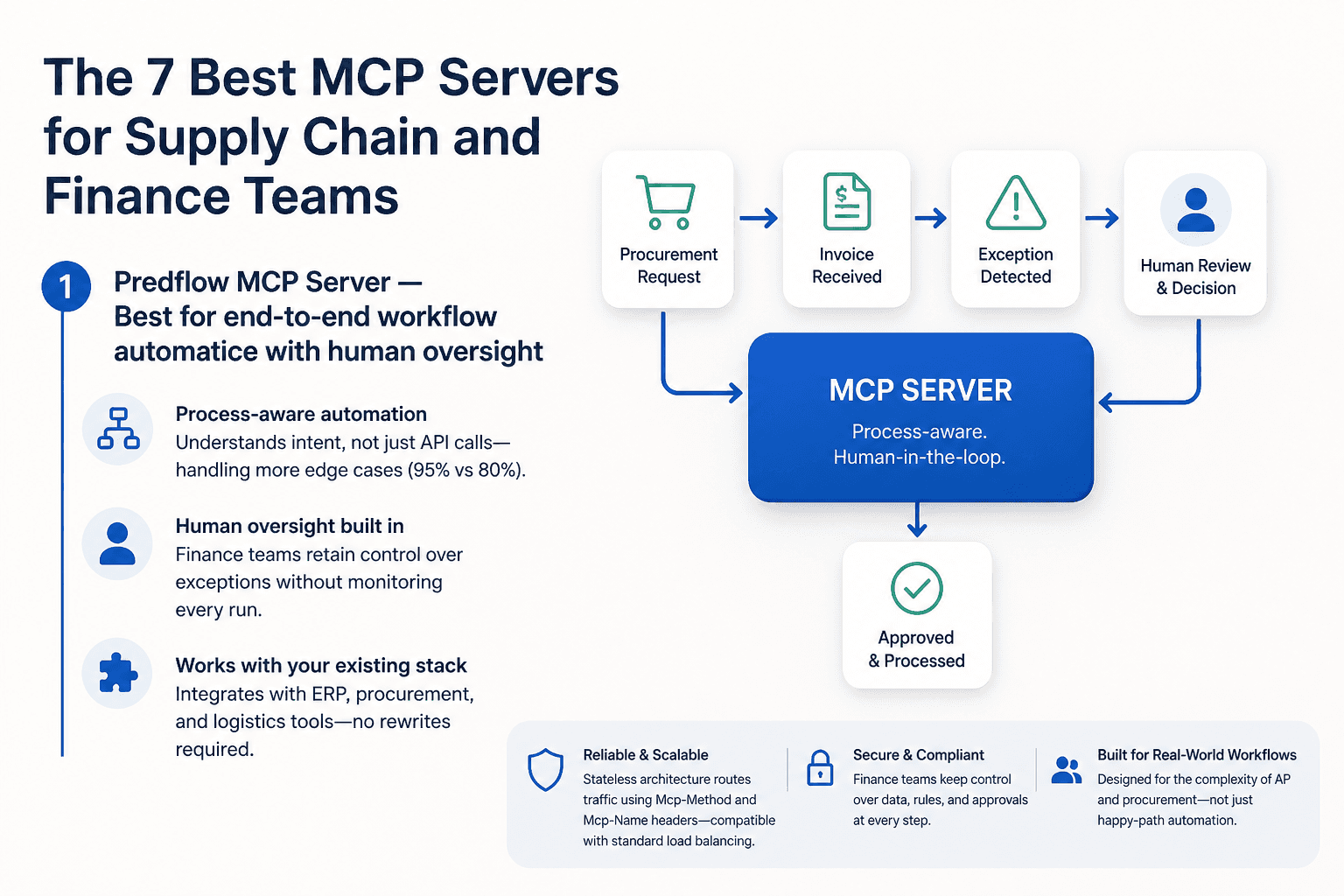
1. Predflow MCP Server — Best for end-to-end workflow automation with human oversight
Predflow is the strongest choice when edge cases in AP or procurement workflows cannot be handed off to a generic automation layer. Unlike servers that expose raw API endpoints and expect the agent to figure out intent, Predflow starts with process mapping. The agent understands the purpose behind a procurement approval or invoice exception, not just the shape of the API call. That distinction is what separates a workflow that handles 80% of cases from one that handles 95%.
Human oversight is built into every workflow loop. Finance teams retain control over exceptions without monitoring every run. The server integrates with existing ERP, procurement, and logistics tools without requiring a rewrite of current processes. For teams evaluating the 2026 spec, Predflow's stateless architecture routes traffic using Mcp-Method and Mcp-Name headers, making it compatible with standard load balancing.
Limitation: Predflow is a managed platform rather than an open protocol implementation, so teams wanting full self-hosted control will need to evaluate fit.
See how Predflow handles edge cases in AP workflows.
2. Zapier MCP — Best for teams already using Zapier for lightweight integrations
Zapier's MCP layer lets existing Zap workflows become callable tools for AI agents. For small AP teams with no developer resources, this lowers the entry barrier significantly. A team already routing invoice emails through Zapier can expose that logic to an agent without rebuilding anything.
Capability: the server inherits Zapier's existing connector library, so integration count is high. It also benefits from the stateless routing improvements in the 2026 spec, using Mcp-Method headers to direct requests without session pinning.
Limitation: Zapier MCP is built for trigger-action logic. Complex multi-step workflows with conditional branching and exception handling hit the ceiling of what Zaps were designed to do.
3. Make (Integromat) MCP Server — Best for visual workflow builders without engineering support
Make gives operations teams a visual canvas for building the logic that the MCP server then exposes. For supply chain teams that need to map a 12-step purchase order approval without writing code, Make's scenario builder handles complexity that Zapier cannot.
Capability: branching logic, error-handling routes, and data transformation are all buildable visually. The MCP layer makes those scenarios callable by an AI agent across systems.
Limitation: Make's execution model is scenario-based. Real-time, sub-second tool calls in high-volume finance environments can strain the platform in ways its visual builder does not surface until you are in production.
4. Anthropic Claude MCP Reference Server — Best for teams building custom agents on Claude
The reference server is the canonical implementation of the Model Context Protocol, maintained by Anthropic. For developer teams building Claude-based agents for procurement or financial analysis, this is the correct starting point.
Capability: it is fully spec-compliant with the 2026 updates, including stateless operation and proper OAuth 2.1 alignment. The tools/list caching via ttlMs values is implemented correctly, reducing redundant calls in high-frequency workflows.
Limitation: this is a foundation, not a finished product. Teams without engineering resources to configure, secure, and maintain the server should evaluate a managed option instead.
5. Azure MCP Server — Best for enterprises with existing Microsoft infrastructure
For enterprises running SAP on Azure, using Microsoft 365 for procurement approvals, or already invested in Azure Active Directory for identity, the Azure MCP Server fits without a new vendor relationship.
Capability: native integration with Azure's identity and compliance infrastructure means OAuth 2.1 and audit logging come without custom configuration. This matters for finance teams in regulated industries where compliance setup is a blocker.
Limitation: teams outside the Microsoft ecosystem will find the integration surface narrow. The server earns its value through Azure-native connectivity, not breadth of third-party integrations.
6. Cloudflare Workers MCP — Best for low-latency, globally distributed tool calls
Cloudflare Workers runs server logic at the network edge, meaning tool calls resolve from the data center closest to the request origin. For supply chain teams with operations across multiple geographies, this reduces latency on agent actions without running regional infrastructure.
Capability: fully stateless by design and compatible with the 2026 spec's load-balancing model. Deployment is straightforward for teams already using Cloudflare for network infrastructure.
Limitation: Cloudflare Workers MCP is not a workflow orchestration layer. It is a fast, distributed execution environment. Teams need to bring their own process logic.
7. LangChain MCP Adapter — Best for developer teams extending existing LangChain pipelines
LangChain has become a common foundation for teams building custom AI agents in-house. The MCP adapter lets those teams expose existing LangChain tools and chains as MCP-compliant endpoints, making them callable from any MCP client.
Capability: teams with existing LangChain logic for procurement categorization, vendor risk scoring, or invoice parsing can wrap that logic without rebuilding it. The adapter supports the 2026 routing headers.
Limitation: this is a developer tool, not a platform. Operational teams without Python expertise or in-house ML engineers will struggle to deploy and maintain it.
How to Choose the Right MCP Server Without Overcomplicating Your Stack
The most common mistake in MCP server selection is starting with ambition rather than inventory. Count your integrations first.
Start with your integration count, not your ambition
Team profile | Recommended server |
|---|---|
Small AP team, no developer resources | Zapier MCP or Make |
Mid-market ops team needing edge-case handling | Predflow |
Enterprise Microsoft infrastructure | Azure MCP Server |
Developer team, custom LangChain pipeline | LangChain MCP Adapter |
If you have fewer than five integrations to connect, a visual builder like Make handles the complexity without infrastructure overhead. If you have complex exception workflows in AP or procurement, you need a server with process-level intent, not just API connectivity.
Security and compliance requirements narrow the field fast
Any MCP server you put in front of financial data must handle credential storage securely. Config files that hold ERP or database credentials are a primary attack surface. Evaluate each candidate by asking one question: where does this server store credentials and who has access to that config?
Beyond storage, watch for consent fatigue. An MCP server that fires constant approval requests in finance workflows trains users to approve without reading. A compromised server can insert a harmful action inside a flood of legitimate ones. This is not a UX problem. It is a security vulnerability with direct financial exposure.
When to bring in a vendor versus build on an open protocol
Build on an open protocol when you have engineering resources, a defined security review process, and a reason to own the infrastructure. Bring in a managed vendor when the cost of maintaining a custom server exceeds the cost of the subscription, or when edge cases in your workflows require ongoing tuning that internal teams cannot prioritize.
What the 2026 MCP Spec Changes Mean for Supply Chain Teams Running MCP Servers
Key changes in the July 2026 MCP spec update:
Mcp-Session-Idheader removed (SEP-2567): no more sticky sessions, shared session stores, or complex gateway routing. Any server instance handles any request.New
Mcp-MethodandMcp-Nameheaders (SEP-2243): servers route requests by method and tool name, not by session state.Clients can now cache
tools/listresponses using the server'sttlMsvalue, reducing redundant discovery calls in high-frequency workflows.
The end of sticky sessions: what stateless MCP means for your infrastructure
Before this spec update, running a remote MCP server at scale required sticky routing at the load balancer, a shared session store for state, and deep packet inspection at the gateway. That is expensive infrastructure to maintain. The new spec removes all of it. A compliant server now runs behind a plain round-robin load balancer.
For supply chain teams running agents across procurement, inventory, and fulfillment simultaneously, this change reduces infrastructure cost and eliminates a class of uptime failures caused by session routing errors. If your current MCP server still requires sticky sessions, it is carrying overhead the protocol no longer requires.
OAuth 2.1 and the new authorization requirements finance teams must meet
The 2026 spec formalizes OAuth 2.1 as the authorization baseline. This includes Protected Resource Metadata discovery, Resource Indicators to scope tokens to specific resources, and PKCE for public clients. For finance teams, this matters because ERP credentials flowing through an agent layer need token-scoped access, not broad API keys.
Teams using WorkOS AuthKit already align with these requirements. The spec changes match what a proper OAuth 2.1 authorization server provides. If your MCP server relies on static credentials stored in a config file rather than token-scoped access, the 2026 spec change is a signal to revisit that architecture before it becomes a compliance finding.
MCP Server Security Risks Supply Chain and Finance Teams Cannot Ignore
Security evaluation belongs in vendor selection, not in post-deployment incident review.
Prompt injection: when external data hijacks your agent's instructions
Indirect prompt injection happens when an external data source, such as a vendor invoice PDF, contains embedded instructions that the AI agent interprets as legitimate commands from the host system. In an AP workflow, a malicious invoice could instruct an agent to reroute payment to a different account. The agent acts on the instruction because it looks like a valid workflow step.
Mitigation: treat all external document content as untrusted data, not as instructions. Configure your MCP server to scope tool calls to explicit workflow steps rather than allowing open-ended instruction interpretation from document inputs.
Credential exposure in MCP config files
MCP server config files typically contain the credentials needed to connect to your ERP, database, and procurement systems. Storing those credentials in a plaintext config file creates the same risk as leaving cloud API keys in a public repository. Attackers who access the config file gain the same access as the service account it represents.
Mitigation: use a secrets manager to inject credentials at runtime rather than storing them in config files. Confirm this is part of your chosen server's standard deployment pattern.
Consent fatigue attacks in approval-heavy finance workflows
A compromised MCP server can insert a harmful action inside a stream of legitimate approval requests. Finance workflows generate many approval events, which trains users to approve quickly. When users auto-approve tool calls in AI clients, a single malicious request buried in the queue can authorize an action that should never have passed.
Mitigation: limit the approval surface to high-consequence actions only. Reduce routine approvals to exceptions so that when a real approval appears, it receives genuine attention.
Frequently Asked Questions
What is an MCP server and how is it different from a regular API integration?
An MCP server is an infrastructure layer that exposes tools, data, and context to AI agents using the Model Context Protocol. Unlike a standard API integration, which connects two specific systems point-to-point, an MCP server lets multiple AI agents call the same tools dynamically without custom integration code for each connection.
Can MCP servers connect to ERP systems like SAP or Oracle without custom code?
It depends on the server. Managed platforms like Predflow and Zapier MCP include prebuilt ERP connectors. Open protocol implementations like the Anthropic reference server require custom connector development. The 2026 spec does not change this. Connectivity is a platform capability, not a protocol guarantee.
How do the 2026 MCP spec changes affect teams already running MCP servers?
The July 2026 spec removed the Mcp-Session-Id header, eliminating the need for sticky session routing. It added Mcp-Method and Mcp-Name headers for server-side request routing, and introduced tools/list caching via ttlMs. Teams running servers that rely on sticky session infrastructure need to evaluate whether their server is spec-compliant and whether their load balancer configuration requires updating.
Are MCP servers secure enough for accounts payable and financial data?
Security depends on implementation, not the protocol itself. The 2026 spec requires OAuth 2.1 with PKCE and token-scoped access. The main risks are credential exposure in config files, prompt injection from external documents, and consent fatigue in approval workflows. A server that meets the 2026 authorization requirements and uses a secrets manager for credentials is a defensible choice for financial data.
What is the difference between a hosted MCP server and a self-hosted one?
A hosted MCP server is managed by a vendor who handles deployment, updates, security patching, and uptime. A self-hosted server runs on your own infrastructure and requires your team to own all of that. Hosted options reduce operational overhead but limit customization. Self-hosted options give full control but require engineering resources to maintain safely in a production environment.
Conclusion
Teams that pick an MCP server based on ease of setup often find it works fine until the first real edge case. A mismatched vendor invoice format, an approval that needs a conditional reroute, a supplier system that times out mid-process. That is the moment when the architectural choices made upfront either resolve the exception cleanly or create a new manual task for someone on your team.
If you are still evaluating, use the decision table in the selection section to narrow your shortlist by team profile. If you are ready to test, start with the server that maps to your existing toolchain. If reliability and edge-case handling in AP or supply chain workflows are the priority, Predflow is worth a closer look.
See how Predflow maps and automates your supply chain or AP workflow. Book a 20-minute process review to see how it handles your specific edge cases, not a generic product demo.
Bring 20 NetSuite bills to a 30-minute teardown
We will walk your actual invoices through capture, 3-way match and posting on the call, and tell you which steps an agent can take over. No prep beyond the PDFs.
FAQ
Frequently asked questions
What exactly is an AI agent
An AI agent is an autonomous system designed to handle specific business tasks end-to-end. Unlike simple chatbots, AI agents can reason, take actions, integrate with tools, and follow defined workflows.