Finance
Intercom Pricing in 2026: Plans, Hidden Costs, and Cheaper Alternatives
You approved the Intercom contract at $29/seat — then the real invoice arrived. Here's what actually drives up intercom pricing in 2026 and what to do about it.

Gautam Borad
Founder at Predflow

You approved the Intercom contract based on $29 per seat per month. Then the first real invoice arrived. Fin AI Agent resolutions, Copilot seats, and Proactive Support Plus had stacked quietly on top, and the total was nearly double what finance had signed off on. This is not an edge case. Pricing predictability has become the most cited concern in 2026 among teams evaluating or renewing Intercom, particularly once AI usage starts to scale.
This guide maps every layer of Intercom pricing as it actually works in 2026, shows where costs compound beyond the headline number, and gives you a framework to calculate your real total cost before signing or renewing.
How Intercom Pricing Is Structured in 2026
Intercom pricing has two separate billing layers in 2026. Most teams budget for one and get invoiced for both.
Seat-Based Plans: Essential, Advanced, and Expert
The seat-based plan covers human agents. There are three tiers:
Plan | Annual (per seat/mo) | Monthly (per seat/mo) |
|---|---|---|
Essential | $29 | $39 |
Advanced | $85 | ~$100 |
Expert | $132 | ~$155 |
Essential covers basic inbox, ticket management, and limited automation. Advanced adds AI-assist features, more routing rules, and reporting depth. Expert adds workload management, SSO, and enterprise controls. Seat count applies to every human agent who needs access.
Fin AI Agent: The $0.99-Per-Resolution Model Explained
Fin AI Agent is billed entirely separately from any seat plan. When Fin resolves a customer conversation without a human agent stepping in, Intercom charges $0.99. When Fin fails to resolve and hands off to a human, there is no charge.
This sounds clean. The complication is in the word "resolution." Outcome-based pricing models like this require a precise definition of what qualifies as a resolved conversation. Fin's model is clearer than most, but teams that budget on estimated resolution rates without auditing actual conversation outcomes consistently find their assumptions were off. Before you forecast Fin costs, pull your historical conversation volume and classify what percentage of those a bot realistically closes without escalation.
Fin is available as a standalone product or as an add-on to any seat plan.
Add-Ons That Routinely Double the Headline Cost
These are the line items most teams miss in the initial contract review:
Copilot: $29 per agent per month (AI assistance for human agents)
Pro: $99 per month (advanced workflow and automation capabilities)
Proactive Support Plus: $99 per month (outbound messaging and campaign tools)
Phone: Usage-based, billed separately
A five-person team on Advanced with Copilot for each agent and Proactive Support Plus added is paying $425 in seat fees plus $145 in add-ons, totaling $570 per month before a single Fin resolution is counted. Add 300 monthly Fin resolutions and that figure crosses $867. The headline number was $425.
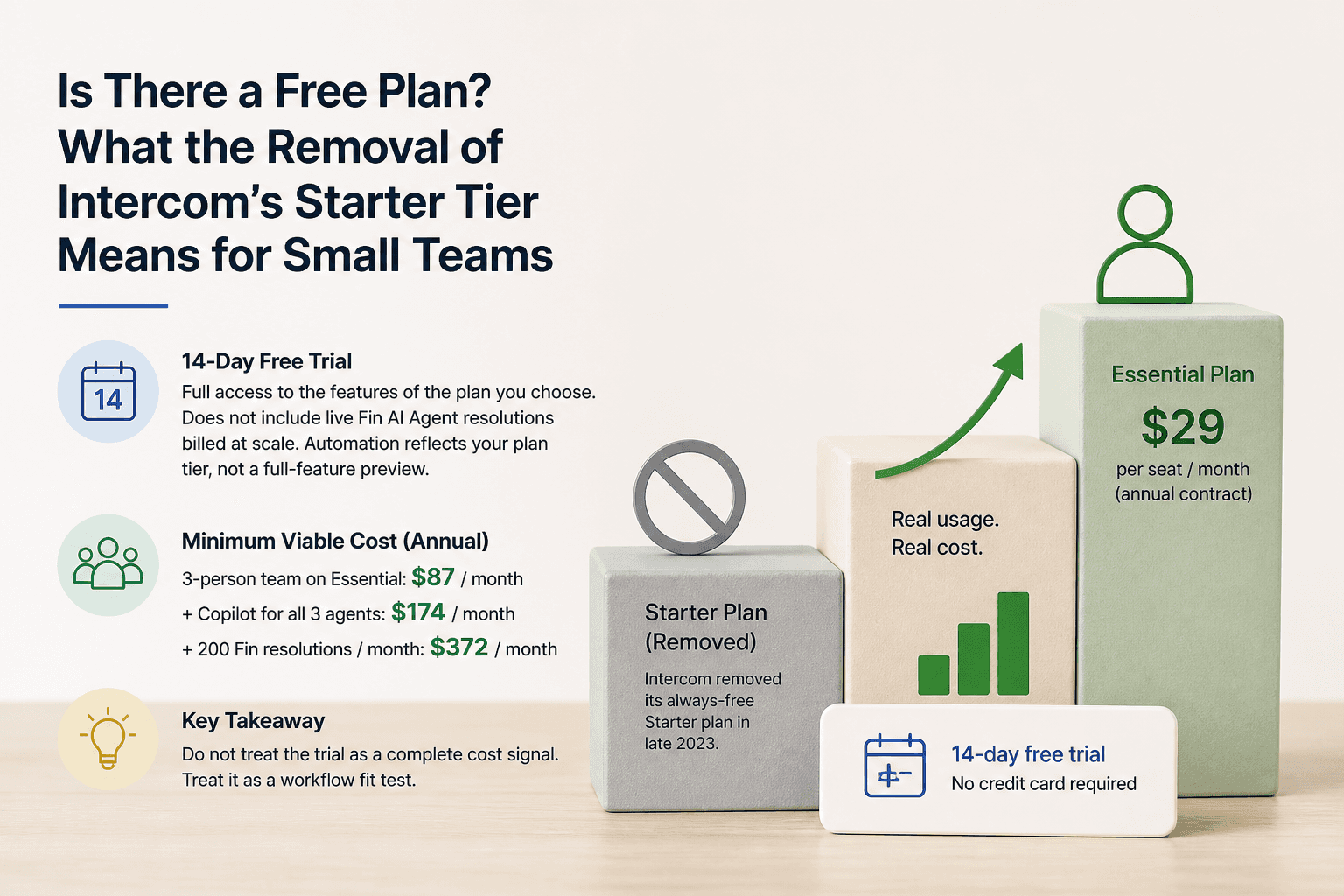
Is There a Free Plan? What the Removal of Intercom's Starter Tier Means for Small Teams
No. Intercom removed its always-free Starter plan in late 2023. As of 2026, the cheapest paid option is the Essential plan at $29 per seat per month on an annual contract ($39 monthly). A 14-day free trial is available on any tier without a credit card.
The 14-Day Free Trial: What It Covers and What It Does Not
The trial gives access to the plan features you select. It does not include live Fin AI Agent resolutions billed at scale, and automation capabilities in the trial environment reflect the plan tier, not a full-feature preview. Teams that evaluate Intercom purely through the trial often underestimate two things: how quickly Copilot becomes necessary for agent productivity, and how the resolution billing behaves once real conversation volume runs through Fin.
Do not treat the trial as a complete cost signal. Treat it as a workflow fit test.
Minimum Viable Cost for a Small Support Team
A three-person team on Essential, annual pricing, with no add-ons pays $87 per month. That is the floor. Add Copilot for all three agents and the floor becomes $174. Add even 200 Fin resolutions per month and total cost reaches $372. The headline price and the operational price are rarely the same number for teams that use Intercom as intended.
The Hidden Costs in Intercom Pricing Most Teams Miss
The invoice-surprise problem is not just about add-ons. It is about a second category of cost that does not appear on the pricing page at all.
When Fin AI Agent Resolutions Become Unpredictable at Scale
Resolution volume is not a fixed number. It shifts with product changes, seasonal support spikes, and new customer segments. Teams that lock in an annual budget against a resolution estimate in month one find that estimate is wrong by month four. Edge-case conversations compound this further: when Fin partially handles an issue before handing to a human, the billing classification requires someone to review and audit regularly. That grey area is real and it requires human attention to manage.
The Operational Overhead Nobody Prices In
Intercom is not a set-and-forget system. Someone on your team needs to keep Fin trained as your product changes, update workflows when processes shift, audit resolution accuracy to validate billing, and handle exceptions that fall outside standard flows. For finance and operations teams already stretched across multiple systems, this is not a minor task. It averages hours per week at scale, and those hours have a cost that never shows up in the vendor contract.
This is where teams running back-office or finance workflows, whether they involve a finance ai bot, a support automation layer, or multi-system handoffs, often find the total cost of ownership diverges furthest from expectations. Predflow takes a process-mapping-first approach before building any AI agent, with continuous improvement and human oversight built into the operating model. For operations and finance teams who cannot absorb open-ended per-resolution fees or unplanned admin overhead, that distinction matters.
Annual Contract Lock-In and Seat Minimums
Annual contracts lock your seat count at signing. If your team shrinks or your support model changes, you still pay for the seats. Adding seats mid-year triggers prorated billing, but removing them before renewal does not yield a refund. For teams with variable headcount, this structure creates a cost floor that does not flex with the business.
Intercom Pricing vs. Cheaper Alternatives: What to Evaluate Before Switching
Switching tools has its own cost. Migration, retraining, workflow rebuilds, and lost institutional configuration can easily consume the savings a cheaper platform appears to offer. The right question is not "what costs less on the pricing page" but "what is the total cost difference including transition."
When Intercom's Pricing Model Makes Sense to Keep
Intercom's model works best when resolution volume is relatively predictable, your team has internal capacity to maintain the tool, and you need a mature, feature-complete support platform rather than point automation. If your Fin resolution rate is high and stable, the per-resolution model rewards you. If you are paying for Advanced features you are actually using, the seat cost is justified.
Before assuming the price is the problem, audit your add-ons. Many teams pay for Proactive Support Plus and use less than 20% of its functionality. Removing one add-on can reduce the monthly bill by $99 without touching the core product.
What Lower-Cost Alternatives Actually Trade Off
Lower-cost alternatives typically trade platform depth for price. That trade is acceptable if you need channel-specific automation, such as an ai chatbot for telegram or ai voice bots for inbound call deflection, rather than a full-service support platform. Dedicated channel tools cost less and do the one job well.
The tradeoff is integration debt. A standalone ai chatbot for telegram does not share context with your ticketing system, your CRM, or your human agent queue without custom work. Intercom's advantage is that it holds all of that in one place. If your operation needs that integration, a cheaper point tool will require you to build the connective tissue yourself.
The One Question to Ask Any Vendor Before Signing
Ask this: "How is a resolved conversation defined in your billing system, and what happens to edge cases where automation partially handles the issue?" If the answer is vague, the billing model will be unpredictable. Intercom's answer is clearer than most, but the question still matters at scale.
Most SaaS vendors structure pricing in three tiers and design it to pull buyers toward the middle plan. Run the math on all three tiers plus every add-on you will realistically need before accepting the middle tier as the default sensible choice. The middle plan often looks safe until you calculate what it actually costs at your specific seat count and usage volume.
How to Calculate Your Real Intercom Cost Before Signing
Use this formula before any contract conversation:
(Seats x plan monthly rate) + (seats x Copilot fee if needed) + (estimated monthly resolutions x $0.99) + (additional add-ons) + (estimated monthly admin hours x internal hourly rate) = true monthly cost
Step 1: Count Seats and Map Required Add-Ons
List every agent who needs inbox access. That is your seat count. Then go through each add-on and ask whether it is required for your use case or optional. Do not include add-ons because they sound useful. Include them only if a specific workflow breaks without them.
Step 2: Estimate Monthly Fin Resolutions and Budget Variance
Pull three months of historical support conversation volume. Estimate the percentage Fin would realistically close without escalation, and apply a conservative adjustment of 15 to 20% lower than your optimistic estimate. Build a high and low scenario. The difference between those two numbers is your budget variance exposure each month.
For a worked example: five agents on Advanced ($85/seat) plus Copilot ($29/seat) equals $570 in seat-related fees. Add 500 estimated Fin resolutions at $0.99 each ($495) and Proactive Support Plus ($99). True monthly cost: $1,164. The headline five-seat Advanced cost was $425.
Step 3: Add Operational Hours as a Cost Line
Estimate how many hours per month your team will spend training Fin, auditing resolutions, updating workflows, and handling exceptions. Assign your team's blended hourly rate to those hours. Add that number to the formula above. For most teams running Intercom at meaningful scale, this adds $500 to $1,500 in hidden labor cost per month.
That number is what you bring to a contract negotiation or an internal budget review.
Frequently Asked Questions
How much does Intercom cost per month in 2026?
The minimum is $29 per seat per month on an annual Essential plan. A realistic five-agent team on Advanced with Copilot, Proactive Support Plus, and 500 monthly Fin resolutions pays approximately $1,164 per month. The headline seat price does not reflect total cost of ownership.
Does Intercom have a free plan?
No. Intercom retired its always-free Starter plan in late 2023. As of 2026, the cheapest entry point is the Essential plan at $29 per seat per month (annual) or $39 monthly. A 14-day free trial is available on any tier without a credit card.
What is the Fin AI Agent and how is it billed?
Fin is Intercom's AI support agent. It is billed at $0.99 per successfully resolved conversation, separate from any seat plan cost. When Fin cannot resolve a conversation and hands it to a human agent, no resolution fee is charged. It is available as a standalone product or as an add-on to a seat plan.
What add-ons does Intercom charge for separately?
The main add-ons are Copilot at $29 per agent per month, Pro at $99 per month, Proactive Support Plus at $99 per month, and Phone at usage-based rates. These stack on top of the seat plan and Fin resolution fees, and they are the primary source of invoice shock for teams that did not budget for them at contract signing.
Is Intercom worth the cost for small operations teams?
It depends on resolution volume predictability and internal admin capacity. For small teams with stable, high-resolution-rate support workflows and someone available to maintain the tool, the model can work. For teams with variable volume or no spare admin capacity, the per-resolution billing and operational overhead create compounding cost pressure that a fixed-price alternative handles more predictably.
Conclusion
Your decision on Intercom pricing comes down to three situations.
If your resolution volume is predictable and your team has the admin capacity to keep Fin trained and audited, Intercom's model can work at a defensible cost. Start by auditing your current add-ons. Removing one or two that are underused frequently recovers $100 to $200 per month with no impact on core functionality.
If your resolution volume is unpredictable or your team has no capacity for ongoing tool maintenance, the per-resolution model will generate budget variance that compounds every quarter. In that case, evaluate alternatives with fixed monthly pricing and narrower scope. If your pain is less about Intercom's specific price and more about fragmented process automation across finance systems, supply chain tools, and back-office workflows, renegotiating a support tool contract will not fix the underlying problem. A workflow-first AI platform addresses that root cause more directly.
If you are evaluating whether Intercom fits your operations budget or whether a workflow automation platform would address more of your process problems, talk to Predflow. We map your process first, then build agents that handle it end to end.
Bring 20 NetSuite bills to a 30-minute teardown
We will walk your actual invoices through capture, 3-way match and posting on the call, and tell you which steps an agent can take over. No prep beyond the PDFs.
FAQ
Frequently asked questions
What exactly is an AI agent
An AI agent is an autonomous system designed to handle specific business tasks end-to-end. Unlike simple chatbots, AI agents can reason, take actions, integrate with tools, and follow defined workflows.