AI AGENTS
How to Use AI Agents for Trading in Finance Ops (2025)
Learn how AI agents for trading fix broken reconciliation workflows, cut manual handoffs, and keep settlement on track inside your existing finance ops stack.

Sanya Shah
Co-founder, Predflow

Finance ops teams running trade reconciliation across three or more disconnected systems know the cost of manual handoffs. Approvals queue up in inboxes, settlement windows close before data syncs, and the team spends the bulk of the week fixing what automation should have handled. This is not a staffing problem. It is a structural one, and it is exactly what AI agents for trading are designed to solve.
This guide shows finance and ops leaders how to deploy AI agents across trading workflows, what to look for in an agent platform, and where the real efficiency gains come from. Skip the theory. Start with the workflow.
What AI Agents for Trading Actually Do in a Finance Workflow
Most finance teams using "automation" are running rule-based bots: rigid scripts that follow fixed decision trees and break the moment data arrives in an unexpected format. AI agents operate differently. They perceive context, reason across variables, and take action in a loop that adjusts when conditions change.
What are AI agents for trading? AI agents for trading are autonomous software systems that ingest real-time financial data, reason across multiple inputs, and execute multi-step workflow tasks without waiting for human instruction. Unlike rule-based bots, they handle exceptions, adapt to new conditions, and escalate only when genuinely uncertain.
How AI Agents Differ from Algorithmic Trading Bots
Algorithmic trading bots execute pre-defined strategies. They do not reason. When a counterparty sends a misformatted settlement file, the bot stops. An AI agent reads the file, infers the intended values from context, flags the anomaly, attempts a corrective action, and logs the decision for audit. The gap between those two outcomes is operational cost.
The shift from rule-based systems to reasoning-capable agents marks the same kind of step-change that moved finance from spreadsheets to ERP systems.
The Structure of an AI Agent: Perception, Reasoning, and Action Loops
The structure of an AI agent has three core components. The perception layer ingests data from connected systems. The reasoning layer applies logic, past context, and defined goals to decide what to do next. The action layer executes the step and feeds results back into the perception layer.
This loop runs continuously. That is what makes agent architecture different from a one-time script or a static workflow.
Rule-Based Bot | AI Agent | |
|---|---|---|
Decision logic | Fixed if/then rules | Context-aware reasoning |
Adaptability | None | Adjusts to new data patterns |
Error handling | Stops on exception | Attempts resolution, then escalates |
Human oversight needed | High (frequent breaks) | Low (exception-only review) |
Why Agentic AI Handles Edge Cases That Rule-Based Tools Cannot
Edge cases are not rare in finance ops. Partial trade data, late counterparty confirmations, and mismatched settlement amounts are daily occurrences. Agentic AI uses knowledge-based reasoning to evaluate what the correct response is, rather than defaulting to failure. The difference between generative AI and agentic AI matters here: generative AI produces outputs, while agentic AI takes actions. In finance ops, the distinction is significant. You need action, not text.
Four Core Capabilities That Make AI Agents Useful for Finance Ops
Finance ops leaders evaluating AI agents need a practical test, not a feature list. These four capabilities determine whether an agent will reduce manual workload or just add a new system to manage.
Real-Time Data Ingestion Across Fragmented Systems
Trade data rarely lives in one place. Positions sit in the trading system, confirmations arrive by email, and reconciliation happens in a separate ERP. An AI agent connects these sources in real time, ingesting data continuously rather than waiting for batch exports. For ops teams, this means exception queues shrink because the agent catches discrepancies before they compound. Teams that implement this capability typically see reconciliation cycles compress from days to hours.
Context-Aware Reasoning for Trade Reconciliation and Exception Handling
Standard automation matches records by exact values. Context-aware reasoning matches records by intent. When a trade confirmation shows a fee calculation rounded differently by two parties, an AI agent identifies the rounding convention, determines whether the discrepancy falls within tolerance, and routes it accordingly. Ops teams running this capability reduce the volume of exceptions that reach human reviewers by a meaningful margin.
Multi-Step Workflow Execution Without Human Handoffs
The highest cost in finance ops is the wait time between steps. A trade comes in, someone checks it, someone else approves it, a third person posts it. AI agents execute the full sequence autonomously when conditions are met, and pause for human input only when a genuine judgment call arises. Finance teams deploying multi-step agent workflows report that same-day settlement processing becomes achievable where it was not before.
Continuous Learning and Process Improvement Over Time
AI agents using agentic RAG (retrieval-augmented generation) improve with each cycle. They reference past decisions, flag patterns that recur, and surface process inefficiencies the team had normalized. Over a 90-day period, an agent handling trade exceptions will become measurably more accurate because it has processed the actual edge cases specific to that workflow. This is what knowledge-based agents in artificial intelligence do differently from static tools: they build a working model of your specific environment in AI operations.
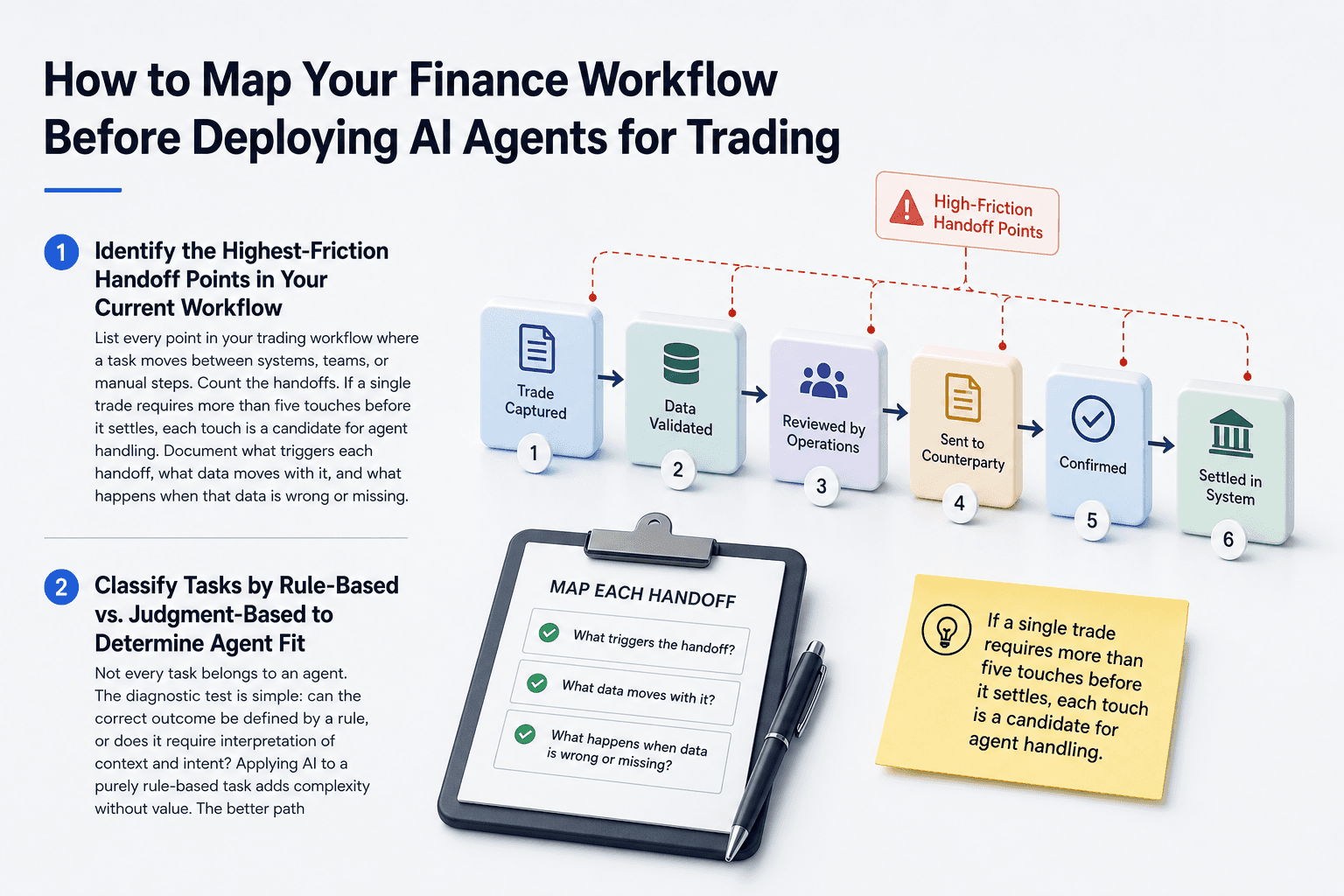
How to Map Your Finance Workflow Before Deploying AI Agents for Trading
Deploying an AI agent into an unmapped process is the most common reason implementations fail. The agent cannot reason its way around a workflow that has never been clearly defined. Before selecting any platform or building any agent, map the process first.
Step 1: Identify the Highest-Friction Handoff Points in Your Current Workflow
List every point in your trading workflow where a task moves between systems, teams, or manual steps. Count the handoffs. If a single trade requires more than five touches before it settles, each touch is a candidate for agent handling. Document what triggers each handoff, what data moves with it, and what happens when that data is wrong or missing.
This is precisely where Predflow's approach differs. Rather than handing you an agent builder and leaving you to figure out the workflow, Predflow begins every deployment by mapping your existing process, identifying edge cases, and defining escalation logic before a single agent is configured. If your team is running five or more manual handoffs per week in a finance workflow, that is a strong signal Predflow can compress them into a single supervised agent loop.
Step 2: Classify Tasks by Rule-Based vs. Judgment-Based to Determine Agent Fit
Not every task belongs to an agent. The diagnostic test is simple: can the correct outcome be defined by a rule, or does it require interpretation of context and intent? Applying AI to a purely rule-based task adds complexity without value. The better path for those tasks is standard workflow automation.
Finance Task | Type |
|---|---|
Match trade confirmations by reference number | Rule-based |
Post settled trades to the ledger | Rule-based |
Generate daily position reports | Rule-based |
Evaluate whether a fee dispute is worth escalating | Judgment-based |
Decide how to handle a counterparty flagged for credit risk | Judgment-based |
Interpret a regulatory exception in a grey area | Judgment-based |
Step 3: Define What "Done" Looks Like for Each Agent Action Before You Build
Every agent action needs a clear success state. "Reconcile the trade file" is not a success state. "Match all confirmed trades to the position ledger with zero unresolved breaks, or flag breaks with a variance above $500 for human review" is a success state. Without this definition, the agent has no way to know when to stop, escalate, or proceed.
Write the success state in plain language before any configuration begins. This step alone prevents most of the scope creep that derails finance automation pilots.
Step 4: Establish Human Oversight Checkpoints for Exception Escalation
AI agent workflows need defined points where a human reviews the agent's output before the process continues. This is not a limitation. It is what makes agents trustworthy in a regulated environment. Map the checkpoints in advance: which exception types require sign-off, who receives the escalation, and what the agent logs for audit purposes. Agent orchestration without human oversight checkpoints is not a finance-grade deployment.
Choosing the Right AI Agent Platform for Trading and Finance Automation
Every platform positions itself as the answer. The better question is whether it can answer five specific criteria before a pilot begins.
Criteria 1: Does It Support Multi-Agent Coordination Across Your Existing Tools?
A single agent handling one task is useful. A multi-agent system handling your end-to-end workflow is transformative. Ask vendors whether their platform supports agent orchestration across your ERP, trading system, and communication tools. Open-source frameworks like CrewAI and LangGraph offer multi-agent architectures but require significant engineering resources to configure for finance-specific workflows. Evaluate whether your team has that capacity.
Criteria 2: How Does It Handle Partial Data and Ambiguous Inputs?
Finance data is rarely clean. Platforms that require complete, structured inputs break on real-world trade data. Ask the vendor to demonstrate exception handling with a real example from a fragmented data environment. If the demo only uses clean data, that is a gap.
Criteria 3: What Does the Human Oversight and Audit Trail Look Like?
In a regulated finance environment, every agent decision needs to be traceable. The platform must log what data the agent received, what decision it made, and why. Review the audit trail interface before committing. Compliance teams will need to access it without engineering support.
Criteria 4: Can It Be Configured Without Engineering Resources?
Finance ops teams cannot wait months for developer capacity. The platform should support workflow configuration through a no-code or low-code interface. Test this claim directly. Ask the vendor to show a workflow being configured by a non-engineer.
Criteria 5: Does It Have a Proven Deployment Path for Finance Workflows?
General-purpose agent builders are not the same as platforms with finance-specific deployment experience. Ask for examples of trading reconciliation, settlement processing, or exception management workflows the platform has already handled.
If a platform cannot answer all five criteria questions before a pilot, it is not ready for finance ops deployment.
What AI Agents for Trading Can and Cannot Automate Right Now
Setting accurate expectations before a pilot prevents the most expensive mistake in AI automation: over-building into territory the technology is not ready to handle reliably.
High-Confidence Automation: Reconciliation, Reporting, and Alert Routing
Green zone. These tasks have clear rules, structured data inputs, and defined success states. Trade reconciliation against confirmed positions, daily P&L reporting, and exception alert routing are all production-ready for AI agent automation today. Finance teams deploying agents in this zone see results within weeks, not quarters.
Emerging Automation: Exception Triage, Counterparty Communication, and Compliance Checks
Yellow zone. These tasks benefit from AI agent support but require human oversight during the pilot phase. Exception triage can be handled by an agent with escalation rules defined in advance. Counterparty communication drafts can be generated by an agent and reviewed before sending. Routine compliance checks can be agent-run with human sign-off on flagged items. Build these workflows with explicit human checkpoints.
Requires Human Judgment: Strategic Trade Decisions and Regulatory Grey Areas
Red zone. Strategic trade decisions, grey-area regulatory interpretations, and counterparty relationship management require human judgment. Deploying agents in this zone without robust oversight is the most expensive implementation error finance teams make. The risk is not that the agent fails loudly. The risk is that it acts confidently on incomplete context. Keep humans in the loop here.
Frequently Asked Questions
What are AI agents for trading and how are they different from trading bots?
AI agents for trading are autonomous systems that perceive financial data, reason across it, and take multi-step actions in a continuous loop. Unlike trading bots, which follow fixed rules and stop on exceptions, AI agents adapt to changing inputs, handle edge cases, and escalate only when genuine uncertainty arises.
Can AI agents for trading integrate with existing ERP and finance systems?
Yes. AI agents are designed to connect with existing tools rather than replace them. Most agent platforms support integration with standard ERP systems, trading platforms, and data feeds through APIs. The key is verifying that the platform handles your specific data formats and exception types before committing to a deployment.
What is agentic AI and how does it differ from generative AI in finance?
Generative AI produces content: reports, summaries, drafts. Agentic AI takes actions: it executes workflows, makes decisions, and adjusts based on outcomes. In finance ops, the difference matters because you need a system that acts on your data, not one that describes it. Agentic AI is goal-directed and operates in loops. Generative AI responds to prompts.
How long does it take to deploy an AI agent in a finance workflow?
A well-scoped pilot on a single workflow, such as trade reconciliation or exception routing, typically runs within 30 to 60 days when the process is clearly mapped in advance. Deployments that skip the mapping step take longer and produce less reliable results. Start with one workflow, define the success state precisely, and scale from there.
What human oversight is required when running AI agents in trading operations?
Oversight requirements depend on the workflow zone. Green-zone tasks like reconciliation and reporting need audit trail review but minimal active oversight. Yellow-zone tasks need defined escalation rules and periodic review of agent decisions. Red-zone tasks require a human in the approval loop before any action is taken. The oversight model should be defined before deployment, not added after problems arise.
Conclusion
The real question is not whether AI agents work in finance ops. The question is whether your current workflow is mapped clearly enough to hand off to an agent.
Take three steps this week. Audit your highest-friction handoff and count how many manual touches it requires. Apply the rule-based versus judgment-based test to each task in that workflow. Then run a 30-day pilot on one clearly scoped process before scaling further.
Finance ops teams that deploy agents effectively in 2025 will enter 2026 able to scale trade volume, reduce settlement cycles, and reallocate their teams to higher-value work without adding headcount. That gap between them and teams still running manual processes will compound quickly.
If you are ready to map your first finance workflow for agent deployment, Predflow offers a process audit session to identify your highest-ROI automation starting point. No engineering resources required to get started.
Bring 20 NetSuite bills to a 30-minute teardown
We will walk your actual invoices through capture, 3-way match and posting on the call, and tell you which steps an agent can take over. No prep beyond the PDFs.
FAQ
Frequently asked questions
What exactly is an AI agent
An AI agent is an autonomous system designed to handle specific business tasks end-to-end. Unlike simple chatbots, AI agents can reason, take actions, integrate with tools, and follow defined workflows.