PERFORMANCE MARKETING
Generative AI for Customer Service: What Works and What Breaks
Generative AI is being sold as the fix for every customer service bottleneck. But hallucinated policies, broken handoffs, and silent wrong answers tell a different story—here's what actually works.

Your customer service team is buried. Tickets come in across email, chat, and phone. Each one requires someone to pull order status from one system, check billing in another, and log the outcome in a third. The handoffs are manual, the visibility is zero, and the repetitive volume never drops. Generative AI is being sold as the answer to every part of that problem. But most deployments either hallucinate policy details that agents spend hours correcting, collapse when a request crosses two systems, or quietly give wrong answers that no one catches until a customer escalates. This article breaks down where generative AI in customer service genuinely reduces operational burden, where it creates new ones, and what deployment decisions determine which outcome you get.
What Generative AI in Customer Service Actually Does
Most operations teams have used rule-based chatbots before. They know what those systems can and cannot do. Generative AI is a different category, and understanding the distinction matters before evaluating any vendor claim.
Generative AI in customer service is a system powered by a large language model that produces original, context-aware responses to customer queries rather than selecting from a fixed script. It can retain conversational context across multiple turns, classify customer intent in real time, and generate replies that are relevant to the specific situation rather than the closest matching rule.
How Generative AI Differs from Rule-Based Automation
A rule-based chatbot follows decision trees. You define every possible path, every accepted input, and every corresponding response. When a customer says something outside that tree, the system fails or escalates.
A generative AI model produces responses from patterns in language. It does not need every scenario scripted in advance. It reads the conversation, infers what the customer needs, and generates a response calibrated to that context.
The operational implication is significant. Rule-based systems break loudly, at defined edges. Generative AI breaks quietly, anywhere.
The Three Capabilities That Matter for Operations Teams
The first is response generation. The model produces natural language answers without requiring a pre-written script for every scenario. This is what handles high-volume, varied ticket queues without manual drafting.
The second is context retention. The model tracks what has been said across a conversation and adjusts its responses accordingly. A customer who mentioned a delayed shipment two messages ago does not need to repeat themselves.
The third is intent classification. The model reads what a customer is asking and routes or tags it correctly, even when the language is ambiguous. This is what enables automated triage without a human reading every ticket first.
These three capabilities work together. Without all three functioning reliably in your specific workflow, the system creates as much cleanup work as it eliminates.
Where Generative AI Customer Service Genuinely Delivers
The use cases where generative AI produces consistent operational value share one trait: the workflow is well-defined, the data the AI needs is accessible, and the cost of an occasional error is recoverable. For supply chain, AP, and operations teams, several of these use cases are directly applicable.
High-Volume Ticket Deflection Without Scripted Trees
Customer service teams handling logistics or billing typically receive the same twenty to thirty question types at high volume. Where is my shipment? Why was this invoice adjusted? When will this credit post?
A generative AI model can handle this tier of questions without a scripted decision tree for each one. It pulls context from the query, checks the relevant system for current status, and generates a direct answer. The agent queue shrinks without requiring additional headcount.
The shift this enables is meaningful. Instead of a reactive function where every inquiry becomes a task, the team focuses human attention on requests the AI flags as complex or high-risk.
Summarizing Customer History Before Human Handoffs
One of the most consistent drains on agent time is reading through a full conversation history before picking up a ticket. In supply chain and AP contexts, that history spans multiple systems and sometimes multiple weeks.
Generative AI handles this well. It reads the full thread, extracts the relevant facts, and produces a structured summary for the agent before they engage. The agent starts with context rather than spending ten minutes building it.
This is the difference between a handoff that works and one that forces the customer to repeat themselves. Personalization and continuity in customer interactions are not just service quality metrics. They reduce handle time and rework.
Drafting Responses Across Billing and Order Status Queries
For back-office teams managing high volumes of billing inquiries or order status requests, response drafting is a significant time cost. Each response needs to be accurate, specific, and appropriately toned.
Generative AI drafts these responses at scale. The agent reviews and sends rather than composing from scratch. Quality stays consistent and volume no longer dictates headcount.
The broader shift here is from reactive complaint handling to proactive resolution. When a billing discrepancy is caught by an AI monitoring system and a resolution is drafted before the customer even notices, the support function stops being a cost center and starts returning operational value. In logistics contexts, this looks like flagging a delayed shipment and generating customer communication before the inquiry arrives.
Where Generative AI Breaks in Real Customer Service Workflows
Generative AI fails in customer service in four specific, predictable ways. Each one creates direct operational cost for the teams responsible for resolving the fallout.
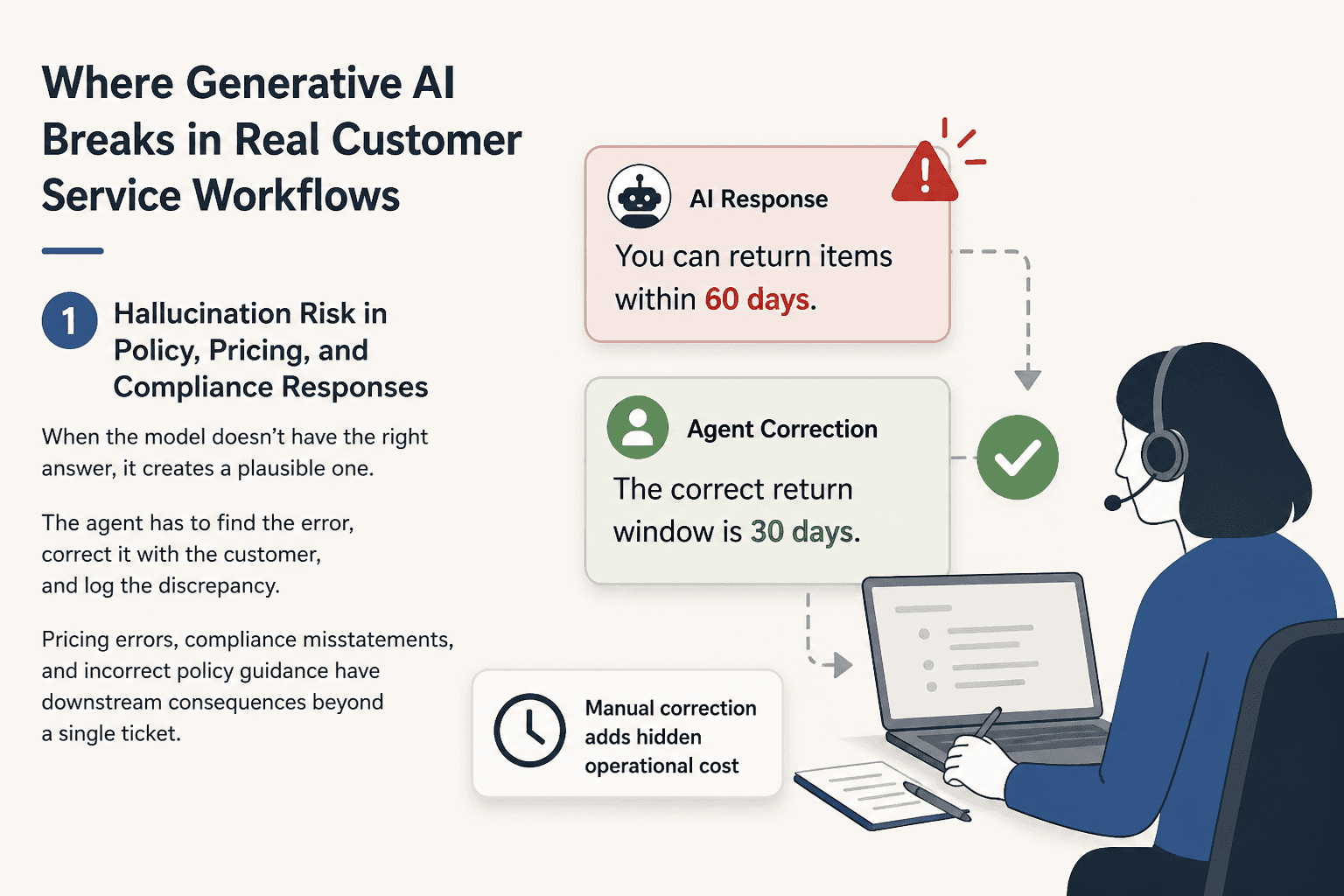
Hallucination Risk in Policy, Pricing, and Compliance Responses
When a generative AI model does not have confident access to the correct answer, it generates a plausible-sounding one. In customer service, this means the model states an incorrect return policy, quotes the wrong contract price, or describes a compliance process that does not exist.
The agent then has to identify the error, correct it with the customer, and log the discrepancy. The manual correction work is invisible in most ticket systems, so it does not get attributed to the AI deployment. It just accumulates as agent overhead.
For AP and operations teams, the risk is higher. Pricing errors, compliance misstatements, and incorrect policy guidance have downstream consequences beyond a single ticket.
Context Collapse Across System Handoffs
Generative AI retains context within a conversation. It does not automatically retain context across systems. When a billing query requires pulling data from an ERP, matching it against a CRM record, and then referencing a logistics platform for shipment status, the model works with whatever it receives from each system.
If those integrations are incomplete or the data is inconsistent across systems, the model generates a response based on a partial picture. The output looks correct. The customer receives it. The error surfaces later.
This is the failure mode that appears most frequently in multi-system environments. Uninformed responses are one of the most damaging patterns in customer service, and generative AI does not automatically solve this when the underlying data pipeline is fragmented.
The Silent Failure Problem: Confident Wrong Answers
Rule-based systems fail with an error message or a dead end. The failure is visible. Generative AI fails with a confident, grammatically correct, plausible answer. No error message appears. No escalation is triggered. The ticket closes.
The customer received the wrong information. No one on the operations side knows. The downstream impact, a missed shipment, an incorrectly applied credit, a compliance breach, materializes later and is difficult to trace back to the AI response.
This is the operational risk that most generative AI vendor conversations skip. Silent failures require active detection infrastructure, not just confidence in the model's quality. Without defined exception thresholds and real-time error flagging built into the workflow, these failures accumulate.
The Deployment Decisions That Determine Whether Customer Service AI Succeeds
The question is not whether to use generative AI. It is how to structure the deployment so it removes manual work rather than relocating it. Three decisions determine the outcome.
Process Mapping First: Define Handoffs Before You Deploy
The most common deployment failure is selecting a tool before mapping the workflow. The AI gets bolted onto a process that already has broken handoffs, unclear ownership at exception points, and inconsistent data across systems. The AI inherits every flaw and adds new ones.
Process mapping means documenting every step in the workflow, identifying every system involved, defining exactly what the AI owns versus what it hands off, and specifying what happens at every edge case before the deployment begins.
For example, platforms like Predflow are built around this sequence. The process is mapped end to end, every exception path is identified, and the agent is built around that structure rather than configured after the fact. Predflow's agents include human oversight and continuous improvement as default components of the architecture, not features added later. This approach means the automation matches the real workflow, not an idealized version of it.
Human-in-the-Loop Isn't Optional—It's the Architecture
Human oversight in AI deployments is typically framed as a fallback. A human reviews flagged tickets. In practice, this means human review is an afterthought triggered only when the AI is already uncertain.
Effective deployments define human intervention points in advance. When a query involves a contract exception, a compliance-sensitive response, or a customer escalation threshold, the AI routes to a human before generating a response. The threshold is set by the operations team, not the vendor.
This structure protects the team from silent failures. It also makes the AI system improvable, because human decisions at defined points generate labeled data that feeds directly back into the model's behavior.
Building Feedback Loops That Improve the System Over Time
A generative AI deployment that does not improve over time degrades. The business changes. New products, new policies, new exception types appear. A static model handles these with decreasing accuracy.
Effective deployments build feedback mechanisms into the workflow from day one. Agent corrections, customer escalations, and exception resolutions feed back into the system as training signal. The model improves on the actual distribution of queries it receives, not on a generalized training set.
This is also what separates process-first deployments from tool-first ones. A tool-first deployment optimizes for the initial rollout. A process-first deployment optimizes for how the system performs six months later.
Frequently Asked Questions
What is the difference between generative AI and a traditional customer service chatbot?
A traditional chatbot follows pre-written decision trees and responds only to anticipated inputs. A generative AI system produces original responses based on the full context of a conversation. It handles varied language and novel scenarios without requiring every possible path to be scripted in advance.
Can generative AI handle complex or exception-based customer service cases?
Generative AI handles complexity poorly without defined escalation architecture. For exception-based cases involving policy judgment, compliance, or multi-system data conflicts, the model needs a structured handoff to a human at a predefined threshold. Without that, it generates a plausible response that is often wrong.
How do you prevent generative AI from giving wrong answers in customer service?
Prevention requires three things: grounding the model in verified, current data sources rather than letting it generate from general knowledge; building real-time exception flagging into the workflow so silent failures surface; and defining human review points at any response type where an error has downstream financial or compliance consequences.
What customer service workflows are best suited for generative AI automation?
High-volume, repetitive query types with well-structured backend data are the best candidates. Order status inquiries, billing question deflection, pre-handoff conversation summarization, and standard policy questions all perform well when the data pipeline feeding the model is clean and complete.
How long does it take to deploy a generative AI customer service solution?
Timeline depends almost entirely on how much process mapping work has been done before deployment begins. A workflow that is already documented, with clear system integrations and defined exception paths, can have a working deployment in weeks. A workflow that needs to be mapped first adds that work to the front of the timeline. Skipping the mapping step to move faster is the most reliable way to produce a failed deployment.
Make the Decision Based on What Your Workflow Actually Looks Like
Generative AI is worth deploying for customer service if your team is buried in repetitive, manual work and the processes are mappable. But the technology does not fix broken workflows. It amplifies whatever structure exists underneath it.
Deploy where the process is already mapped, exceptions have a human escalation path, and there is an active mechanism to surface silent failures. Where those three conditions are not in place, the deployment adds coordination overhead rather than removing it. The honest next step is not evaluating AI tools. It is auditing the workflows first.
If you are evaluating whether your workflows are ready for AI automation, Predflow offers a process audit to map your current state before any deployment decision. Request a workflow review at predflow.com.
Bring 20 NetSuite bills to a 30-minute teardown
We will walk your actual invoices through capture, 3-way match and posting on the call, and tell you which steps an agent can take over. No prep beyond the PDFs.
FAQ
Frequently asked questions
What exactly is an AI agent
An AI agent is an autonomous system designed to handle specific business tasks end-to-end. Unlike simple chatbots, AI agents can reason, take actions, integrate with tools, and follow defined workflows.