Logistics & Freight
Freight Audit Software Compared: 9 Top Platforms
Compare 9 freight audit software platforms that catch carrier billing errors and recover parcel overcharges before they drain your freight budget.

Khushbu Adav
Product at Predflow

Your AP team is matching line items on hundreds of freight invoices against carrier contracts every week. They are still missing overcharges. Billing errors typically run 2–5% of total freight spend, and for a company moving $5M in freight annually, that is $100K–$250K silently leaking out each year. Most teams don't realize how much slips through until they run their first automated audit. That suspicion you have about your current process is usually correct.
Freight audit software is the structural fix, not a reporting add-on. It systematically verifies every carrier invoice against your contracted rates, accessorial schedules, fuel surcharges, and shipment documentation before payment clears. This article breaks down nine platforms across the shipper and broker split, gives you a vendor-neutral evaluation framework, and flags the one pricing model that costs more than it saves at scale.
What Freight Audit Software Actually Does (And What It Doesn't)
What is freight audit software? Freight audit software automates the comparison of carrier invoices against contracted rates, service levels, and shipment records to identify billing errors before payment. It extracts invoice data, applies your contract rules, flags discrepancies, and routes exceptions for recovery.
The four things it validates in every audit cycle:
Rates: contracted lane and mode pricing vs. what the carrier billed
Accessorials: detention, liftgate, fuel surcharges, and other add-on fees
Fuel surcharges: index-based calculations applied to the correct base rate
Duplicate invoices: same shipment billed twice under different reference numbers
The core audit loop: extract, compare, flag, recover
The software ingests invoice data via API, EDI, or email. It parses each line item using document extraction, compares values against your rate cards, and pushes exceptions into a dispute queue. Without automation, a human analyst does every one of those steps manually, which is where errors accumulate.
Shipper-side vs. broker-side audit: why the workflow differs
Shippers audit what they pay their carriers. Brokers audit what carriers bill them for moves they brokered. The data sources, contract structures, and dispute mechanisms are different enough that a platform built for one buyer type will underperform for the other. This distinction drives every platform recommendation in this article.
What freight audit software cannot replace
It cannot negotiate better carrier rates, manage carrier relationships, or automatically move audit exceptions into your AP system or ERP. The audit finding is just the start. Dispute resolution, credit processing, and payment holds still require a downstream workflow.
Shipper or Broker? The Buyer Split That Changes Which Freight Audit Software Fits
Selecting the wrong platform for your buyer type is the most common implementation mistake. Shipper-focused platforms assume you have contracted rates on file and audit against your outbound freight spend. Broker-focused platforms assume carriers are billing you for moves you arranged for your clients, with a different set of rules applied per shipper.
Shipper | Broker | |
|---|---|---|
Data source | Carrier invoices vs. your rate cards | Carrier invoices vs. shipper-specific business rules |
Audit trigger | Invoice receipt before payment | Invoice receipt after carrier delivery confirmation |
Recovery mechanism | Carrier credit or short pay | Dispute with carrier, protect shipper margin |
Shipper-focused platforms: auditing what you pay carriers
Cass Information Systems, CTSI-Global, and nVision Global are built for this workflow. They integrate with your TMS, hold your carrier contracts, and audit at volume. Enterprise shippers with multiple carriers and modes get the most value here.
Broker-focused platforms: auditing what carriers bill you
Navix is the clearest example of a platform purpose-built for brokers. It validates carrier invoices at the line-item level using AI-driven document processing, applying each shipper's specific rules rather than a generic rate card.
Mixed-use platforms and their trade-offs
TriumphPay and Transflo serve both buyer types but with different primary strengths. Mixed-use platforms trade depth for breadth. They work well for companies with moderate audit requirements across both workflows, but high-volume shippers or brokers often find they need a specialist tool.
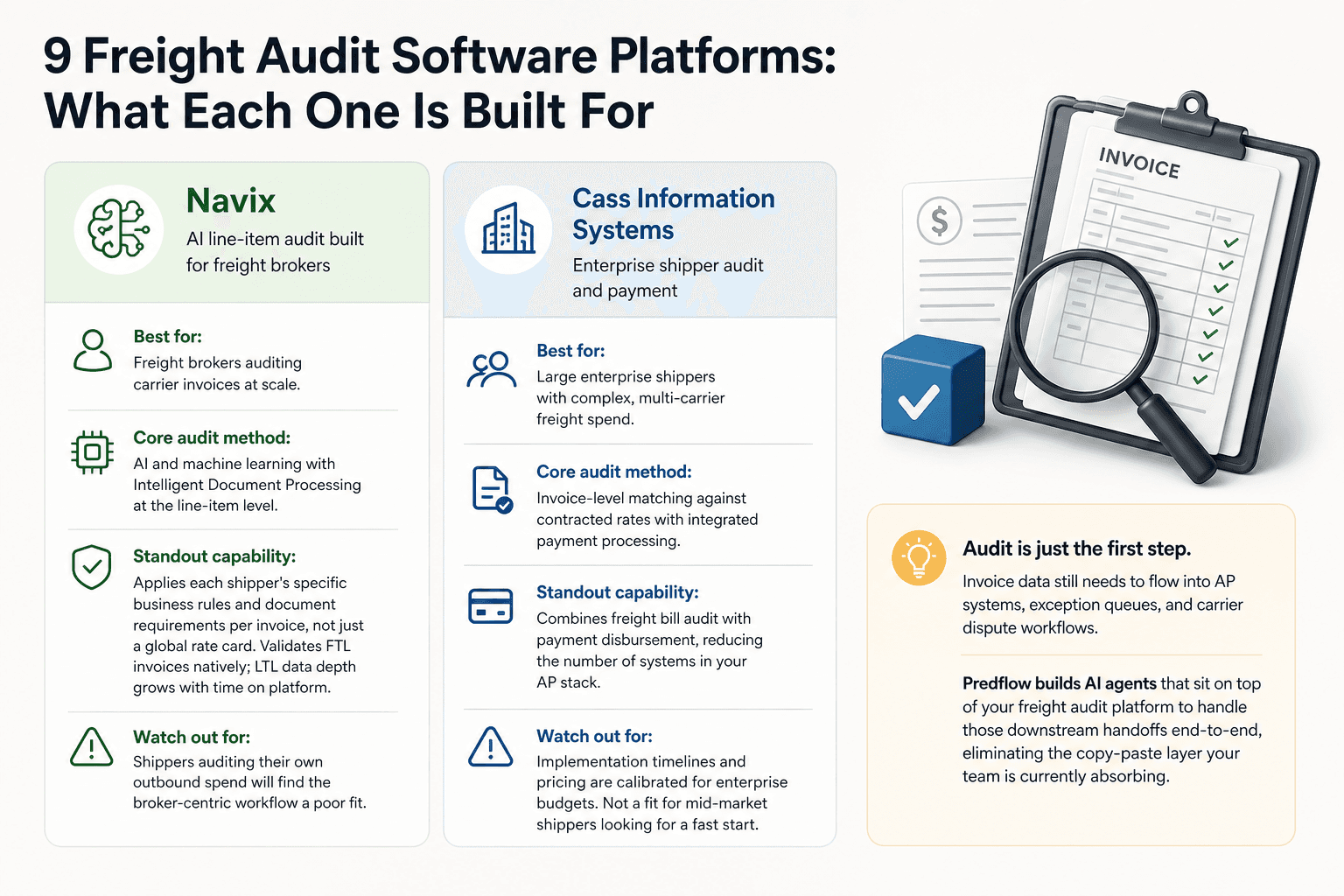
9 Freight Audit Software Platforms: What Each One Is Built For
Navix — AI line-item audit built for freight brokers
Best for: Freight brokers auditing carrier invoices at scale.
Core audit method: AI and machine learning with Intelligent Document Processing at the line-item level.
Standout capability: Applies each shipper's specific business rules and document requirements per invoice, not just a global rate card. Validates FTL invoices natively; LTL data depth grows with time on platform.
Watch out for: Shippers auditing their own outbound spend will find the broker-centric workflow a poor fit.
Whichever platform you shortlist, the manual work doesn't end at audit. Invoice data still needs to flow into AP systems, exception queues, and carrier dispute workflows. Predflow builds AI agents that sit on top of your freight audit platform to handle those downstream handoffs end-to-end, eliminating the copy-paste layer your team is currently absorbing.
Cass Information Systems — enterprise shipper audit and payment
Best for: Large enterprise shippers with complex, multi-carrier freight spend.
Core audit method: Invoice-level matching against contracted rates with integrated payment processing.
Standout capability: Combines freight bill audit with payment disbursement, reducing the number of systems in your AP stack.
Watch out for: Implementation timelines and pricing are calibrated for enterprise budgets. Not a fit for mid-market shippers looking for a fast start.
CTSI-Global (CT Global) — global shipper audit with TMS integration
Best for: Shippers with international freight spend and multi-modal complexity.
Core audit method: Automated rate auditing with TMS integration and analytics reporting.
Standout capability: Global carrier rate library with strong cross-border audit coverage. Analytics layer surfaces freight cost trends over time.
Watch out for: TMS integration depth varies by your specific TMS vendor. Confirm connector availability before committing.
nVision Global — mid-market shipper audit and analytics
Best for: Mid-market shippers who need audit plus spend visibility without enterprise pricing.
Core audit method: Automated freight invoice audit with carrier data normalization.
Standout capability: Strong reporting and analytics on freight spend patterns, useful for carrier contract renegotiation cycles.
Watch out for: Parcel audit capabilities are less developed than LTL and FTL coverage.
TriumphPay — payment network with invoice-level matching
Best for: Brokers and carriers already operating within the TriumphPay payment network.
Core audit method: Invoice-level matching; line-item audit is a more recent addition to the platform.
Standout capability: Network effects. If your carriers are already on TriumphPay, payment speed and audit happen within a single ecosystem.
Watch out for: Audit depth for complex accessorial structures is thinner than dedicated audit-first platforms.
Epay Manager — TMS-native workflow automation
Best for: Brokers whose audit workflow starts inside their TMS before invoices are received.
Core audit method: TMS-generated data comparison; the goal is to reduce the need for post-invoice audit by resolving discrepancies earlier.
Standout capability: Reduces duplicate data entry by keeping the audit trigger inside the TMS workflow.
Watch out for: Works best when carrier invoices closely match TMS load data. High exception rates strain the model.
Transflo — document AI with configurable audit rules
Best for: Operations teams that need document processing plus configurable audit logic across FTL and LTL.
Core audit method: Document AI extracts invoice data; configurable rules engine applies audit logic.
Standout capability: LTL audit capability launched in 2026, expanding coverage for mixed-mode shippers.
Watch out for: Rule configuration requires upfront setup time. Teams expecting out-of-the-box accuracy on complex accessorials will need a dedicated implementation resource.
Loop Freight Audit — automated parcel and LTL recovery
Best for: Shippers with significant parcel volume looking for guaranteed service refund (GSR) recovery alongside LTL audit.
Core audit method: Automated parcel audit with GSR claim filing and LTL invoice matching.
Standout capability: Parcel GSR recovery runs without manual intervention. Refunds are filed and tracked automatically.
Watch out for: Contingency-based pricing can reduce net recovery value at high parcel volumes. Model the fee structure before committing.
Trax Freight Audit — enterprise parcel audit and carrier benchmarking
Best for: Enterprise shippers who want parcel audit combined with carrier rate benchmarking data.
Core audit method: Automated parcel invoice audit with spend analytics and market rate comparison.
Standout capability: Benchmarking layer helps shippers understand whether their carrier rates are competitive, not just whether they were billed correctly.
Watch out for: Benchmarking value depends on your freight profile matching Trax's data set. Validate coverage for your specific lanes and carriers.
Freight Audit Software Evaluation Criteria: 5 Factors That Predict ROI
Before you book a demo, define the questions you will ask every vendor. Platforms that can't answer these specifically are not ready for your volume.
Extraction accuracy: IDP vs. OCR vs. TMS-generated data
IDP (Intelligent Document Processing) handles unstructured invoice formats better than standard OCR. TMS-generated data skips extraction entirely but requires carriers to submit structured data. Ask: "What is your extraction accuracy rate on invoices outside standard carrier formats, and how do you handle exceptions?"
Audit depth: line-item validation vs. invoice-level matching
Invoice-level matching catches gross billing errors. Line-item validation catches incorrect accessorial fees, misapplied fuel surcharges, and wrong rate tables on individual charges. Ask: "Does your platform validate at the line-item level, and can I see a demo using an invoice with three accessorial discrepancies?"
Integration path: API, EDI, email ingestion, and TMS connectors
Your TMS, ERP, and AP system all need to exchange data with the audit platform. Platforms sold as "automated" often require significant manual setup for accessorial fee rules, and integration depth varies widely by connector. Ask: "Which TMS and ERP systems do you have pre-built connectors for, and what does a typical integration timeline look like?"
Recovery workflow: how disputes are surfaced and resolved
Finding an overcharge is not recovery. Recovery requires surfacing the dispute to the right person, tracking carrier response, and applying credits or short pays. Ask: "Show me the exception queue. How does a flagged item move from detection to resolved credit?"
Scalability: what happens when invoice volume doubles
Contingency-based pricing (percentage of recovery) compounds as volume grows. A platform that costs less at 1,000 invoices per month may cost significantly more at 5,000 invoices without any change in the work it does. Ask: "What does pricing look like if our invoice volume doubles in 18 months?"
Frequently Asked Questions
What is freight audit software and how does it work?
Freight audit software automates the verification of carrier invoices against contracted rates, accessorial schedules, and shipment records before payment is issued. It extracts invoice data, compares each charge to your rate cards, flags discrepancies, and routes exceptions to a dispute workflow for recovery.
What types of errors does a freight audit typically catch?
The most common errors are incorrect rate applications, unapplied contract discounts, overcharges on accessorial fees, duplicate invoices, misclassified freight, and incorrect fuel surcharge calculations. Tax and tariff miscalculations also appear regularly on cross-border shipments.
Is freight audit software worth the investment for small shippers?
For shippers below a certain invoice volume, the setup cost and ongoing fees can outweigh recovery. The threshold depends on your carrier mix and error rate. Small shippers with a single carrier and simple contracts may recover more value from periodic manual audits than a dedicated platform.
What is the difference between freight audit software and freight audit and payment services?
Freight audit software is a tool your team operates. Freight audit and payment services are outsourced providers that audit invoices and disburse payment on your behalf. Software gives you more control and data visibility. Services reduce internal headcount requirements but add a layer between you and your carrier data.
How long does it take to implement a freight audit system?
Implementation time ranges from a few weeks for cloud-based platforms with standard carrier integrations to several months for enterprise deployments requiring custom TMS connectors and rate card configuration. Accessorial fee rule setup is consistently the longest step regardless of platform. Budget more time than the vendor estimates for that phase.
Which Freight Audit Platform Fits Your Situation
If you are a broker auditing carrier invoices at scale, platforms with line-item AI validation are the correct tier. Navix is the clearest fit. If you are a shipper auditing outbound freight spend across multiple carriers and modes, shipper-side platforms with TMS integration are the right category. Cass and CTSI-Global are the reference points at enterprise scale, nVision at mid-market.
Whichever platform you choose, the downstream gap remains. Audit findings still need to move into AP systems, trigger dispute correspondence, and update payment holds. That handoff is currently a manual burden on your team, and it doesn't get lighter as invoice volume grows.
See how Predflow agents connect your freight audit platform to the rest of your AP and dispute workflow without adding headcount. Book a 20-minute process review.
Bring 20 NetSuite bills to a 30-minute teardown
We will walk your actual invoices through capture, 3-way match and posting on the call, and tell you which steps an agent can take over. No prep beyond the PDFs.
FAQ
Frequently asked questions
What exactly is an AI agent
An AI agent is an autonomous system designed to handle specific business tasks end-to-end. Unlike simple chatbots, AI agents can reason, take actions, integrate with tools, and follow defined workflows.