Finance
5 Best Finance AI Chatbots for Banks and Personal Finance
Finance teams waste hours every week answering the same repetitive questions. These 5 finance AI bots change that — here's which one actually fits your workflow.

Sanya Shah
Co-founder at Predflow

Finance teams spend hours every week answering the same questions: account balances, payment statuses, invoice approvals, compliance confirmations. While those repetitive queries pile up, the actual backlog of work that requires human judgment keeps growing.
The promise of a finance AI bot is real. The problem is that most roundups on this topic mix consumer budgeting apps with enterprise workflow tools and call it a comparison. That leaves AP managers and operations leaders either picking a tool built for individual users or buying an enterprise platform with features they will never touch.
This article evaluates five finance AI chatbots specifically for back-office and banking use cases. Each tool is assessed against the same criteria: how well it handles real operational workflows, whether it survives integration with existing systems, and where it breaks down in production.
What Makes a Finance AI Bot Actually Useful for Operations Teams
Most finance chatbots fail not because they lack features but because they were built for a different problem than the one your team actually has.
The difference between a chat widget and a workflow automation agent
A chat widget answers questions. A workflow automation agent takes action inside a process.
The distinction matters because most "finance AI bots" are chat widgets with financial vocabulary. They can tell a customer their account balance or route a ticket to the right support agent. What they cannot do is pick up a flagged invoice, check it against your ERP, route it for approval, and log the outcome for a compliance audit.
Back-office and AP teams need process execution, not just conversational responses. Picking a chat widget for a workflow problem means your team still handles every step manually; the bot just adds a conversational front end.
Five criteria that matter for finance and banking use cases
1. System integration depth. Can the bot read and write to your ERP, accounting software, or payment platform? Or does it only connect to a ticketing system?
2. Edge-case handling. Finance processes regularly produce exceptions: duplicate invoices, failed payments, flagged transactions. A bot that breaks on exceptions adds work instead of removing it.
3. Human escalation paths. The most common reason finance chatbots fail in production is missing a reliable handoff to a human when the bot reaches its limit. A bot without a structured escalation path creates resolution gaps.
4. Auditability and compliance logging. Every action a finance bot takes needs to be traceable. Regulators and internal auditors do not accept "the bot handled it" as a sufficient answer.
5. Deployment channel flexibility. Does the bot only work in a web widget, or can it operate across email, voice, and messaging platforms like Telegram? Channel limitations become operational bottlenecks quickly.
Training gaps and absent human fallback are two of the most documented failure modes for finance chatbots in production environments. These five criteria are designed to surface those problems before you sign a contract.
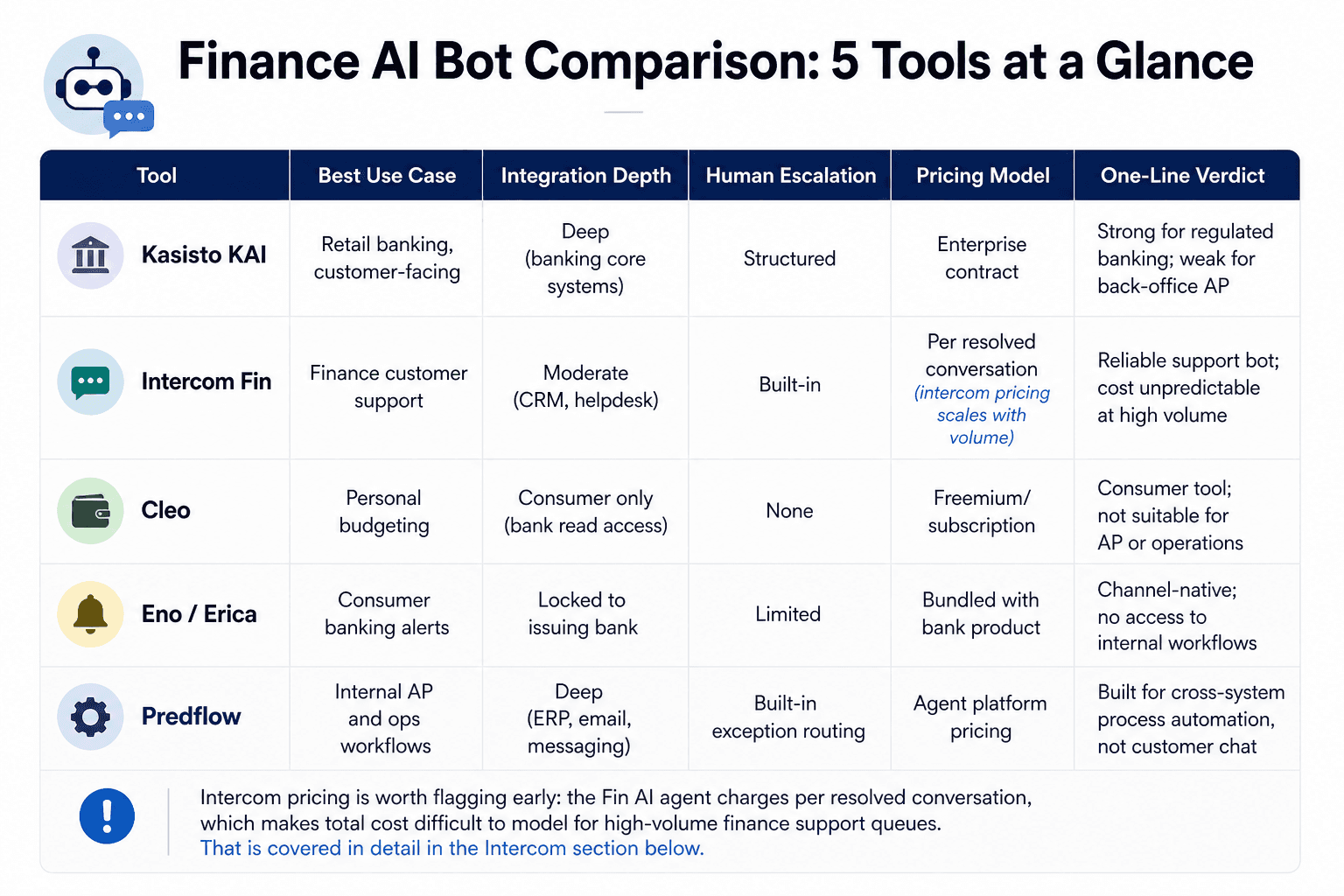
Finance AI Bot Comparison: 5 Tools at a Glance
Tool | Best Use Case | Integration Depth | Human Escalation | Pricing Model | One-Line Verdict |
|---|---|---|---|---|---|
Kasisto KAI | Retail banking, customer-facing | Deep (banking core systems) | Structured | Enterprise contract | Strong for regulated banking; weak for back-office AP |
Intercom Fin | Finance customer support | Moderate (CRM, helpdesk) | Built-in | Per resolved conversation (intercom pricing scales with volume) | Reliable support bot; cost unpredictable at high volume |
Cleo | Personal budgeting | Consumer only (bank read access) | None | Freemium/subscription | Consumer tool; not suitable for AP or operations |
Eno / Erica | Consumer banking alerts | Locked to issuing bank | Limited | Bundled with bank product | Channel-native; no access to internal workflows |
Predflow | Internal AP and ops workflows | Deep (ERP, email, messaging) | Built-in exception routing | Agent platform pricing | Built for cross-system process automation, not customer chat |
Intercom pricing is worth flagging early: the Fin AI agent charges per resolved conversation, which makes total cost difficult to model for high-volume finance support queues. That is covered in detail in the Intercom section below.
Kasisto KAI: Finance AI Bot Built Specifically for Banking
Kasisto KAI is one of the few finance AI bots designed from the ground up for regulated financial institutions. It is not a general-purpose chatbot retrained on banking data. It was built for banking workflows from the start.
What KAI handles well: account queries, transaction disputes, compliance logging
KAI handles the queries that dominate retail bank contact centers: balance inquiries, transaction history, dispute initiation, and loan status updates. Its compliance audit trail is a genuine differentiator. Every conversation is logged in a format that supports regulatory review, which matters when your institution faces examination.
It integrates with core banking systems at a level most general-purpose chatbots cannot match. For customer-facing retail banking, that depth of integration is the product's strongest argument.
Where it falls short for back-office and AP teams
KAI's core feature set is built around customer queries, not internal process execution. An AP team trying to automate three-way invoice matching or vendor payment escalation will find little in KAI that addresses those workflows directly.
The platform also requires significant setup time and enterprise-level contracts. Smaller finance operations or teams running mixed AP and customer support functions will likely find the deployment cost and complexity hard to justify. If your primary need is internal workflow automation rather than customer-facing banking support, KAI is not the right fit.
Intercom Fin: AI Chatbot for Finance Support With Transparent Pricing
Intercom Fin sits in a different category from KAI. It is a support-layer AI, built to deflect repetitive customer service queries before they reach a human agent. For finance teams managing high volumes of payment status questions, billing disputes, or account access requests, it can meaningfully reduce agent workload.
Intercom pricing breakdown for finance use cases
Intercom pricing for Fin operates on a per-resolved-conversation model. The Fin AI agent is available as a standalone add-on without requiring the full Intercom suite, which lowers the entry point. However, costs scale directly with resolution volume.
For a finance support team handling several thousand conversations per month, that pricing structure requires careful modeling before commitment. A month with unusually high payment dispute volume will produce a bill that does not match your baseline forecast. Operations leaders budgeting at scale should run a volume estimate before treating Intercom Fin as a fixed cost line.
Fin AI agent vs. full Intercom suite: what you actually need
The full Intercom suite includes CRM features, outbound messaging, and reporting that most finance-specific support teams do not need. The Fin agent alone handles AI-driven resolution, escalation routing to human agents, and basic integration with helpdesk tools.
For a finance team whose primary problem is repetitive support volume, the standalone Fin agent is a reasonable starting point. The limitation is integration depth. Fin connects well with CRM and helpdesk platforms but does not reach into ERP systems, payment processors, or accounting software. It resolves the conversation but does not close the underlying process. That gap matters for AP and operations teams who need the bot to do something downstream after answering the question.
Cleo and Plaid-Integrated Personal Finance Bots: Consumer Tools Misapplied to Business
Cleo and similar personal finance bots are frequently recommended to finance teams by stakeholders who have seen positive consumer reviews. The recommendation is well-intentioned but misses the core problem.
What Cleo and similar bots are actually designed to do
Cleo is a personal budgeting assistant. It reads consumer bank account data via open banking connections, identifies spending patterns, and delivers insights through a conversational interface. For individuals managing personal cash flow, it works well. The product does what it claims to do.
Plaid-integrated finance apps follow a similar model: they aggregate account data for individual users and surface it through an application layer. The intelligence sits in the presentation of data, not in executing business processes.
Why consumer finance AI bots fail in AP and operations workflows
AP and operations teams need a bot that can act inside a business process: flag a duplicate invoice, trigger an approval workflow, update a vendor record, or log an exception for audit. Consumer finance bots have no mechanism for any of that.
They also lack the compliance logging, role-based access controls, and ERP connectivity that enterprise finance environments require. Using Cleo or a Plaid-integrated tool in a business back-office context is not a configuration problem. It is a category mismatch. The tool was not built for that environment, and no amount of configuration will change what the product fundamentally is.
Telegram and Voice-Enabled Finance AI Bots: Eno, Erica, and Channel-Specific Tools
Capital One Eno and Bank of America Erica are the most mature examples of channel-native finance AI bots. Both are well-built products for their intended purpose. The question for operations leaders is whether that purpose overlaps with yours.
AI chatbot for Telegram: real use cases in finance operations
An AI chatbot for Telegram in a finance operations context is most useful for internal alerting and status queries. Teams already using Telegram for internal communication can route invoice status updates, payment confirmations, or exception flags into a channel without switching tools.
The practical limit is that Telegram bots handle messaging well but do not execute business logic on their own. A Telegram bot can deliver an alert that an invoice is overdue. It cannot trigger the approval workflow, update the ERP, or log the resolution. It handles the message but not the downstream process.
AI voice bots for payment alerts, collections, and internal escalation
AI voice bots are gaining real traction in two specific finance use cases: outbound collections calls and internal escalation routing. For collections, a voice bot can make initial contact, confirm payment intent, and log outcomes without human agent involvement on the first pass. For internal escalation, a voice bot can route a flagged transaction to the right approver via a phone call when email escalation has failed.
Compliance is the central concern for AI voice bots in finance. Call recording requirements, consent disclosures, and audit trail standards vary by jurisdiction. Any voice bot deployment in a regulated finance environment needs explicit compliance review before going live.
Channel flexibility vs. process depth: the core trade-off
Channel-native bots like Eno and Erica are locked to the surface they were built for. Eno lives in Capital One's app and messaging integrations. Erica operates within Bank of America's platform. Neither can be extracted and deployed into an internal AP workflow or across a third-party ERP.
The trade-off every operations team faces is this: channel-specific tools deliver a polished experience in one place, but they do not follow the process across systems. When a payment escalation starts in Telegram, moves to email, and needs to update a record in your ERP, a channel-native bot drops the thread at the first handoff.
If your team needs a bot that handles a payment escalation across Telegram, email, and your ERP in a single workflow without stitching three separate tools together, that is the problem Predflow was built to solve. Predflow builds agents that maintain process context across channels and systems, so the escalation completes rather than stalls at the boundary of a single tool.
How to Choose the Right Finance AI Bot for Your Team's Workflow
The right finance AI bot for operations teams is not the one with the most features. It is the one that matches the specific type of problem your team actually has.
If your team's primary problem is answering repetitive customer queries at volume, you need a support-layer AI. If your primary problem is manual handoffs between systems and processes that stall without human intervention, you need an agent platform. These are different categories, and no single tool in the current market covers both without significant trade-offs.
If you need customer-facing banking support: start with Kasisto or Intercom Fin
For regulated financial institutions handling customer queries at scale, Kasisto KAI offers the deepest banking-specific integration and the strongest compliance audit trail. For finance support teams dealing primarily with billing, payment status, and account access queries, Intercom Fin offers a faster deployment path with lower initial cost.
The key variable with Intercom is volume. Model your monthly conversation volume before committing to a per-resolution pricing structure.
If you need internal workflow automation across AP and ops: evaluate agent platforms
Customer-facing chatbots are built to answer questions. Internal AP and operations workflows require a tool that executes steps inside a process, handles exceptions, routes approvals, and logs outcomes. That is a different product category entirely.
Teams expecting a support chatbot to handle end-to-end AP automation will spend months discovering its limits. The cost of picking the wrong category is not just a wasted subscription. It is implementation time, internal credibility, and the months of manual work that continues while the wrong tool is being evaluated.
AI deployments are increasingly being held to measurable process outcomes, not just deflection rates. Before committing budget to any vendor, demand metrics tied to actual process completion, exception rates, and cycle time reduction.
Three questions to ask any vendor before signing a contract
1. Can your bot take action inside my existing systems, or does it only respond with information?
2. What happens when the bot encounters an exception it was not trained on?
3. How is every bot action logged, and can that log be accessed by an auditor?
If a vendor cannot answer all three directly, the product is a chat widget regardless of what the sales materials say.
Frequently Asked Questions
What is a finance AI bot and how is it different from a regular chatbot?
A finance AI bot is an AI system trained on financial data and processes, capable of handling tasks like balance inquiries, payment status updates, invoice queries, and compliance logging. Unlike a general chatbot, a finance AI bot connects to financial systems and operates within regulatory constraints. The key distinction is whether it can execute steps inside a financial workflow or only answer questions about one.
Can a finance AI bot integrate with my existing ERP or accounting software?
It depends on the tool category. Customer-facing bots like Intercom Fin connect to CRM and helpdesk platforms but not typically to ERP or accounting systems. Purpose-built banking tools like Kasisto KAI integrate with core banking infrastructure. Agent platforms designed for internal workflow automation generally offer deeper ERP and accounting software integration, but integration scope should always be confirmed before purchase.
What does Intercom pricing look like for a finance team handling high support volume?
Intercom pricing for the Fin AI agent is based on resolved conversations rather than a flat monthly fee. The standalone Fin agent is available without the full suite, but costs scale directly with the number of conversations the bot resolves. High-volume finance support teams should model their average monthly conversation volume against the per-resolution rate before committing, as costs can vary significantly month to month.
Is an AI chatbot for Telegram secure enough for financial data?
Telegram bots can be configured with access controls and operate over encrypted channels, but the security posture of any AI chatbot for Telegram deployment depends heavily on how it is implemented. For internal alerting and status updates, the risk profile is manageable. For transmitting sensitive financial data or executing transactions, additional security review, data handling policies, and access restrictions are required before deployment in a regulated environment.
How do AI voice bots handle compliance and call recording requirements in finance?
AI voice bots in finance must meet jurisdiction-specific requirements for call recording consent, data retention, and audit logging. Most enterprise-grade voice bot platforms include configurable consent disclosure prompts and call recording integration. However, the compliance configuration is the deploying organization's responsibility. Any voice bot handling collections calls, payment confirmations, or internal escalations in a regulated finance environment should go through a compliance review before going live.
Conclusion
Finance teams evaluating AI chatbots face a clear fork. If your problem is customer-facing support volume, Kasisto KAI or Intercom Fin are the most defensible starting points. Both have the compliance logging and escalation paths that consumer-grade tools lack, and both are built to operate in financial services contexts.
If your problem is internal: manual handoffs between AP systems, invoice exceptions sitting unresolved, approval workflows that stall without someone chasing them, none of the five tools reviewed here fully solves that problem. That requires an agent platform designed around your specific processes. Picking a support chatbot for an internal automation problem is the most common implementation mistake finance teams make, and it costs months.
See how Predflow handles your specific AP or operations workflow before committing to any tool. A workflow assessment will show you exactly where process automation applies and where a chatbot will hit its ceiling.
Bring 20 NetSuite bills to a 30-minute teardown
We will walk your actual invoices through capture, 3-way match and posting on the call, and tell you which steps an agent can take over. No prep beyond the PDFs.
FAQ
Frequently asked questions
What exactly is an AI agent
An AI agent is an autonomous system designed to handle specific business tasks end-to-end. Unlike simple chatbots, AI agents can reason, take actions, integrate with tools, and follow defined workflows.