AI AGENTS
Done-For-You AI Automation Agency vs DIY Tools: The Real Cost of Building In-House
Comparing an AI automation agency to in-house tools? See the hidden costs, risks, and tradeoffs before your team spends months building what breaks overnight.

Sanya Shah
Co-founder, Predflow

A finance team at a mid-market manufacturer spent four months and roughly 600 engineering hours building an internal AI agent workflow to automate invoice processing. The day a key vendor updated their API, the entire pipeline broke, and the team spent two more weeks debugging edge cases that a proper process map would have caught before a single line of code was written.
That story is not unusual. The real cost of DIY AI automation is not the tool subscription. It is the hidden labor, maintenance debt, and opportunity cost that never appear in the initial business case. One of the most common pitfalls organizations encounter when building AI agents is applying sophisticated solutions to problems that could be handled with simpler workflow automation, or, worse, building complex agents without mapping the process first
This article gives you a concrete decision framework: what DIY actually costs across the full lifecycle, why most internal builds stall before they deliver value, and how to evaluate whether an ai automation agency is the faster, cheaper path for your specific situation.
What DIY AI Agent Building Actually Costs Across the Full Lifecycle
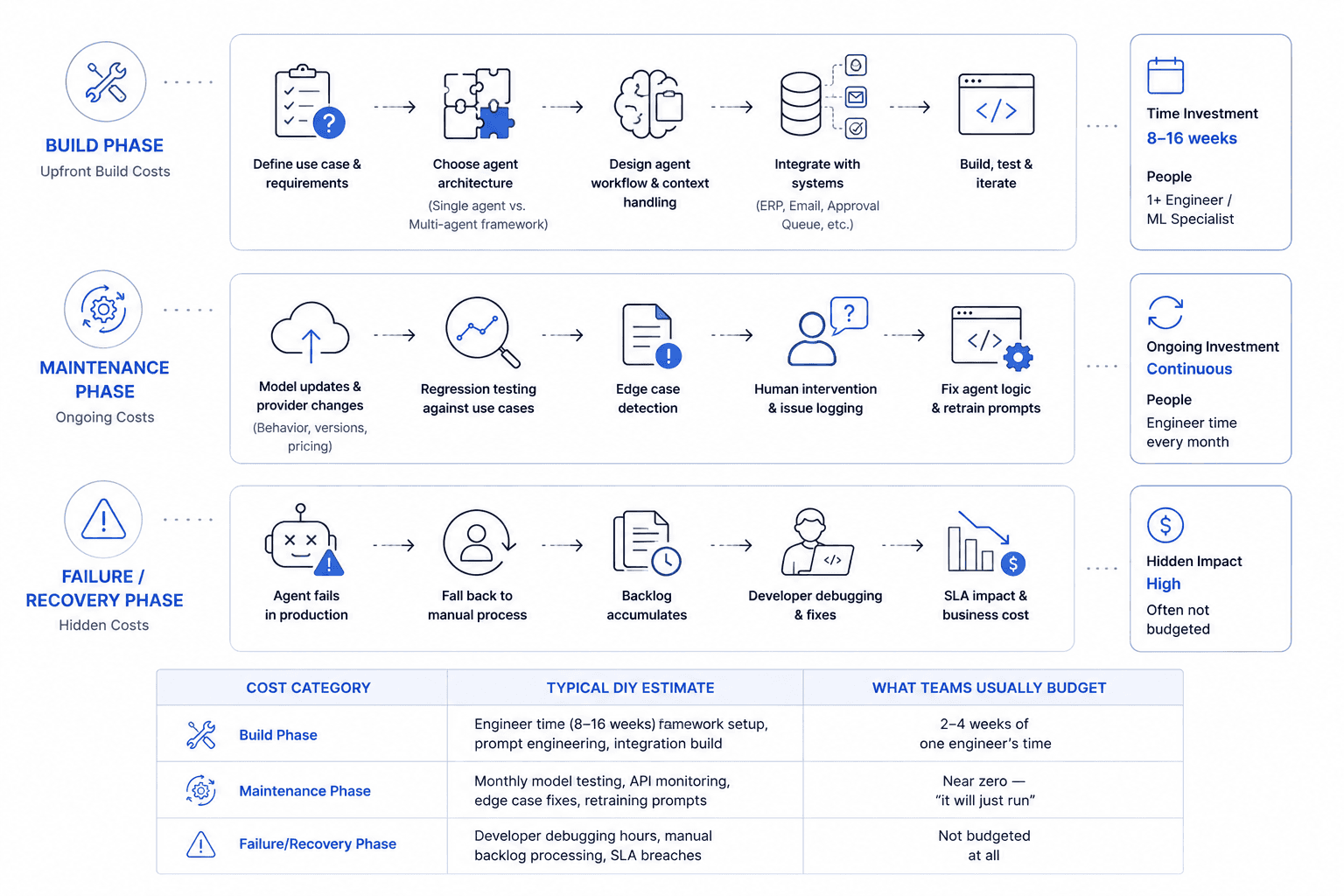
Most ops teams calculate DIY cost as: tool subscription + one engineer's time for a few weeks. The real number is significantly higher once you account for every phase.
Upfront Build Costs: Engineering Hours and Agent Architecture Decisions
Before writing a single prompt, your team needs to make consequential decisions about AI Agent architecture. Which agent framework fits the use case, a single LLM agent or a multi agent framework? How does the agent handle context across steps? How does the AI Agent workflow connect to your ERP, your email system, your approval queue?
These decisions take time even for experienced ML engineers. For ops teams without a dedicated AI specialist, the architecture phase alone can consume four to eight weeks. Mistakes made here compound through every subsequent phase.
Ongoing Costs: Maintenance, Edge Case Handling, and Model Updates
LLM agents are not static software. Model providers update behavior, deprecate versions, and change pricing. Every update requires regression testing against your use cases.
Edge cases in finance and supply chain are not rare, they are the norm. A three-way match exception, a duplicate PO line, a vendor with inconsistent invoice formats. Each edge case that the agent was not designed for requires a human to intervene, log the issue, and often a developer to fix the agent logic.
Hidden Costs: Process Downtime When Agents Break
When a DIY agent fails in production, the immediate fallback is manual work, exactly the process you automated. The team absorbs the backlog while the build is fixed.
Cost Category | Typical DIY Estimate | What Teams Usually Budget |
|---|---|---|
Build Phase | Engineer time (8–16 weeks), framework setup, prompt engineering, integration build | 2–4 weeks of one engineer's time |
Maintenance Phase | Monthly model testing, API monitoring, edge case fixes, retraining prompts | Near zero, "it will just run" |
Failure/Recovery Phase | Developer debugging hours, manual backlog processing, SLA breaches | Not budgeted at all |
The common mistake is treating AI Automation as a one-time build rather than an ongoing system that requires ownership. If your process can be mapped with a clear decision tree, a traditional workflow tool is likely sufficient. The structure of ai agents adds value when the process requires reasoning over variable context, not when it requires following fixed rules.
How AI Agent Workflow Design Determines Whether Your Build Succeeds or Stalls
Most internal DIY attempts do not fail because of the tools chosen. They fail because the process was never properly mapped before building began.
Why Process Mapping Must Come Before Tool Selection
The debate over crewai vs langgraph, or which agent framework to use, is secondary to a more important question: do you fully understand every step, exception, and handoff in the process you are automating?
In artificial intelligence, the environment in which an agent operates defines what the agent needs to know and do. In business terms, your environment includes your ERP fields, your approval hierarchies, your vendor exception rules, and your escalation paths. An agent built without mapping this environment will handle the clean 80% of transactions and fail on the 20% that matter most.
Planning in artificial intelligence, specifically deciding which tasks must complete before others begin, is directly analogous to process design in business automation. Partial order planning in artificial intelligence allows tasks to run in parallel where order does not matter, while enforcing sequence where it does. The same logic applies to ai agent workflow design: you cannot automate what you have not sequenced.
The Role of Knowledge-Based Agents in Handling Real Business Complexity
Knowledge-based agents in artificial intelligence do not just follow rules. They reason over a stored representation of the domain to make decisions when conditions vary. In practice, this means an agent that understands the difference between a disputed invoice and a missing PO number, and routes each differently.
Simple rule-based bots break when an input falls outside their defined conditions. Knowledge-based agents in ai handle variability because they operate from context, not just triggers. For finance and supply chain teams, this distinction determines whether the agent handles 60% of cases or 95%.
Where Multi-Agent Systems Break Down Without Orchestration Logic
A multi-agent system distributes work across specialized agents: one for data extraction, one for validation, one for approval routing. This structure works well when agent orchestration logic defines how agents hand off to each other, what happens when one fails, and which agent holds final accountability.
Without that orchestration layer, multi agent architectures create new failure points instead of removing them. The best practices in trust and safety applications reinforce this: AI and automation systems require clear accountability design, not just task distribution.
Done-For-You AI Automation Agency Model: What You Actually Get and What You Give Up
A done-for-you agency is not a shortcut. It is a different allocation of expertise, risk, and ownership. Understanding the trade-offs clearly is how you make the right call.
What a Legitimate AI Automation Agency Delivers Beyond the Initial Build
The initial agent deployment is the smallest part of what a legitimate ai automation agency provides. The ongoing value is in edge case handling, model update management, exception monitoring, and process refinement as your workflows evolve.
An agency that has deployed agents across multiple clients in your industry has already encountered the failure modes you have not thought of yet. That accumulated pattern recognition is not something you build in one internal project.
What is an AI Agency in practice? It is a team that owns the agent's performance post-deployment, not just hands over a configured tool and walks away. The distinction matters for operations leaders who cannot afford a fragile process in a business-critical workflow.
The Predflow Approach: Process Mapping First, Then Agent Deployment
Predflow starts every engagement by mapping the client's existing process end-to-end, including manual handoffs, exception handling paths, and escalation logic, before a single agent is configured. This process-first approach is specifically why their agents handle edge cases reliably rather than failing on the first unusual invoice or shipment exception. If your team is watching agents break on edge cases you know exist, that is a process mapping problem, not a tool problem.
Trade-Offs You Should Demand Straight Answers On Before Signing
Done-for-you is not without real trade-offs. Internal IP ownership is the most important one. Before signing any agency engagement, get clear answers to these questions:
Who owns the agent logic if you part ways? Can you export the workflow, prompts, and integration configuration?
How are model updates handled? Who tests for behavioral drift when the underlying LLM changes?
What SLA exists for agent failures? What is the guaranteed response time, and what is the fallback process?
How do you document what the agent does? Your team needs to understand the process even if they are not maintaining it.
An agency that cannot answer these questions directly is one that has not built for long-term client accountability.
AI Automation Agency vs DIY: A Direct Comparison Across Five Decision Factors
Factor | DIY Build | Done-For-You Agency |
|---|---|---|
Time to First Working Agent | 3–6 months for a cross-system workflow with edge cases | 3–8 weeks depending on process complexity and integration access |
Internal Expertise Required | At minimum one ML or AI engineer with agent architecture experience | Process documentation and subject matter access from your team |
Edge Case Handling | Requires ongoing developer time; each new edge case is a build task | Handled by agency as part of ongoing service; logged and resolved without internal dev cycles |
Scalability Without Hiring | Each new agent or workflow requires additional engineering capacity | Additional workflows added through the agency without proportional internal headcount |
Total 12-Month Cost Estimate | Tool costs plus 20–40% of one engineer's annual salary for maintenance, plus downtime costs | Agency fees, typically predictable monthly retainer; no hidden developer overhead |
Choose DIY if: You have a dedicated ML engineer on staff, the use case is contained within a single system, the process is stable and unlikely to change, and you have six or more months before the automation needs to be operational. In this scenario, building internal capability makes strategic sense; you will own the IP and accumulate expertise.
Choose a done-for-you AI Automation agency if: The process spans multiple systems (ERP, email, approval tools, supplier portals), your team has no AI agent expertise internally, and you need the workflow operational in under 60 days. Cross-system ai agent workflow automation without orchestration expertise is where DIY builds most commonly fail and where agency delivery provides the clearest advantage.
How to Evaluate Any AI Automation Agency Before You Commit
Choosing the wrong agency vendor is a different kind of expensive mistake. Here is how to separate agencies with real process depth from those selling configured tools with a consulting wrapper.
Five Questions to Ask in the First Vendor Call
Describe the last time one of your deployed agents failed. What was the recovery process? A credible agency has a specific answer. Vague responses about "monitoring systems" without a concrete failure story indicate limited production experience.
Walk me through how you map a client's process before you build. If they go straight to tool selection, they are a tools-first agency, not a process-design partner.
What is your process for handling a new edge case that appears six months after deployment? You want a defined workflow, not "we'll address it when it comes up."
Which parts of our process do you think do NOT need an AI agent? An agency that cannot identify where simpler automation is sufficient is not giving you objective advice.
What does client offboarding look like? How you exit a vendor relationship tells you everything about how they structure ownership and documentation.
Red Flags That Signal a Tools-First Agency With No Process Depth
An agency that leads with the tools they use, specific LLM providers, specific agent platforms, before asking about your process is telling you something important. Tool selection should follow process understanding, not precede it.
The most common pitfall in AI agent development is applying sophisticated AI solutions to problems that do not require them. An agency that cannot tell you when you do not need an AI agent is not a trustworthy advisor. They are optimizing for their own deployment scope, not your operational outcome.
Also watch for agencies that cannot describe their human oversight layer. Agentic AI systems require exception escalation and human review protocols, especially for finance workflows where errors have compliance implications. If the agency does not mention this, ask directly.
Frequently Asked Questions
What does an AI automation agency actually do differently from a software consultant?
A software consultant typically builds a system to your specification and hands it over. An ai automation agency owns agent performance after deployment, including edge case handling, model updates, and exception monitoring. The ongoing accountability for whether the automation actually works is the core difference.
How long does it take to deploy AI agents through a done-for-you service?
For a well-documented process with clear integration access, most agencies deploy a first working agent within three to eight weeks. Complex cross-system workflows with multiple exception paths take longer. Timelines depend heavily on how well the client can document their current process and provide access to the relevant systems.
What types of AI agents are most useful for finance and supply chain operations?
Knowledge-based agents in artificial intelligence are the most effective for finance and supply chain because they reason over variable context rather than following fixed rules. Useful ai agent types include invoice processing agents, three-way match validation agents, shipment exception handlers, and approval routing agents. The agent types that deliver consistent value are those designed around specific, high-volume processes with predictable inputs and measurable outputs.
What is the difference between agentic AI and generative AI for business automation?
Generative AI produces content such as text, summaries, and draft responses based on a prompt. Agentic AI takes actions across systems, makes sequential decisions, and executes multi-step workflows without human initiation at each step. The difference between generative AI and agentic AI in practice is that agentic systems operate processes end-to-end, while generative AI assists humans who are still running those processes themselves.
Can I switch from a DIY agent build to a done-for-you agency without losing what I built?
Yes, but it requires honest documentation of what the current build does and where it fails. Most agencies will assess your existing agent architecture and determine what is worth preserving versus rebuilding. The integration logic and process documentation your team has produced is genuinely useful, even if the agent implementation needs to be restructured. Do not discard internal work before an agency reviews it.
Conclusion
If you have a dedicated ML engineer, a single-system use case, and six months of runway, DIY is a viable path. Start by mapping every edge case in the process before touching any agent framework; that documentation will save you months of rework.
If your process spans multiple systems, your team is absorbing manual work that should not exist, and you need a working automation in under 60 days, a done-for-you ai automation agency removes the execution risk that kills most internal builds. The four months and 600 engineering hours spent on a fragile pipeline is not a story about bad engineers; it is a story about what happens when the build-versus-buy decision is made without accounting for the full cost.
Inaction is not free. Every week of manual handoffs between your ERP, your email, and your spreadsheets is a week of labor cost, error risk, and delayed decisions that compound.
If your team is in path two, Predflow offers a free process mapping session, a 45-minute working call where they map your highest-priority workflow and tell you exactly what an agent would and would not handle. No pitch deck. Request your session at https://predflow.ai/contact
Bring 20 NetSuite bills to a 30-minute teardown
We will walk your actual invoices through capture, 3-way match and posting on the call, and tell you which steps an agent can take over. No prep beyond the PDFs.
FAQ
Frequently asked questions
What exactly is an AI agent
An AI agent is an autonomous system designed to handle specific business tasks end-to-end. Unlike simple chatbots, AI agents can reason, take actions, integrate with tools, and follow defined workflows.