AI AGENTS
What Is Amazon Bedrock? Models, Pricing, and Alternatives
Getting access to an AI model is the easy part — making it work reliably inside your existing systems is where most teams get stuck. Here's how Amazon Bedrock tries to solve that problem, and what to consider before committing.

Gautam Borad
Founder at Predflow

Adding AI to existing operations sounds straightforward until your team realizes that getting access to a powerful model is only the first step. The real work is stitching together integrations, managing guardrails, and ensuring every handoff between systems works reliably at scale. Amazon Bedrock is AWS's answer to that stitching problem. It sits between your applications and a catalogue of foundation models, managing the infrastructure, security, and compliance layer so your developers do not have to build it from scratch.
This article covers exactly what Bedrock does, how it charges, which models it offers, and whether it is the right tool for automating business processes or a developer building block that still requires significant engineering before it delivers value.
What Amazon Bedrock Actually Does (Plain-Language Definition)
Amazon Bedrock is a fully managed AWS service that provides access to foundation models from multiple AI providers through a single API. It handles infrastructure, security, and compliance so teams can build AI-powered applications without managing model deployments. Bedrock also includes tools for agents, knowledge bases, and guardrails.
The core idea: one API, many foundation models
Before Bedrock, teams that wanted to experiment with different large language models had to manage separate API keys, rate limits, and billing relationships for each provider. Bedrock removes that friction by routing requests through one AWS-managed endpoint.
This matters for operations teams because model selection becomes a configuration decision, not an infrastructure project. You point your application at Bedrock, choose a model, and AWS handles availability and scaling.
What Bedrock manages so your team does not have to
Bedrock takes responsibility for model hosting, version management, and the compliance framework that enterprise deployments require. It handles data encryption in transit and at rest, supports private connectivity through AWS VPC endpoints, and keeps your prompts and completions out of model training pipelines by default.
For finance and supply chain teams, the compliance posture matters as much as the model quality. Bedrock's managed environment means you are not building a custom security review every time you add a new model.
Where Bedrock sits in the AWS AI stack
Bedrock is not Amazon SageMaker and it is not a standalone AI product. SageMaker is for teams that want to train, fine-tune, and host their own models. Bedrock is for teams that want to use pre-trained foundation models without managing that infrastructure.
Think of it this way: SageMaker is a machine learning platform. Bedrock is a serverless AI access layer. Most operations teams have no reason to go near SageMaker unless they are building proprietary models on custom data.
Which Foundation Models Are Available on Amazon Bedrock
The model catalogue inside Bedrock is one of its strongest selling points. Instead of being locked to one provider, teams can test Anthropic, Amazon's own models, Meta, Mistral, and others from a single interface.
Anthropic Claude models: best fit for document and reasoning tasks
Claude is the default choice for document-heavy workflows. It handles long-context inputs well, which makes it practical for invoice processing, contract review, purchase order matching, and summarizing operational reports.
The April 2026 AWS Weekly Roundup announced Claude Mythos as a preview in Amazon Bedrock, signalling that the model catalogue is actively expanding. Teams should treat current model availability as a snapshot, not a fixed list, and verify options at the time of evaluation.
Amazon Titan, Meta Llama, Mistral, and Stability AI: when to consider them
Amazon Titan models are positioned for text generation and embedding tasks inside AWS-native architectures. They integrate cleanly with other AWS services but are not always the strongest performer for complex reasoning.
Meta Llama models offer open-weight transparency, which appeals to teams with data governance requirements. Mistral is a strong option for faster, lower-cost completions where reasoning depth is less critical. Stability AI covers image generation, which is less relevant to operations and finance teams but relevant to marketing or product workflows.
How model choice affects cost and output quality
More capable models cost more per token and produce better outputs on complex tasks. For straightforward data extraction or classification, a lighter model keeps costs down without sacrificing accuracy.
Choosing the wrong model tier is a common and expensive mistake. A model calibrated for creative writing is not the right tool for structured financial data extraction.
Amazon Bedrock Pricing: How the Cost Model Works in Practice
Bedrock pricing follows the same pattern as most managed AI services: you pay for what you use, until production volume makes on-demand pricing unpredictable.
On-demand pricing: pay per token with no upfront commitment
On-demand pricing charges separately for input tokens (the text you send) and output tokens (the text the model returns). Input tokens are cheaper than output tokens across all model families.
This model works well for experimentation and low-volume workloads. There is no minimum commitment, so teams can test multiple models without financial risk before deciding which fits their use case.
Provisioned Throughput: when predictable volume justifies a reservation
At production volume, on-demand pricing introduces two problems: unpredictable costs and throttling during peak periods. Provisioned Throughput lets teams reserve model capacity in exchange for a fixed hourly charge.
The trade-off is straightforward. Reservation gives you guaranteed throughput and cost predictability. On-demand gives you flexibility but exposes you to rate limits and variable bills. Most teams start on-demand and switch to Provisioned Throughput once they have validated a workflow in production.
Hidden cost drivers: knowledge bases, guardrails, and agent invocations
The token charges are visible. The supporting service costs are less obvious. Knowledge base queries, guardrail evaluations, and agent step invocations each carry separate charges that accumulate quickly in multi-step workflows.
A workflow that processes an invoice through an agent, checks a knowledge base for policy rules, and passes the result through a guardrail is not one API call. It is three or four billable interactions per document.
Cost visibility problem teams hit at scale
The April 2026 AWS Weekly Roundup flagged cost visibility as a top concern as teams move from experimentation to full production. Bedrock does not natively surface cost per workflow or per process step. Teams need to instrument their own cost tracking or rely on AWS Cost Explorer with custom tagging to understand which processes are driving spend.
This is not a blocker, but it is a setup cost that teams rarely budget for in the initial project plan.
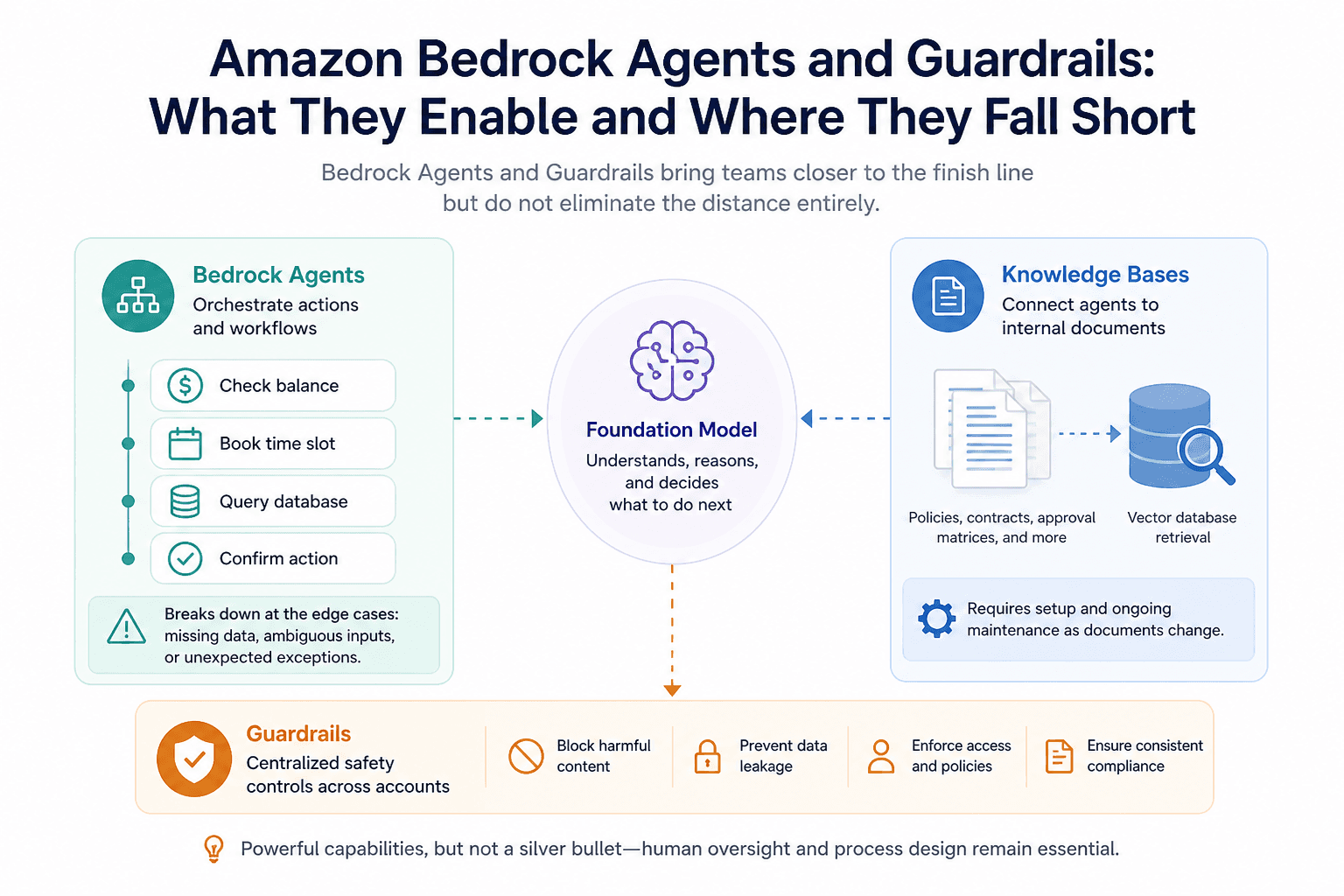
Amazon Bedrock Agents and Guardrails: What They Enable and Where They Fall Short
Building an agent on top of a foundation model is different from building a production-ready business process. Bedrock Agents and Guardrails bring teams closer to the finish line but do not eliminate the distance entirely.
What Bedrock Agents can orchestrate out of the box
Bedrock Agents let developers define a set of actions, connect them to APIs or Lambda functions, and let the model decide which steps to execute in response to a user prompt or trigger. The agent can check a balance, book a time slot, query a database, and confirm an action in sequence.
This is genuinely useful for structured tasks with defined steps and clear success criteria. Where it breaks down is at the edge cases: missing data, ambiguous inputs, exceptions that fall outside the defined action set.
Knowledge bases: connecting agents to internal documents
Bedrock Knowledge Bases let teams index internal documents into a vector database and give agents access to that information during interactions. For finance teams, this means an agent can query policy documents, vendor contracts, or approval matrices without hard-coding every rule into the prompt.
The setup involves indexing documents, configuring retrieval, and deciding how the agent cites source material in its responses. It is a real capability, but it requires engineering time to configure and maintain as documents change.
Guardrails: centralized safety controls across accounts
Amazon Bedrock Guardrails reached general availability for organizational safeguards in April 2026. This means teams can enforce consistent content filters, topic restrictions, and input validation rules across multiple AWS accounts from a central control point.
For enterprise deployments where different teams or business units run separate workloads, centralized guardrails reduce the risk of one team's configuration creating liability for the whole organization. It is a meaningful step toward enterprise-grade governance.
The gap between a Bedrock agent and a production-ready business process
Bedrock gives teams the raw materials: model access, agent orchestration, knowledge retrieval, and safety controls. What it does not provide is the process layer. Mapping a real business workflow, handling exceptions gracefully, routing edge cases to human reviewers, and maintaining audit trails are responsibilities the team building on Bedrock must design and implement themselves.
AWS announced in May 2026 that WorkSpaces now lets AI agents operate legacy desktop applications using computer vision, which extends what Bedrock Agents can reach. That is progress. But most operations teams are not positioned to implement computer vision workflows without dedicated engineering support.
Platforms like Predflow are built for exactly this layer. They use model infrastructure like Bedrock underneath but lead with process mapping, edge-case handling, and human oversight rather than raw API access. For ops and finance teams who need end-to-end automation without a dedicated ML engineering team, that distinction matters.
Amazon Bedrock vs. Real Alternatives for Operations Teams
The right tool depends on where your data lives, how much engineering capacity you have, and how quickly you need results.
Bedrock vs. Azure OpenAI Service: infrastructure and compliance trade-offs
Azure OpenAI Service is the closest structural equivalent to Bedrock. Both are managed model access layers with enterprise compliance postures. The practical difference is the cloud environment your team already operates in.
If your organization runs primarily on Azure and uses Microsoft 365 extensively, Azure OpenAI integrates more naturally with existing identity and data governance. If your stack is AWS-native, Bedrock keeps everything inside one environment with unified billing and IAM controls.
Bedrock vs. Snowflake AI: when your data already lives in Snowflake
Snowflake AI Cortex lets teams run foundation models directly inside the Snowflake data platform. For finance and supply chain teams whose operational data already lives in Snowflake, this is a meaningful advantage.
Running models where the data already exists eliminates the need to move sensitive data to an external service, simplifies governance, and reduces latency for data-heavy tasks like anomaly detection on transaction records or demand forecasting on supply chain data. If your team spends significant time moving data out of Snowflake to process it elsewhere, Snowflake AI Cortex deserves a direct comparison against Bedrock before you commit to either.
Bedrock vs. purpose-built workflow automation platforms
Bedrock is a model access and orchestration layer. Purpose-built workflow automation platforms are designed around the process itself, with pre-built connectors, exception handling, and human review queues built in from the start.
The distinction is real for teams without ML engineering resources. Bedrock lets you build almost anything. A workflow automation platform lets you deploy a working process faster, with less custom code and more predictable maintenance costs.
Decision framework: which type of team should use which tool
Use Bedrock if your team has ML engineers, your use case requires maximum model flexibility, and you are already running workloads on AWS that need AI capabilities embedded at the infrastructure level.
Use Snowflake AI if your operational and financial data already lives in Snowflake, your primary use cases involve querying or analyzing that data with AI, and you want to avoid data movement and the governance complexity that comes with it.
Use a workflow automation platform if you are an operations, finance, or supply chain team that needs a working automated process within weeks rather than months, you do not have dedicated ML engineering capacity, and the cost of building and maintaining custom orchestration is not justified by the expected return.
Common Mistakes Teams Make When Deploying Amazon Bedrock in Production
Teams that run into trouble with Bedrock deployments almost always make the same set of errors. Knowing them in advance is cheaper than discovering them at production scale.
Skipping process mapping and jumping straight to prompts
The fastest way to build something that fails in production is to start with a prompt before you have mapped the process it is supposed to execute. A prompt that works on ten sample invoices breaks on the eleventh when a field is missing or formatted differently.
Process mapping first means defining every input state, every expected output, every exception path, and every point where a human needs to review. The prompt comes after that design work, not before it.
Underestimating token costs at production volume
On-demand pricing feels cheap when you are testing with fifty documents. At ten thousand documents per month with multi-step agent workflows, the token costs are a different number entirely.
Model the costs before you build. Count the average input and output tokens per document, multiply by your expected volume, add knowledge base and guardrail charges, and stress-test the number against your budget before you write the first line of production code.
Ignoring error handling for 503 throttling and model unavailability
Bedrock returns 503 errors when the service is overloaded or unavailable. Applications that do not handle this gracefully will drop requests silently, which is worse than a visible failure in a back-office workflow.
The correct pattern is exponential backoff with random jitter on retries, cross-region inference to distribute load during traffic bursts, and Provisioned Throughput for steady, predictable workloads where 503s are unacceptable. These are not optional refinements. They are the baseline for production reliability.
Building without human oversight checkpoints
Back-office processes where errors carry financial consequences are not good candidates for fully autonomous operation on day one. An AI agent that misroutes an invoice or misreads a purchase order amount needs a human to catch that error before it propagates downstream.
Human oversight checkpoints are not a sign that the automation is not working. They are the mechanism that catches the edge cases the original process design missed. Build them in from the start, not as an afterthought when something goes wrong.
Frequently Asked Questions
Is Amazon Bedrock the same as ChatGPT or OpenAI?
Amazon Bedrock is not the same as ChatGPT or OpenAI. Bedrock is a managed AWS service that provides API access to multiple foundation models, including Anthropic Claude, which is a separate product from OpenAI. ChatGPT is a consumer-facing product built on OpenAI's models, while Bedrock is a developer and enterprise platform for building AI-powered applications inside AWS.
Do I need an AWS account and developer team to use Amazon Bedrock?
You need an AWS account to access Bedrock, and in practice, meaningful deployments require developer or ML engineering support. The service provides APIs and managed infrastructure, but designing workflows, connecting data sources, and handling exceptions requires technical implementation work.
How does Amazon Bedrock handle data privacy and compliance?
Bedrock encrypts data in transit and at rest, supports private VPC connectivity, and does not use your prompts or completions to train foundation models by default. AWS also provides compliance certifications relevant to enterprise workloads, including SOC, ISO, and HIPAA eligibility for certain configurations.
What is the difference between Amazon Bedrock and Amazon SageMaker?
SageMaker is a platform for training, fine-tuning, and hosting custom machine learning models. Bedrock is a managed access layer for pre-trained foundation models. Teams use SageMaker when they need to build proprietary models. They use Bedrock when they want to use existing foundation models without managing infrastructure.
Can Amazon Bedrock automate full business workflows end to end?
Bedrock Agents can orchestrate multi-step tasks, but full end-to-end workflow automation requires additional design work on process mapping, exception handling, and human review routing. Bedrock provides the model and orchestration layer. The workflow logic, integrations, and oversight mechanisms are the team's responsibility to build and maintain.
Conclusion
Bedrock is a strong foundation for teams that have ML engineering capacity and need flexible model access inside AWS. It handles the infrastructure complexity that used to require months of setup, and it is expanding its capabilities quickly across agents, guardrails, and legacy system integration.
For operations, finance, and supply chain teams, the honest question is not whether Bedrock is powerful. It is whether your team has the capacity to build the process layer that turns model access into a working business automation. Every month of manual handoffs between systems is a quantifiable cost in labor, errors, and delay. Choosing the right level of the stack to build at determines how quickly that cost stops.
If you are evaluating AI workflow automation for operations or finance, see how Predflow maps and automates your specific processes without requiring your team to become AI engineers.
Bring 20 NetSuite bills to a 30-minute teardown
We will walk your actual invoices through capture, 3-way match and posting on the call, and tell you which steps an agent can take over. No prep beyond the PDFs.
FAQ
Frequently asked questions
What exactly is an AI agent
An AI agent is an autonomous system designed to handle specific business tasks end-to-end. Unlike simple chatbots, AI agents can reason, take actions, integrate with tools, and follow defined workflows.