Backoffice Ops
7 Freight Invoice Mistakes That Delay Payments and Cost More
These 7 freight invoice mistakes cost more than you think. Learn how to catch errors before approval and stop payment delays before they start.

Sanya Shah
Co-founder, Predflow

Your AP team clears the freight invoice backlog on Friday afternoon. Monday morning, someone notices three invoices carried duplicate accessorial charges. The carrier's dispute window closes in 48 hours. This is not bad luck. It is a predictable failure at a known handoff point, and it happens because no repeatable process caught it before approval.
Freight invoice errors are not random. They occur at the same points in the billing cycle, for the same structural reasons, every time. Errors cluster around weight verification, duplicate entry, accessorial billing, rate sync, and surcharge indexing. Left unchecked, they consume a measurable share of annual freight spend that teams rarely track as a single line item.
These are the seven mistakes that recur most often, why each one survives long enough to cost money, and what a repeatable fix looks like for each.
Why Freight Invoice Errors Are So Persistent and Expensive
Freight billing errors are not an edge case. They are a structural feature of a process that involves multiple carriers, inconsistent invoice formats, and manual data entry at several stages.
The 3–7% annual freight spend leak most teams don't track
Freight billing errors cost mid-market shippers between 3% and 7% of total freight spend annually. That range does not appear in a single budget line. It hides across dozens of invoices processed by a team focused on throughput, not pattern recognition.
Manual data entry error rates run around 2% for standard invoices. Freight bills spike higher because format inconsistencies across carriers mean the same data point appears in different fields, in different units, at different stages of the billing cycle. That inconsistency is where errors enter and survive.
Why sampling invoices misses the recurring mismatches
Sampling feels efficient. Auditing every tenth invoice saves time without obvious cost. The problem is that freight billing errors are not randomly distributed. Specific carriers, lanes, and charge types generate errors repeatedly. Sampling the full invoice pool means the same error clears audit every time it falls outside the sample.
Best practice is to verify every freight invoice, particularly when a clear rate source and a repeatable workflow already exist. When teams sample instead, they leave recurring mismatches undetected across weeks or months. The procurement management software or billing and inventory management software a team uses matters less than whether it processes every invoice against a verified rate source, not a selected subset. An automated supply chain audit layer catches what sampling structurally cannot.
Mistake 1: Weight and Dimensional Charges Accepted Without Verification
Carriers reweigh and re-measure shipments after pickup. When their measurement produces a higher billable weight than the original quote, that higher figure appears on the invoice with no automatic flag.
How uncalibrated carrier equipment creates billable discrepancies
Weight and dimension errors occur when carriers apply charges higher than the original quote, often because of uncalibrated equipment or missing product specifications at the time of booking. The carrier's reweigh data becomes the invoice basis, and if the shipper has no counter-documentation, the charge holds.
This is not always carrier error. Missing or outdated product spec data on the shipper's side is a frequent root cause teams control directly.
The documentation you need to dispute a reweigh charge
Compare the carrier's reweigh data against the original product specifications or your inventory management software records. If your product master data shows a consistent packaged weight and the carrier's figure differs materially, that gap is documentable and disputable.
Maintain calibrated scale records at your shipping dock. Match those records against the software bill of materials or item master for each SKU. When a discrepancy appears on a freight invoice, you need three things: the original quote, your own weight documentation, and the carrier's reweigh record. Without all three, disputes stall.
Mistake 2: Duplicate Freight Invoices Processed Across Disconnected Systems
A single shipment generates one carrier invoice. But that invoice reaches your team through email, EDI, and a carrier portal simultaneously. When each channel feeds a separate queue, the same invoice enters the payment system more than once.
Three entry points where the same invoice enters twice
Email inboxes, EDI feeds, and carrier web portals each represent a valid invoice source. When AP processes email invoices in one queue and EDI feeds in another, with no cross-reference check at ingestion, duplicates clear payment before the month-end report reveals the mismatch. Distribution management software and WMS software companies often handle one channel natively but leave the others unconnected.
The duplicate is not visible at either entry point because each record looks complete and legitimate in isolation. It only becomes visible when both records exist in the same view.
Why fragmented tool coordination hides duplicates until month-end
ERP supply chain software and billing and inventory software tools often operate on daily or weekly batch reconciliation. A duplicate that enters on Tuesday may not surface until the Friday close, by which point payment has already cleared on both records.
A connected invoice ingestion process catches duplicates at the point of entry by matching shipment reference numbers, BOL numbers, and invoice dates before the record reaches the payment queue. Catching duplicates at entry costs nothing beyond the process design. Catching them at month-end costs the time and fees required to recover an overpayment from a carrier.
Mistake 3: Accessorial Fees Added After Delivery Go Unquestioned
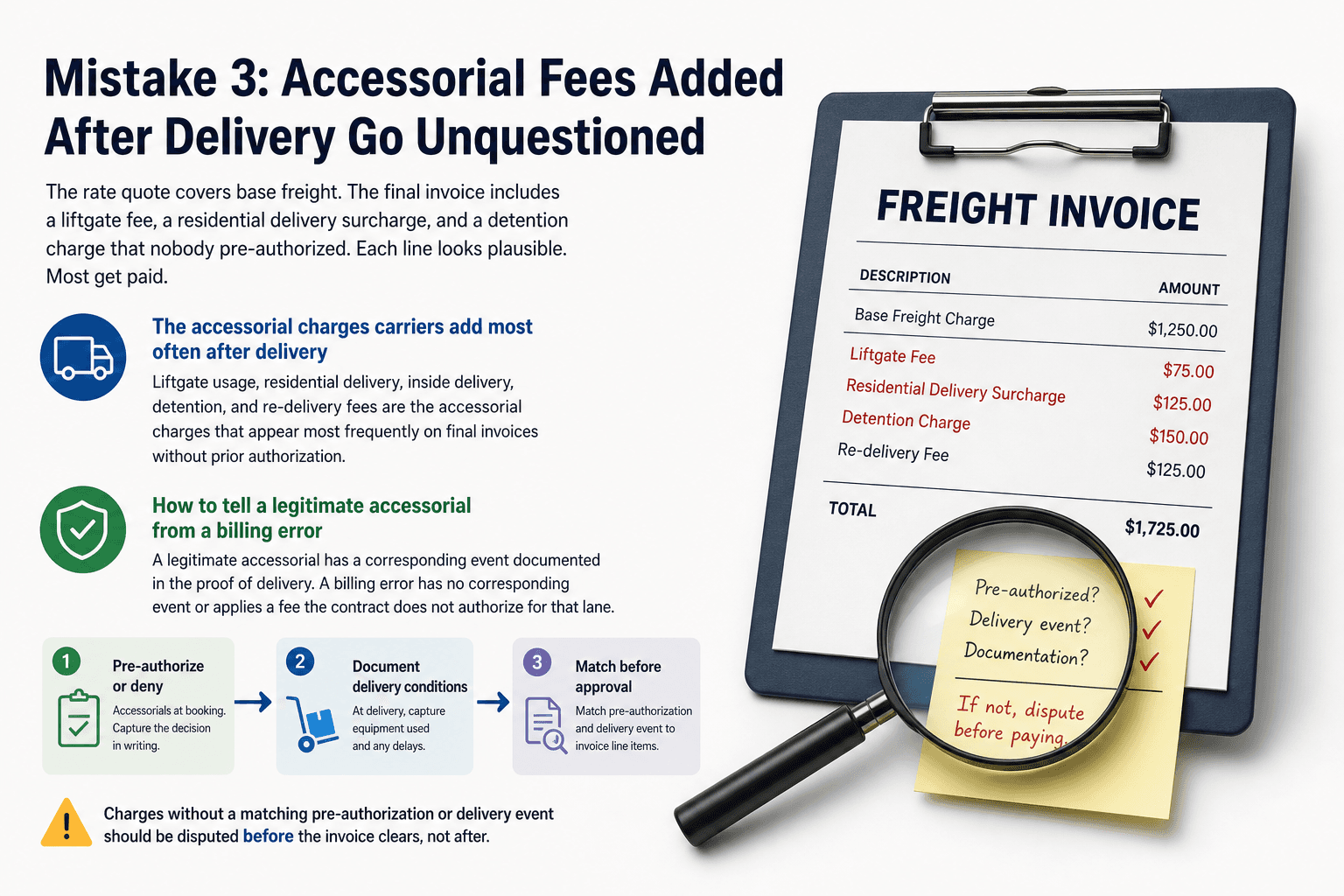
The rate quote covers base freight. The final invoice includes a liftgate fee, a residential delivery surcharge, and a detention charge that nobody pre-authorized. Each line looks plausible. Most get paid.
The accessorial charges carriers add most often after delivery
Liftgate usage, residential delivery, inside delivery, detention, and re-delivery fees are the accessorial charges that appear most frequently on final invoices without prior authorization. They are also the charges most likely to appear on the invoice without matching documentation from the delivery event.
Accessorial fees are a documented category of freight billing errors. They are not always illegitimate, but they require verification against delivery conditions before payment.
How to tell a legitimate accessorial from a billing error
A legitimate accessorial has a corresponding event: a liftgate was used because the consignee had no dock, documented in the proof of delivery. A billing error has no corresponding event or applies a fee the contract does not authorize for that lane.
The action framework is three steps. Pre-authorize or explicitly deny accessorials at booking, capturing that decision in writing. Require delivery condition documentation at the point of delivery, including equipment used and any delays. Match both against the freight invoice line items before approval. Charges without a matching pre-authorization or delivery event should be disputed before the invoice clears, not after. Dispatching software that captures delivery conditions at POD gives you the evidence needed for this match.
Mistake 4: Missing or Misapplied Discount Codes Paid at Full Rate
Negotiated rates, contract lane pricing, and volume tier codes exist in your rate agreement. They do not always exist in the carrier's billing system at the time the invoice is generated. The result is an invoice at full tariff rate when a lower contract rate should apply.
Where negotiated rates break down between contract and invoice
The breakdown happens at the sync point between your rate table and the carrier's billing system. When contract terms are updated, both sides need to reflect the change before the next invoice cycle. When only one side updates, the next invoice applies the wrong rate. This is a data-sync problem, not a one-time oversight. It recurs on every invoice until the sync is corrected.
ERP supply chain software and SAP in manufacturing environments often hold the negotiated rate data. But if that data is not automatically referenced at invoice validation, an AP team member must perform a manual rate table lookup for each invoice, which scales poorly.
Auditing for rate misapplication without a manual rate table lookup
Rate audits work when every invoice is compared against the active contract rate for that lane, carrier, and shipment date automatically. Manual lookups introduce delay and miss invoices processed during high-volume periods.
Predflow's AI agents can be configured to pull negotiated rate data from your existing ERP or TMS and automatically flag invoices where applied rates deviate from contract terms, without requiring a separate audit team or manual rate table lookup. For teams processing high invoice volumes, this turns a recurring manual check into a background process that flags exceptions for human review rather than passing errors through.
Mistake 5: Fuel Surcharge Volatility Not Reconciled Against Invoice Date
Fuel surcharges are not fixed. They are indexed to published benchmarks that update weekly or monthly. An invoice that applies the wrong index week, even by one week, produces a different surcharge than the contract specifies.
How fuel surcharge indexes work and where the mismatch occurs
Carriers use published fuel indexes to calculate surcharge percentages. The applicable rate is determined by the index value in effect during the week of pickup, not the week of invoicing. When carrier billing systems apply the invoice-date index instead of the pickup-date index, the surcharge is wrong. This is documentable because the index values are published and timestamped.
Total transportation costs continue to increase as surcharges are applied more frequently, even while base freight rates remain relatively steady. That shift means fuel surcharge reconciliation is no longer a niche audit task. It is a growing line item on every invoice, and the dollar impact compounds across high-volume shipment periods.
Reconciling surcharge rates against the correct shipment date
Pull the published index value for the pickup date. Compare it against the surcharge percentage on the invoice. If they do not match, the discrepancy is the basis for a dispute. Supply chain risk management software or supply chain cloud software that stores shipment dates and links them to invoice records makes this comparison systematic rather than manual.
Mistake 6: COD and Cash Transactions Left Unreconciled in the Invoice Cycle
COD shipments create a specific reconciliation gap. Payment is collected at delivery. The invoice arrives later. Between those two events, the payment is recorded in one system and the invoice liability is recorded in another, with no automatic link.
The timing gap between COD collection and invoice arrival
The driver collects payment at delivery. That collection is logged, often on paper or in a separate field tool. The invoice arrives in the AP queue days later. If the COD collection record and the invoice record are not matched, accounts payable books the invoice as unpaid. The result is a double payment risk or an inflated AP balance that does not resolve until someone manually traces the transaction. Billing and inventory management software and manufacturing accounting software that treat COD collection and invoice receipt as separate workflows leave this loop open by design.
Closing the COD reconciliation loop without double-entry
The fix requires a single reconciliation step: match the COD collection confirmation to the invoice before the invoice enters the payment queue. Inventory management software solutions that capture delivery confirmation and payment collection in the same record eliminate the timing gap. Without that link, the reconciliation happens at month-end through manual comparison, which delays close and inflates error rates.
Mistake 7: No Escalation Path When a Freight Invoice Is Disputed
A disputed freight invoice flagged by AP and dropped into a shared inbox is not a dispute. It is a stalled payment with no resolution timeline and no owner.
Why disputed invoices stall: no owner, no deadline, no audit trail
Disputed invoices sit because they require action from someone outside the immediate AP workflow: a carrier account manager, a logistics coordinator, or a contracts team. When there is no assigned owner, no response deadline, and no audit trail, the invoice ages past the carrier's dispute window without resolution. The carrier then treats silence as acceptance and applies the charge.
Procurement management software or maintenance management software used in adjacent workflows often has escalation logic built in. Freight invoice disputes rarely do.
A three-step escalation structure any back-office team can implement
Assign every disputed invoice to a named owner at the moment of flagging. Set a response deadline that sits inside the carrier's dispute window, not at the edge of it. Log every action taken, including carrier communications, documentation submitted, and resolution status, in a single record attached to the invoice.
That structure requires no new headcount. It requires a defined process and a place to track it.
Each of the seven mistakes in this list persists not because the error is hard to spot once, but because there is no repeatable process catching it every time.
Frequently Asked Questions
What is a freight invoice and what should it include?
A freight invoice is a billing document from a carrier to a shipper detailing charges for transporting goods. It should include the shipment date, origin and destination, BOL number, base freight rate, fuel surcharge, any accessorial fees, and the total amount due. Discrepancies in any of these fields are the most common sources of billing errors.
How do I dispute a freight invoice error with a carrier?
Gather the original rate quote, your shipment documentation, and the specific invoice line item you are disputing. Contact the carrier's billing department in writing, reference the BOL or PRO number, and attach your counter-documentation. Submit the dispute before the carrier's deadline, which typically ranges from 30 to 180 days depending on carrier terms.
What percentage of freight invoices contain errors?
Freight billing errors cost shippers between 3% and 7% of total annual freight spend. Manual data entry error rates for standard invoices run around 2%, but freight invoices spike higher due to format inconsistencies across carriers and invoice types.
How long do I have to dispute a freight billing error?
Dispute windows vary by carrier and shipment mode. LTL carriers commonly allow 180 days from the invoice date. Some carriers set shorter windows of 30 to 60 days. Review your carrier contract for the specific terms, and build your dispute process around the shortest window in your carrier set to avoid missing deadlines.
Can software automatically audit freight invoices for errors?
Yes. Automated audit tools can compare invoice data against contracted rates, flag duplicate invoice numbers, and check surcharge indexes against shipment dates without manual lookup. The effectiveness depends on whether the tool has access to your current rate agreements and shipment records. Process mapping before tool selection determines whether the automation catches errors at entry or only surfaces them later.
The Decision in Front of You
If three or more of these mistakes are happening in your current process without a systematic catch, that is not a people problem. It is a process architecture problem. The errors are predictable. The handoff points are known. What is missing is a repeatable verification layer that runs on every invoice, not just the ones someone has time to check.
The choice is direct: continue absorbing the 3–7% freight spend leak through manual spot-checks, or build a process that catches errors at the point of entry on every invoice cycle. What changes when the process is mapped before any tool is chosen is that the tool solves a defined problem instead of a vague one.
If you want to see how Predflow maps your freight invoice workflow before automating it, request a process review. No demo script, just your actual workflow.
Bring 20 NetSuite bills to a 30-minute teardown
We will walk your actual invoices through capture, 3-way match and posting on the call, and tell you which steps an agent can take over. No prep beyond the PDFs.
FAQ
Frequently asked questions
What exactly is an AI agent
An AI agent is an autonomous system designed to handle specific business tasks end-to-end. Unlike simple chatbots, AI agents can reason, take actions, integrate with tools, and follow defined workflows.