


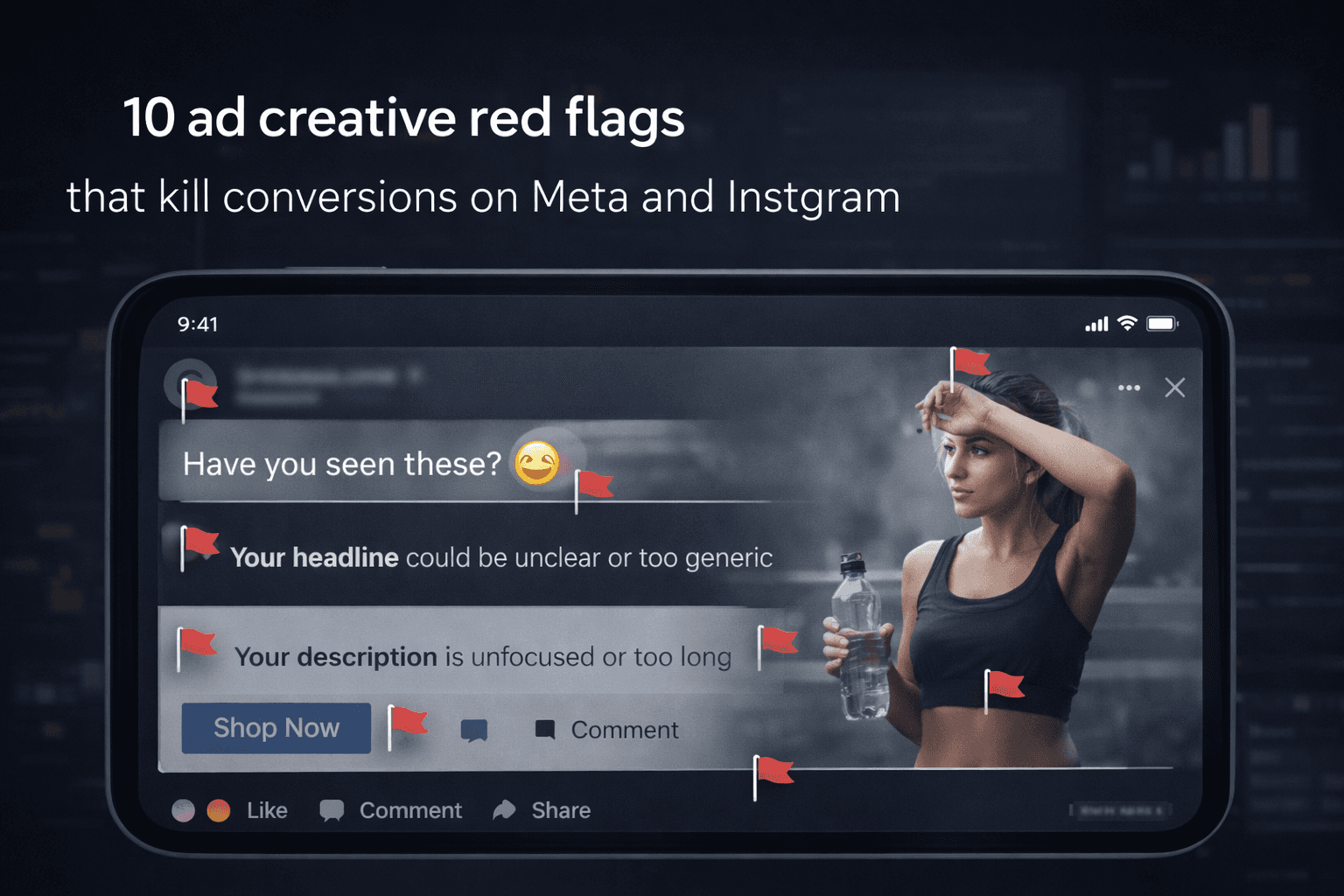
Most performance marketers focus on the wrong thing when a campaign underperforms. They change the audience. They adjust the bid strategy. They rebuild the campaign structure.
The creative was the problem the entire time.
In 2026, with Meta's Andromeda algorithm now using your ad creative as the primary targeting signal (Meta decides who sees your ad based on what your creative looks like and says, not just who you told it to reach), getting the creative wrong is more expensive than ever. A weak creative does not just underperform. It actively teaches the algorithm to find the wrong audience, raising your CPMs and burning budget in the process.
These are the ten creative red flags I see most often across D2C ad accounts, and what each one actually costs you.
1. A Hook That Takes More Than 3 Seconds to Say Anything
This is the most expensive mistake on this list because it affects everything downstream.
Hook Rate is now a primary creative health metric. The benchmark for top-performing D2C ads on Meta in 2026 is above 30%. Below 20% means your opening is too slow or too generic to stop a scroll.
The red flags: video opens with a logo animation, first frame is a product shot with no context, opening line is a benefit claim rather than a pattern interrupt, no text overlay in the first second for sound-off viewers.
Strong hook structures that consistently outperform: problem callouts, surprising claims, and direct-to-camera authenticity that looks native to the feed. Your first 3 seconds need to answer one question: "Is this for me?"
2. A Strong Hook but No Hold Rate
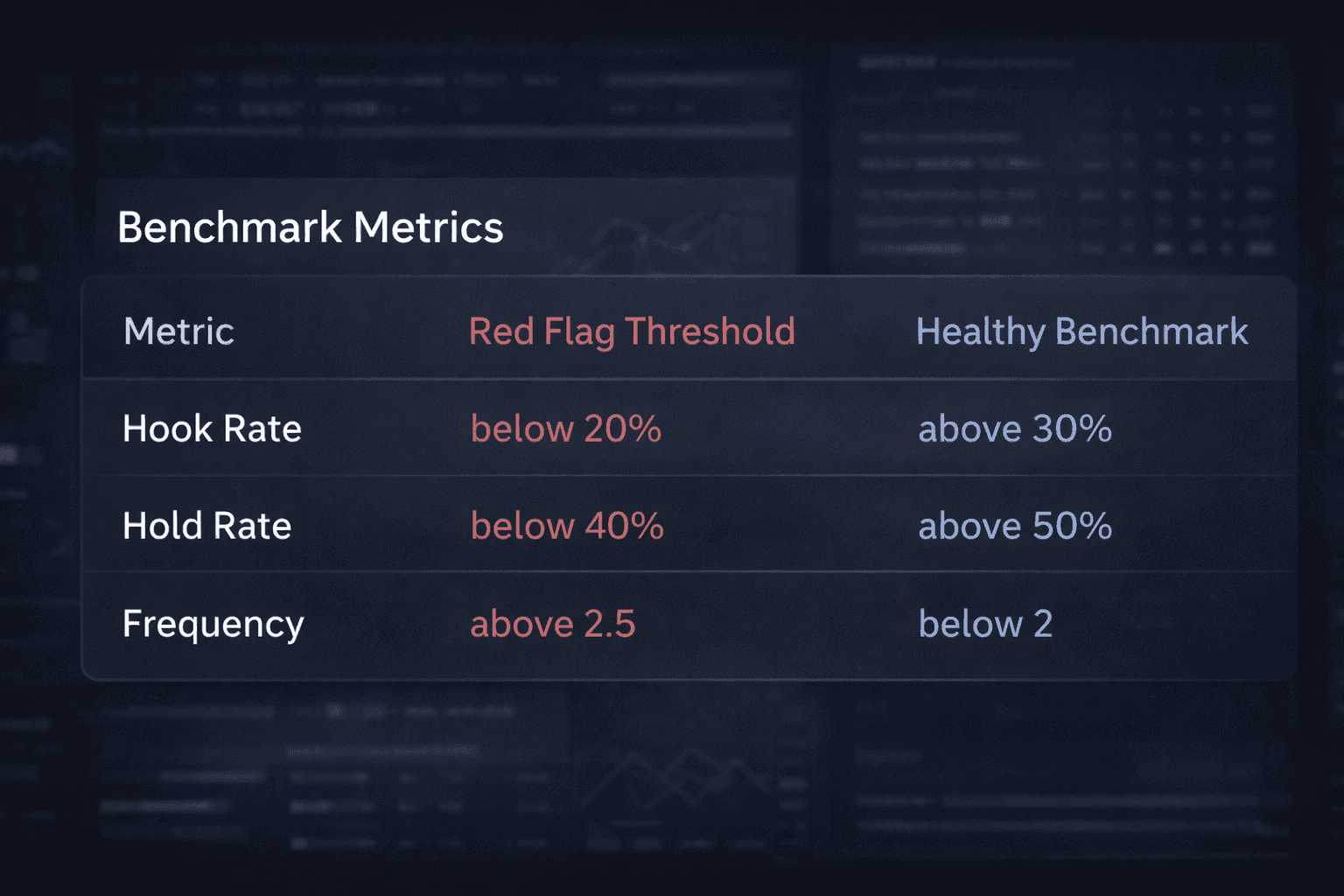
Hold Rate, which is the percentage of viewers who watch through to your core value proposition, should be above 25% at the halfway point. If your Hook Rate is strong but Hold Rate collapses, the problem is what comes after the hook. The hook created curiosity the body failed to deliver on.
What this looks like in data: CTR fine. ROAS broken. You assume it is an audience problem. It is a creative structure problem no audience testing will fix.
3. Creative Similarity: Running Variations of the Same Idea
Since Andromeda, if your account has multiple ads that look visually similar, Meta flags this as repetitive and raises your CPMs. Launching 8 creatives that are all variations of the same video with different captions reads as one creative to the algorithm.
True creative diversity means different formats, different angles, and different visual aesthetics. Repurpose winning messaging across new formats. Do not just crop and repost.
4. Copy That Talks to Itself
"Revolutionary formula. Clinically proven. Best in class." These mean nothing to a cold prospect. They are written for an internal audience that already believes in the product.
The test: show your copy to someone with no brand context. Can they tell what it does and who it is for in 5 seconds? If not, the copy is talking to itself. Strong copy starts with the customer's situation, not the product's features.
5. Misleading Claims: the Policy Risk That Kills Accounts, Not Just Conversions
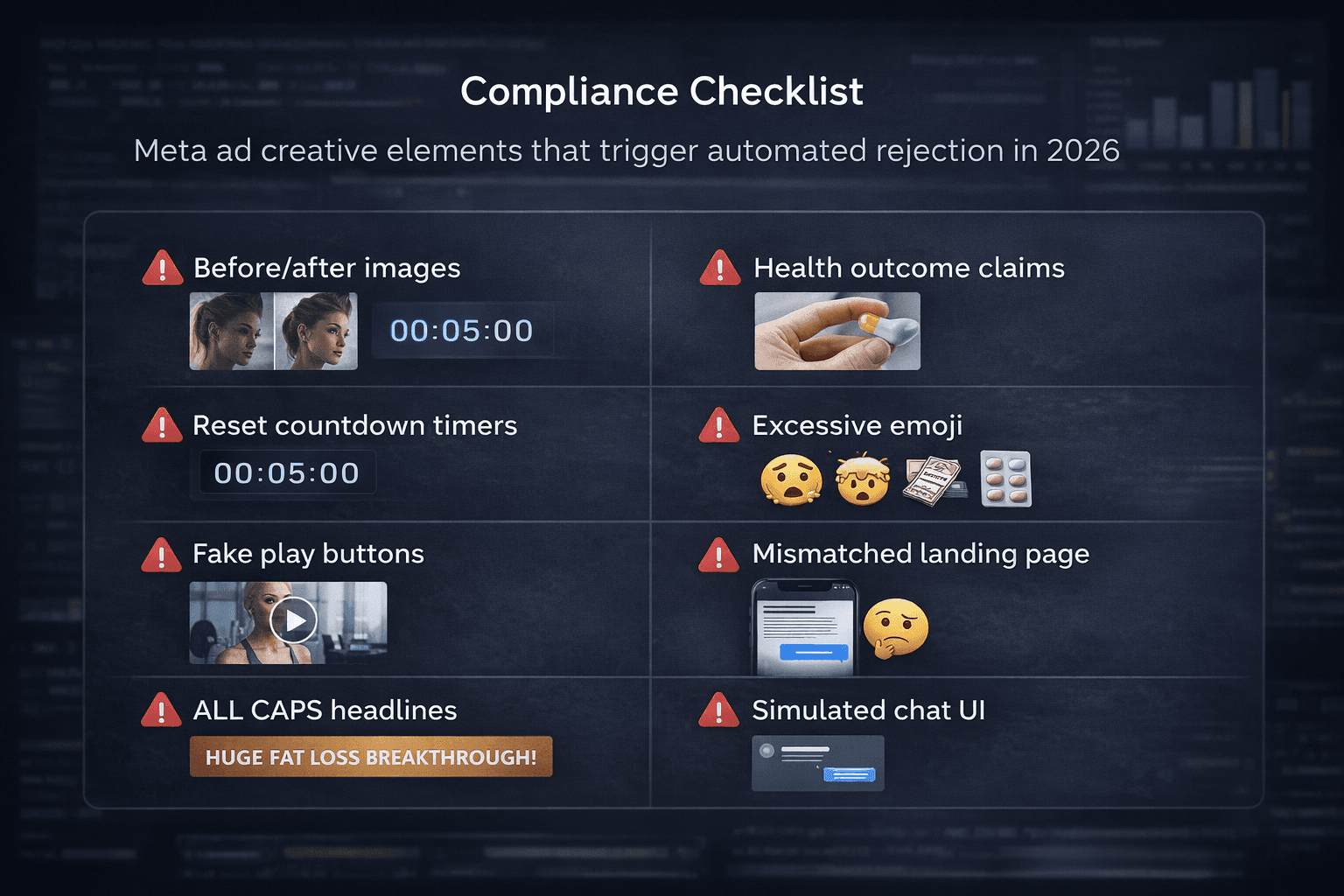
Meta's March 2026 policy update introduced multimodal AI review. The system now evaluates your ad copy, creative, and landing page simultaneously. "See results in 7 days" paired with a before/after image is now treated as an unverified transformation claim even if neither element alone would trigger rejection.
What Meta's AI specifically flags in 2026: before/after images implying dramatic transformation, health outcome copy without disclaimers, countdown timers that reset, fake UI elements like play buttons on static images, ALL CAPS headlines, and excessive emoji at the start of copy.
The key change: semantic intent detection. "Feel 10 years younger" no longer needs to be a literal claim to get flagged. And repeated rejections degrade your account quality score, throttling delivery on every campaign you run, not just the rejected one.
6. No CTA, or a CTA That Asks Too Much Too Soon
A cold audience does not know you. "Buy Now" in the first 5 seconds is the equivalent of proposing on a first date. The red flag: every ad in your account uses the same CTA regardless of funnel stage.
The fix: match the CTA to the creative's job. Awareness creatives drive lower-commitment actions. Retargeting creatives push harder. Treating all stages the same wastes budget on friction that does not need to be there.
7. Landing Page Mismatch
Meta's review system now evaluates your ad and landing page as a single unit. If your ad says "Get 20% off" and your landing page shows full-price products with no visible offer, you have broken the promise. Users bounce. The algorithm notes the poor post-click behaviour and reduces your delivery efficiency.
The benchmark: message match should be exact. The headline, offer, and visual tone should feel continuous across the ad-to-page handoff.
8. Running the Same Creative Past Its Natural Life
In 2026, fatigue arrives faster than it used to. What lasted 3-4 weeks in 2022 now fatigues in 7-10 days for highly scaled accounts. Andromeda concentrates delivery on winning creatives, which means a winner burns out faster precisely because it is getting more exposure.
The fix is not to pause immediately. It is to have the next batch ready before the current ones start declining. You should be refreshing creative on a rolling basis, not in response to a performance drop. Predflow's anomaly detection flags creative performance shifts early, including CTR decay curves, frequency thresholds, and engagement drops, so you act before ROAS follows them down.
9. Creative Not Built for Where It Is Shown
60-80% of Meta impressions now serve on Instagram. Yet most teams still design for Facebook Feed and repurpose without proper adaptation.
Specific red flags: important copy or product in the unsafe zones of Stories and Reels (first and last 15% of the frame where UI overlaps), no captions on Reels, static image ads running on Reels placement. If your creative assets are not built for where most impressions serve, you are capping performance from the start.
10. Making Decisions on Vanity Metrics Instead of Creative Intelligence
ROAS tells you the outcome. Hook Rate, Hold Rate, CTR, frequency trends, and creative similarity scores tell you why that outcome happened and what to do next. Teams that pause ads because "ROAS dropped" without understanding what specifically failed will make the same mistake on the next creative.
The question to ask before pausing any creative: what specifically failed? If you cannot answer that with data, you are guessing.
This is what creative intelligence is built for: breaking down which elements are performing and which are not, so your next brief is specific rather than directional. You can also run any creative through Predflow's free Ad Analyzer before it goes live to get a structured score in 30 seconds. And the full performance marketer's AI tools guide covers what to use at each stage of the creative process.
The Pattern Across All 10
Every red flag on this list has the same root cause: making assumptions instead of reading data. The performance marketers who consistently get creative right are not better writers or designers. They are better at building feedback loops that tell them what is actually happening inside their ads, early enough to do something about it.
That starts with knowing which signals to watch, and having a system that watches them even when you are not looking.
Improve Ad performance with Predflow
Diagnose performance drops, creative fatigue, and attribution shifts